
Mediocrity is the correct word when you mean average quality, ordinary performance, or a lack of excellence. Mediocracy is also used in English, but it is much less common and generally refers to a system, society, or situation in which mediocre people or standards dominate.
For example, a student who consistently produces average work may be described as showing mediocrity. A workplace that repeatedly rewards average performance and discourages excellence might be criticized for promoting mediocracy.
Although the two words look and sound similar, they are not always interchangeable. Understanding their meanings helps you choose the right word for essays, professional writing, discussions about performance, and everyday conversation.
Quick Answer
- Mediocrity: The state or quality of being average, ordinary, or not particularly good.
- Mediocracy: A system or environment in which mediocrity prevails, often because average standards or mediocre people dominate.
Examples:
- The coach refused to accept mediocrity from the team.
- The author criticized the company’s culture of mediocracy.
Use mediocrity when discussing average quality or performance. Use mediocracy when discussing a system or culture that allows mediocrity to dominate.
What Does Mediocrity Mean?
Mediocrity is a noun that describes average, ordinary, or unimpressive quality. It often carries a negative meaning when the speaker believes that someone or something could perform better.
The word does not always mean terrible or completely unsuccessful. Instead, it often suggests that the quality or performance falls short of excellence.
Definition of Mediocrity
Mediocrity refers to the condition of being mediocre rather than outstanding, exceptional, or highly effective.
It can describe:
- Average academic performance.
- Ordinary work that lacks excellence.
- Unremarkable creative output.
- Weak standards in an organization.
- Performance that falls below expectations.
Examples of Mediocrity in Sentences
- The athlete worked hard to overcome mediocrity.
- The company refused to settle for mediocrity.
- Years of poor preparation resulted in mediocrity.
- The teacher encouraged students to aim higher than mediocrity.
- The film received criticism for its mediocrity.
In these sentences, mediocrity describes a level of quality or performance that is ordinary rather than excellent.
What Does Mediocracy Mean?
Mediocracy is a noun used to describe a system, culture, or situation in which mediocrity dominates. It may also describe an environment in which mediocre people or standards are favored over excellence.
The word is much less common than mediocrity. It often appears in criticism of organizations, leadership, institutions, or societies.
Definition of Mediocracy
Mediocracy refers to a condition or system in which average ability, ordinary standards, or mediocre performance becomes dominant.
It can be used when discussing:
- Organizations that reward average performance.
- Leadership that discourages exceptional talent.
- Institutions that tolerate low standards.
- Cultures that resist innovation or improvement.
- Systems that prioritize conformity over excellence.
Examples of Mediocracy in Sentences
- The writer argued that the organization had become a mediocracy.
- Poor leadership allowed mediocracy to spread throughout the department.
- The critic described the system as a mediocracy that discouraged innovation.
- The company introduced new standards to prevent mediocracy.
- The article examined how mediocracy can weaken institutions.
These examples use mediocracy to describe a broader system or culture, rather than simply the quality of one person’s work.
Mediocracy vs Mediocrity: Key Differences
The main difference is how each word is used and what it emphasizes.
| Feature | Mediocracy | Mediocrity |
| Word type | Noun | Noun |
| Main meaning | A system or culture dominated by mediocrity | Average or unimpressive quality |
| Common usage | Less common | Much more common |
| Focus | A broader system or environment | Quality, ability, or performance |
| Example | The workplace became a mediocracy. | The work showed mediocrity. |
| Best use | Criticizing a system that tolerates average standards | Describing ordinary or below-expectation quality |
Remember: Mediocrity describes the quality; mediocracy describes a system in which that quality dominates.
Why Do People Confuse Mediocracy and Mediocrity?
People confuse these words because they share the same root and have similar spellings. Both relate to the idea of being mediocre, but their endings help distinguish their meanings.
1. Similar Spellings
Both words begin with mediocr-, making it easy to mix up the endings when writing quickly.
2. Related Meanings
Both words relate to average quality or a lack of excellence. However, one focuses on the quality itself, while the other focuses on a broader system or environment.
3. Unfamiliar Vocabulary
Mediocrity is used more frequently in everyday English. Some writers encounter mediocracy less often and may use it incorrectly when they simply mean average performance.
4. Confusion About Word Endings
The ending -ity commonly forms nouns describing a quality or condition. In mediocrity, it refers to the state of being mediocre.
The ending -cracy often relates to a system of government, rule, or organization. In mediocracy, it helps convey the idea of a system dominated by mediocre standards or people.
Common Mistakes to Avoid
Mistake 1: Using Mediocracy to Describe Average Work
Incorrect: The student’s essay showed mediocracy.
Better: The student’s essay showed mediocrity.
Mediocrity is the more natural word for describing the quality of an essay.
Mistake 2: Using Mediocrity to Name a System
Possible but less precise: The organization had a culture of mediocrity.
More specific: The organization had become a mediocracy.
The second sentence emphasizes a system or culture in which mediocre standards dominate. The first is also correct and often more natural.
Mistake 3: Assuming Mediocracy Is Always a Misspelling
Mediocracy is an established but uncommon word. It should not automatically be treated as incorrect. Its suitability depends on the intended meaning and context.
Mistake 4: Assuming Mediocrity Means Complete Failure
Mediocrity generally means average or unimpressive quality, not necessarily total failure.
Example: The restaurant’s food was mediocre, but the service was excellent.
Everyday Examples of Mediocracy and Mediocrity
Here are practical examples that show how to use the two words.
Academic Performance
- Mediocrity: The student wanted to improve her grades and move beyond mediocrity.
- Mediocracy: The critic described the school system as a mediocracy that failed to reward excellence.
Workplace
- Mediocrity: The manager was disappointed with the mediocrity of the final report.
- Mediocracy: Employees complained that the company’s culture had become a mediocracy.
Sports
- Mediocrity: The team struggled with mediocrity throughout the season.
- Mediocracy: The analyst argued that poor management had created a mediocracy within the club.
Art and Entertainment
- Mediocrity: The reviewer criticized the movie for its mediocrity.
- Mediocracy: The author used the term mediocracy to criticize an industry that rewarded uninspired work.
Leadership
- Mediocrity: The leader wanted to eliminate mediocrity from the team’s performance.
- Mediocracy: The report described a mediocracy in which ineffective leaders continued to promote one another.
Mediocracy vs Mediocrity in British and American English
Both words can be encountered in British and American English, but mediocrity is the widely established and much more common term for average or unimpressive quality.
Mediocracy has the same general meaning across English varieties when used to describe a system dominated by mediocre standards. It is uncommon and may sound unusual to some readers.
| Feature | American English | British English |
| Standard word for average quality | Mediocrity | Mediocrity |
| Less common word for a system dominated by mediocrity | Mediocracy | Mediocracy |
| Spelling difference | None | None |
| Everyday frequency | Mediocrity is more common | Mediocrity is more common |
Neither word has a major British-American spelling variation.
Easy Trick to Remember the Difference
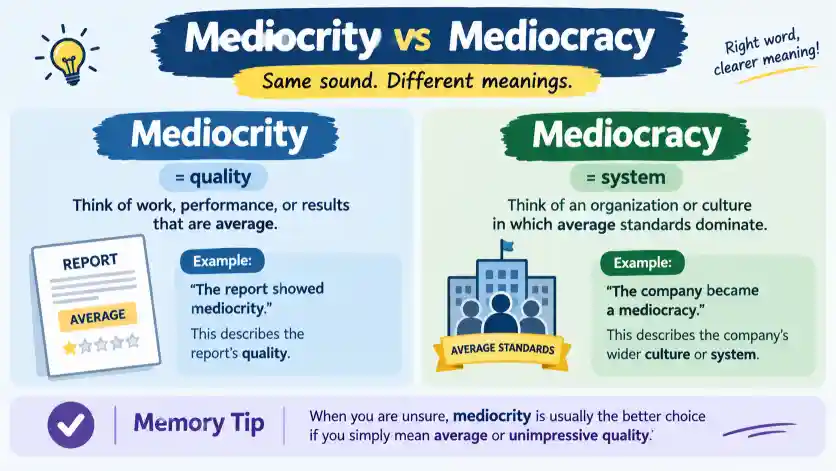
Use this simple memory rule:
- Mediocrity = quality. Think of work, performance, or results that are average.
- Mediocracy = system. Think of an organization or culture in which average standards dominate.
For example:
“The report showed mediocrity” describes the report’s quality.
“The company became a mediocracy” describes the company’s wider culture or system.
When you are unsure, mediocrity is usually the better choice if you simply mean average or unimpressive quality.
Frequently Asked Questions (FAQs)
1. Is mediocracy or mediocrity correct?
Both words exist, but they have different uses. Mediocrity is the standard, common word for average or unimpressive quality. Mediocracy refers to a system or culture dominated by mediocrity.
2. What does mediocrity mean?
Mediocrity means average, ordinary, or unimpressive quality or performance, especially when excellence is expected.
3. What does mediocracy mean?
Mediocracy describes a system, organization, or culture in which mediocre people, performance, or standards dominate.
4. Is mediocracy a real word?
Yes. It is an uncommon English word, not simply a misspelling of mediocrity.
5. Which word is more common?
Mediocrity is much more common in everyday English and general writing.
6. Can mediocrity describe a person?
It can describe a person’s performance, ability, or work as average or unimpressive. It is often more precise to describe the person’s work or performance rather than label the person.
7. Can mediocracy describe a workplace?
Yes. It can describe a workplace culture or organizational system in which mediocre standards or performance dominate.
8. Is mediocrity always negative?
Not necessarily. It means average or ordinary quality, but it often has a negative tone when excellence is expected.
9. Are mediocracy and mediocrity spelled differently in British and American English?
No. The spellings are the same in both varieties.
10. Which word should I use in formal writing?
Use mediocrity when discussing average quality or performance. Use mediocracy when you specifically mean a system or culture dominated by mediocre standards.
Conclusion
Mediocrity and mediocracy are related words, but they are not exact synonyms. Mediocrity refers to average or unimpressive quality, while mediocracy describes a system or culture in which mediocrity prevails.
Since mediocrity is much more common, it is generally the right choice when discussing ordinary performance or a lack of excellence. Choose mediocracy when you specifically want to criticize a broader system that allows mediocre standards to dominate.
Read More:
- Copyright or Copywrite: Don’t Make This Common Mistake
- Cancel or Cancell: Which Word Is Actually Right?
- Cummerbund or Cumberbund: Which Spelling Is Correct in 2026?








2 thoughts on “Mediocracy or Mediocrity: Which Word Is Correct?”