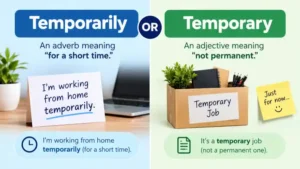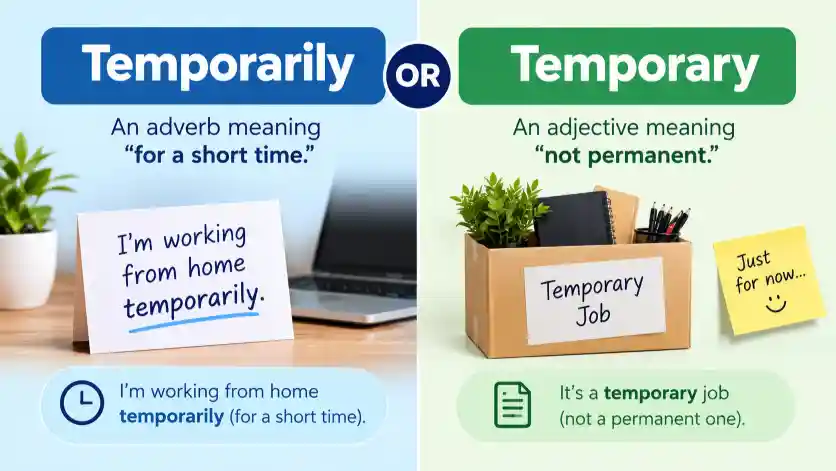
Temporarily and temporary are both correct English words, but they serve different grammatical purposes. Temporary is an adjective that describes something that lasts for a limited time, while temporarily is an adverb that describes an action or situation that lasts for a limited time. Understanding this difference helps you choose the right word in emails, school assignments, workplace communication, and everyday conversations.
For example, you might say, “I have a temporary job” or “I am temporarily working from home.” Both sentences are correct, but each word performs a different function.
Many people confuse these words because they share the same root and express a similar idea. The main difference lies in how you use them in a sentence. Once you understand their grammatical roles, choosing between temporarily and temporary becomes much easier.
Temporarily or Temporary: Quick Answer
Temporary is an adjective that describes a person, thing, arrangement, or situation that lasts for a limited period. Temporarily is an adverb that describes an action or condition that continues for a limited time.
Examples:
- Temporary: She accepted a temporary position at the company.
- Temporarily: The office is temporarily closed.
Use temporary before a noun, such as temporary job, temporary solution, or temporary arrangement. Use temporarily to explain how long an action or situation lasts, such as temporarily unavailable or temporarily relocated.
Definition and Meaning of Temporary
The word temporary describes something that exists, happens, or remains in place for a limited period rather than permanently.
It commonly appears in discussions about jobs, housing, repairs, arrangements, and changes that may not last forever.
Examples:
- He found a temporary job during the summer.
- We made a temporary arrangement for the meeting.
- The building provides temporary accommodation for visitors.
- She experienced temporary discomfort after the procedure.
- They installed a temporary fence around the construction site.
In each example, temporary describes a noun and explains that the person, thing, or situation will not necessarily last indefinitely.
Definition and Meaning of Temporarily
The word temporarily is an adverb that means for a limited time or during a period that is not permanent.
It often modifies verbs, adjectives, or other descriptions to explain that an action or condition will last only for a while.
Examples:
- The website is temporarily unavailable.
- She temporarily moved to another city.
- The road was temporarily closed for repairs.
- He is temporarily staying with his relatives.
- The service has been temporarily suspended.
In these examples, temporarily explains the limited duration of an action or condition.
Origin of Temporary and Temporarily
Both words come from the Latin word temporarius, meaning lasting for a time, and are related to tempus, meaning time.
English adopted temporary to describe things that do not last indefinitely. The word temporarily developed by adding the adverb-forming suffix -ly to temporary.
This word formation explains their relationship:
- Temporary: adjective
- Temporarily: adverb
The words share a meaning, but their grammatical roles determine where they fit in a sentence.
Temporary vs. Temporarily: Key Differences
| Feature | Temporary | Temporarily |
| Part of speech | Adjective | Adverb |
| Meaning | Lasting for a limited time | For a limited time |
| Main function | Describes a noun | Modifies an action or condition |
| Example | A temporary solution | Temporarily unavailable |
| Common use | Temporary job | Temporarily closed |
The easiest way to distinguish them is to identify what you want to describe. If you are describing a thing or arrangement, use temporary. If you are explaining that an action or condition lasts for a limited time, use temporarily.
When Should You Use Temporary?
Use temporary when you need an adjective to describe something that will last for a limited period.
Common expressions include:
- Temporary job
- Temporary accommodation
- Temporary solution
- Temporary closure
- Temporary employee
- Temporary change
- Temporary arrangement
Examples in sentences:
- The company hired a temporary employee to cover the position.
- We need a temporary solution until the equipment arrives.
- They found temporary accommodation near the university.
- A temporary closure affected several local businesses.
- The manager approved a temporary change to the schedule.
Remember that temporary generally answers the question “What kind of job, solution, or arrangement?”
When Should You Use Temporarily?
Use temporarily when you want to explain that an action or situation continues for a limited time.
Common expressions include:
- Temporarily closed
- Temporarily unavailable
- Temporarily suspended
- Temporarily relocated
- Temporarily disabled
- Temporarily removed
- Temporarily staying
Examples in sentences:
- The restaurant is temporarily closed for renovations.
- My account was temporarily suspended.
- The family temporarily relocated during the repairs.
- The manager is temporarily working from another office.
- This feature is temporarily unavailable.
Remember that temporarily often answers the question “For how long?” or “For what period?”
Common Mistakes to Avoid
Writers sometimes use these words interchangeably because they express a similar idea. However, their grammatical roles are different.
Mistake 1: Using temporary instead of temporarily
Incorrect: The website is temporary unavailable.
Correct: The website is temporarily unavailable.
Explanation: Temporarily modifies the adjective unavailable.
Mistake 2: Using temporarily instead of temporary
Incorrect: She accepted a temporarily job.
Correct: She accepted a temporary job.
Explanation: Temporary describes the noun job.
Mistake 3: Confusing spelling
The correct spellings are temporary and temporarily. Avoid misspellings such as temporery or temporarely.
Mistake 4: Assuming both words fit every sentence
Although they share a root, you cannot replace one with the other without considering sentence structure.
Incorrect: They arranged a temporarily solution.
Correct: They arranged a temporary solution.
Everyday Examples of Temporary and Temporarily
These examples show how both words appear naturally in daily communication.
| Temporary | Temporarily |
| This is a temporary arrangement. | We are temporarily staying here. |
| He needs a temporary job. | He is temporarily working elsewhere. |
| The company hired a temporary worker. | The worker was temporarily assigned elsewhere. |
| They built a temporary shelter. | The shelter was temporarily occupied. |
| We found a temporary solution. | The problem was temporarily resolved. |
| She received a temporary pass. | Entry was temporarily restricted. |
Notice how the adjective describes a noun, while the adverb explains an action or condition.
Easy Trick to Remember the Difference
Use this simple memory rule:
- Temporary = Thing. It describes a noun, such as a temporary job or a temporary solution.
- Temporarily = Action or condition. It explains that something happens or remains in a particular state for a limited time.
Here is an easy comparison:
“The shop has a temporary closure.”
“The shop is temporarily closed.”
In the first sentence, temporary describes the noun closure. In the second, temporarily modifies the condition closed.
When you are unsure, check the word that follows or the role the word plays in the sentence. If you are describing a noun, temporary is usually correct. If you are modifying an action or description, temporarily is generally the right choice.
Frequently Asked Questions
1. Is temporary or temporarily correct?
Both words are correct. Temporary is an adjective, while temporarily is an adverb. The correct choice depends on how you use the word in your sentence.
2. Is it temporarily closed or temporary closed?
Temporarily closed is correct because the adverb temporarily modifies closed.
3. Is it a temporary job or a temporarily job?
A temporary job is correct because temporary describes the noun job.
4. What is the difference between temporary and temporarily?
Temporary describes something that lasts for a limited time. Temporarily means that an action or condition lasts for a limited time.
5. Can temporarily describe an adjective?
Yes. For example, “The service is temporarily unavailable.” Here, temporarily modifies the adjective unavailable.
6. What is the opposite of temporary?
The most common opposite is permanent, which describes something intended to last indefinitely or remain in place for the long term.
7. How do you spell temporarily correctly?
The correct spelling is temporarily: T-E-M-P-O-R-A-R-I-L-Y. Remember that it contains the word temporary with the ending changed to -arily.
Conclusion
The difference between temporary and temporarily comes down to grammar. Temporary is an adjective that describes something lasting for a limited time, while temporarily is an adverb that describes an action or condition lasting for a limited time.
Use temporary job, temporary arrangement, and temporary solution when describing nouns. Choose temporarily closed, temporarily unavailable, and temporarily relocated when explaining an action or condition.
Remembering this simple distinction will help you write more accurately and confidently in everyday conversations, professional emails, and academic assignments.
Read More:
- Cummerbund or Cumberbund: Which Spelling Is Correct in 2026?
- Mediocracy or Mediocrity: Which Word Is Correct?
- Copyright or Copywrite: Don’t Make This Common Mistake