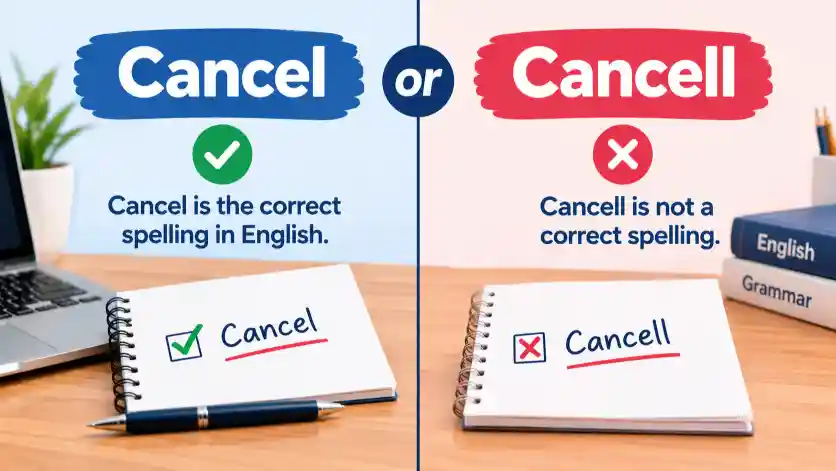
Cancel is the correct spelling, while cancell is incorrect in standard English. The word cancel means to stop, call off, remove, or decide that something will no longer happen.
Cancell is simply a common spelling mistake and should not be used in standard writing.
The confusion often comes from the different spelling patterns used when adding endings to cancel.
In American English, the word usually keeps one l in forms such as canceled and canceling. In British English, cancelled and cancelling are commonly written with two l letters.
However, the base word itself is always spelled cancel, not cancell.
For example:
I need to cancel my appointment.
She decided to cancel the order.
They cancelled the event because of the weather.
The correct base form is therefore easy to remember: cancel ends with one l.
Quick Answer
Cancel is correct. Cancell is incorrect.
| Word | Correct? | Meaning |
| Cancel | Yes | To stop or call off something |
| Cancell | No | Incorrect spelling |
The correct sentence is:
Please cancel my reservation.
Not:
Please cancell my reservation.
What Does Cancel Mean?
Cancel is a verb that means to stop something that was planned, arranged, or scheduled.
For example:
We had to cancel the meeting.
She cancelled her trip.
He wants to cancel his subscription.
The word can also mean to remove or make something no longer valid.
The company cancelled the order.
The bank cancelled the old card.
Cancel can also be used when two things balance or offset each other.
The two effects cancel each other out.
What Does Cancell Mean?
Cancell is not the standard spelling of the English verb.
People sometimes add an extra l because related forms such as cancelled and cancelling can contain two l letters in British English.
However, the base form remains:
Cancel
Not:
Cancell
For example:
❌ I want to cancell the order.
✅ I want to cancel the order.
Cancel vs Cancell: Main Difference
The difference is simple.
Cancel
Cancel is the standard English spelling.
Please cancel the appointment.
Cancell
Cancell is an incorrect spelling.
Please cancell the appointment. ❌
There is no separate meaning for cancell in standard English.
Cancel in British and American English
The base word cancel is spelled the same in both British and American English.
The main difference appears in some forms of the word.
American English
American English commonly uses:
- cancel
- canceled
- canceling
Examples:
The airline canceled the flight.
She is canceling the meeting.
British English
British English commonly uses:
- cancel
- cancelled
- cancelling
Examples:
The airline cancelled the flight.
She is cancelling the meeting.
The base form is still cancel in both varieties.
Cancel Verb Forms
The spelling becomes especially useful when looking at the different forms of the verb.
| Verb Form | American English | British English |
| Base form | Cancel | Cancel |
| Third person | Cancels | Cancels |
| Past tense | Canceled | Cancelled |
| Past participle | Canceled | Cancelled |
| Present participle | Canceling | Cancelling |
The important point is that cancell is never the base form.
Why Does Cancelled Have Two Ls?
The spelling can look confusing because cancelled commonly has two l letters in British English.
For example:
The concert was cancelled.
American English commonly uses:
The concert was canceled.
This difference does not change the spelling of the base verb.
The base form is:
cancel
So you should never write:
cancell
Common Mistakes With Cancel
Writing Cancell
This is the most common mistake.
❌ Please cancell the order.
✅ Please cancel the order.
Using Cancelled in American English
In American English, canceled with one l is generally preferred.
The event was canceled.
British English commonly uses:
The event was cancelled.
Confusing Cancel and Canceled
Remember that cancel is the base form.
I want to cancel the booking.
The past form changes according to the variety of English:
The booking was canceled. — American English
The booking was cancelled. — British English
Everyday Examples of Cancel
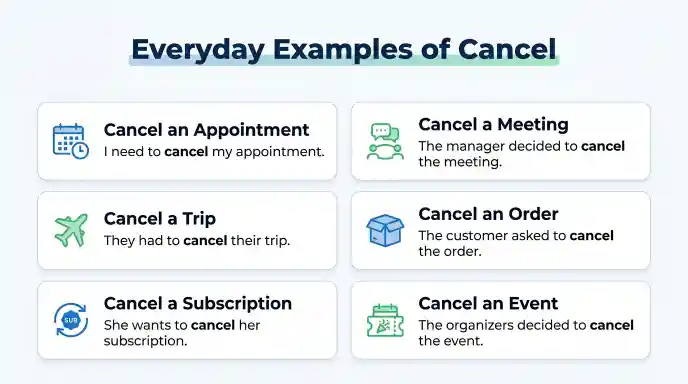
Cancel an Appointment
I need to cancel my appointment.
Cancel a Meeting
The manager decided to cancel the meeting.
Cancel a Trip
They had to cancel their trip.
Cancel an Order
The customer asked to cancel the order.
Cancel a Subscription
She wants to cancel her subscription.
Cancel an Event
The organizers decided to cancel the event.
Cancel in Different Contexts
Plans
Cancel can mean stopping a planned activity.
We had to cancel our picnic.
Reservations
It can refer to ending a booking.
I need to cancel my hotel reservation.
Services
It can mean ending a service or membership.
He decided to cancel his membership.
Events
It can mean deciding that an event will not take place.
The organizers cancelled the concert.
Payments and Orders
It can mean stopping an order or transaction.
The customer canceled the order.
Cancel or Cancell in Formal Writing
Cancel is the correct spelling for formal and informal writing.
You can use it in:
- Emails
- School assignments
- Business documents
- Reports
- Articles
- Instructions
- Messages
- Official notices
For example:
Customers may cancel their subscription at any time.
Avoid:
Customers may cancell their subscription at any time.
The second version contains a spelling error.
How to Remember the Correct Spelling
A simple trick is to remember that cancel is the base word.
Think:
CAN + CEL = CANCEL
It ends with one l.
The extra l appears in forms such as British cancelled and cancelling, which can cause confusion.
Remember:
Cancel ✅
Cancell ❌
Cancel or Cancell Comparison Table
| Feature | Cancel | Cancell |
| Correct spelling | Yes | No |
| Standard English word | Yes | No |
| Meaning | Stop or call off something | — |
| British English | Correct | Incorrect |
| American English | Correct | Incorrect |
| Base verb | Yes | No |
| Past form | Canceled / Cancelled | — |
| Present participle | Canceling / Cancelling | — |
Which Spelling Should You Use?
Always use cancel when you are using the base form of the verb.
Correct:
I want to cancel the appointment.
Incorrect:
I want to cancell the appointment.
If you need the past tense, choose the spelling that matches your English variety:
- Canceled — commonly American English
- Cancelled — commonly British English
But the base form is always:
Cancel
FAQs About Cancel or Cancell
Is cancel or cancell correct?
Cancel is correct. Cancell is an incorrect spelling.
Is cancell a word?
No. Cancell is not the standard spelling of the English verb. The correct word is cancel.
How do you spell cancel?
The correct spelling is C-A-N-C-E-L.
Is cancel spelled the same in British and American English?
Yes. The base word cancel is spelled the same in both varieties.
Is it canceled or cancelled?
Both are correct depending on the variety of English. Canceled is commonly used in American English, while cancelled is commonly used in British English.
Is canceling or cancelling correct?
Both forms are used. Canceling is common in American English, while cancelling is common in British English.
Why does cancelled have two Ls?
British English commonly doubles the final l before endings such as -ed and -ing in cancelled and cancelling. This does not change the base spelling cancel.
Conclusion
Cancel is the correct spelling, while cancell is incorrect. The word cancel means to stop, call off, remove, or end something that was planned or arranged.
The base form is the same in British and American English:
Cancel ✅
Cancell ❌
The main spelling difference appears in related form. American English commonly uses canceled and canceling, while British English commonly uses cancelled and cancelling.
Read More:
- Discard or Disgard: Which One Is Actually Correct?
- Socialise or Socialize: Which Spelling Should You Choose?
- Copyright or Copywrite: Don’t Make This Common Mistake




1 thought on “Cancel or Cancell: Which Word Is Actually Right?”