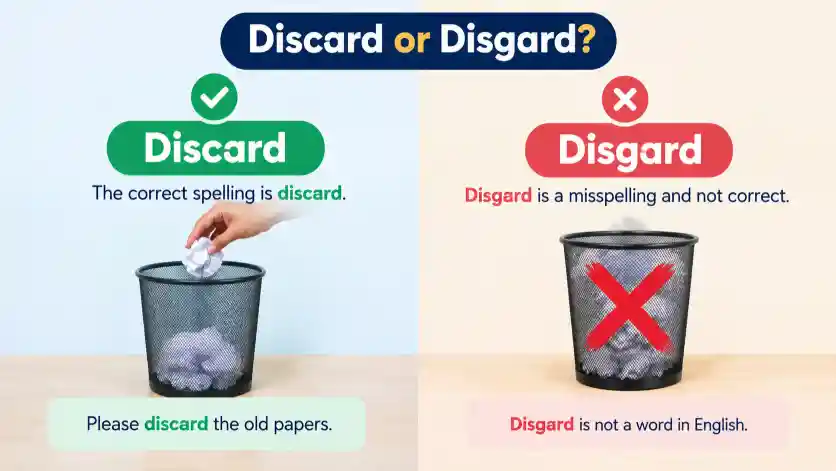
Discard is the correct spelling, while disgard is a misspelling. The word discard means to throw something away, get rid of something, or reject something that is no longer wanted or needed.
Disgard is not a standard English word and should not be used in formal or everyday writing.
The confusion usually happens because discard contains the letters -card, while people may incorrectly remember it as -gard.
The correct spelling is always discard when you mean to throw away, reject, or remove something.
For example:
Please discard the empty box.
She decided to discard her old notes.
The editor discarded the incorrect information.
The word discard can be used as both a verb and, less commonly, a noun. Its past tense and past participle are discarded, and its present participle is discarding.
If you are unsure between discard and disgard, remember that discard is the only standard spelling.
Quick Answer
Discard is correct. Disgard is incorrect.
| Word | Correct? | Meaning |
| Discard | Yes | To throw away, reject, or get rid of something |
| Disgard | No | Misspelling of discard |
Correct example:
You should discard the damaged item.
Incorrect:
You should disgard the damaged item.
What Does Discard Mean?
Discard means to throw something away because it is unwanted, unnecessary, damaged, or no longer useful.
For example:
Please discard the empty bottle.
He discarded his old shoes.
She discarded the broken phone.
The word can also mean to reject an idea, plan, option, or piece of information.
The team discarded the original plan.
The writer discarded several ideas.
So, discard can describe both physical objects and ideas.
What Does Disgard Mean?
Disgard is not the standard spelling of an English word.
People sometimes write disgard when they mean discard. This is simply a spelling mistake.
For example:
❌ Please disgard the old files.
✅ Please discard the old files.
If you are writing an email, article, report, school assignment, or other formal text, always use discard.
Discard vs Disgard: Main Difference
The main difference is simple:
- Discard = correct spelling
- Disgard = incorrect spelling
There is no separate meaning for disgard in standard English.
Correct Form
Please discard the damaged package.
Incorrect Form
Please disgard the damaged package.
The correct word contains card:
dis + card = discard
Origin of the Word Discard
The word discard has a long history in English. It originally developed from the idea of removing or putting aside something that was no longer wanted.
It later became widely used for throwing away objects, rejecting ideas, and removing unwanted choices.
Today, discard is common in everyday English, business writing, technology, games, and many other situations.
Common Uses of Discard
Throwing Away an Object
Discard the empty container.
He discarded the broken chair.
Rejecting an Idea
The manager discarded the proposal.
They discarded the first idea.
Removing Unwanted Information
The editor discarded unnecessary details.
The program discards duplicate data.
Games and Cards
In card games, discard can mean to remove a card from your hand or place it in a discard pile.
The player decided to discard two cards.
Common Mistakes With Discard
Writing Disgard Instead of Discard
This is the most common mistake.
❌ Disgard the old documents.
✅ Discard the old documents.
Adding an Extra Letter
Some writers may accidentally spell the word in other incorrect forms.
The standard spelling is:
D-I-S-C-A-R-D
Using Discard When Keep Is Intended
Discard means to get rid of something.
Discard the damaged copy.
This means the damaged copy should not be kept.
If you want to keep something, use words such as keep, save, or retain.
Everyday Examples of Discard
Here are some natural examples:
Please discard the empty box.
She discarded her old clothes.
Do not discard the receipt.
He discarded the broken equipment.
The company discarded the outdated policy.
We should discard these damaged files.
The chef discarded the spoiled food.
They discarded the original plan.
Discard in Different Verb Forms
Discard follows a regular verb pattern.
| Verb Form | Word |
| Base form | Discard |
| Third-person singular | Discards |
| Past tense | Discarded |
| Past participle | Discarded |
| Present participle | Discarding |
Examples:
I discard unwanted papers.
She discards old receipts.
He discarded the damaged file.
They have discarded the old equipment.
We are discarding unnecessary items.
Discard in British and American English
Discard is spelled the same in both British and American English.
There is no major regional spelling difference.
| British English | American English |
| Discard | Discard |
| Discarded | Discarded |
| Discarding | Discarding |
| Discards | Discards |
So, you can use discard in both varieties of English.
Discard or Disgard in Formal Writing
Discard is the correct choice in formal writing.
You can use it in:
- School assignments
- Business emails
- Reports
- Articles
- Instructions
- Academic writing
- Technical writing
For example:
Users should discard damaged materials safely.
Avoid the incorrect spelling:
Users should disgard damaged materials safely.
How to Remember the Correct Spelling
A simple way to remember discard is to focus on the middle of the word:
DIS + CARD = DISCARD
Think of a card being removed from a hand in a card game. You discard the card.
Remember:
Discard = correct
Disgard = incorrect
Discard or Disgard Comparison Table
| Feature | Discard | Disgard |
| Correct spelling | Yes | No |
| Standard English word | Yes | No |
| Meaning | Throw away or reject | — |
| Past tense | Discarded | — |
| Present participle | Discarding | — |
| British English | Correct | Incorrect |
| American English | Correct | Incorrect |
Which Spelling Should You Use?
Always use discard when you mean to throw away, reject, or get rid of something.
Use:
Discard the old documents.
Do not use:
Disgard the old documents.
Discard works in both British and American English, so there is no need to change the spelling based on your audience.
FAQs About Discard or Disgard
Is discard or disgard correct?
Discard is correct. Disgard is a misspelling.
What does discard mean?
Discard means to throw away, reject, or get rid of something that is unwanted or unnecessary.
Is disgard a real word?
Disgard is not a standard English spelling. The correct word is discard.
How do you spell discard?
The correct spelling is D-I-S-C-A-R-D.
Is discard spelled the same in British and American English?
Yes. Discard is spelled the same in both British and American English.
What is the past tense of discard?
The past tense is discarded.
She discarded the old papers.
What is the opposite of discard?
Depending on the context, possible opposites include keep, retain, save, or accept.
Conclusion
Discard is the correct spelling, and disgard is incorrect. Discard means to throw away, reject, or get rid of something that is no longer wanted or needed.
The correct spelling is:
Discard ✅
Disgard ❌
Remember the spelling as dis + card = discard. The word is spelled the same in British and American English.
Read More:
- Socialise or Socialize: Which Spelling Should You Choose?
- Consentual or Consensual: The Correct Spelling Explained
- Tierd or Tired: Avoid This Common Spelling Error





3 thoughts on “Discard or Disgard: Which One Is Actually Correct?”