
Tired is the correct spelling. People often misspell “tired” as “tierd,” but standard English uses “tired.”
The word tired describes a feeling of needing rest or having little energy. It can also describe someone who has become bored or worn out from repeated activity.
For example, you can say, “I feel tired after work” or “She felt tired after the long journey.”
The confusion usually happens because the pronunciation of “tired” can differ from what some people expect based on its spelling.. The correct spelling includes -ired, not -ierd.
Tierd or Tired: Quick Answer
Correct Spelling: Tired
Tired is the correct spelling.
I am tired after working all day.
Incorrect Spelling: Tierd
Tierd is not the standard spelling of the word.
I am tierd after working all day. ❌
The correct form is:
I am tired after working all day. ✅
A simple rule to remember is:
Tired = correct
Tierd = incorrect
What Does Tired Mean?
Tired Means Needing Rest
The most common meaning of tired is feeling physically or mentally exhausted.
I feel tired after exercising.
She was tired after a long day at work.
He looks tired this morning.
In these sentences, the person has less energy and may need rest or sleep.
Tired From Physical Activity
You can use tired after activities that require physical effort.
Playing outside made the children tired.
Walking for several hours made me tired.
The runner felt tired after the race.
Tired From Mental Work
Tired can also describe mental exhaustion.
I feel tired after studying for several hours.
The difficult exam left her mentally tired.
He became tired of solving the same problem.
Why Is “Tierd” Incorrect?
The Correct Spelling Pattern
The word is spelled:
T-I-R-E-D
Not:
T-I-E-R-D
The base verb is tire.
When we add -ed, we retain the final e.
tire + d = tired
This gives us:
tired
Writers can easily place the letters i and e in the wrong order, creating the common misspelling tierd.
Remember the Base Word
A useful way to remember the spelling is to start with the base word:
Tire → Tired
For example:
The long journey will tire me.
The journey made me tired.
Tired as an Adjective
We commonly use tired as an adjective to describe someone’s physical or mental condition.
She is tired.
They were tired after the trip.
I feel tired today.
It describes how someone feels rather than naming an action.
More Examples
The students looked tired after the exam.
The hike made my legs tired.
He felt tired but continued working.
We felt too tired to go out.
Tired of Something
The expression tired of has a slightly different meaning.
You can use tired to describe someone who feels bored, annoyed, or no longer interested because something has happened too often.
Waiting makes me tired.
The same routine makes her tired.
They feel tired of hearing the same excuse.
Here, tired of does not necessarily mean physically exhausted.
Physical Tiredness vs Tired of Something
Compare these two sentences:
The long walk made me tired.
This means I need rest because of physical effort.
I am tired of this argument.
This means I am annoyed or bored with the repeated situation.
Tired in Everyday Sentences
After Work
I am tired after work.
After Exercise
She felt tired after her workout.
Before Sleep
I feel very tired, so I am going to bed.
After Traveling
The long flight made us tired.
After Studying
Studying all evening made him tired.
Feeling Bored
I feel tired of doing the same thing every day.
Common Mistakes With Tierd or Tired
Writing “Tierd”
Incorrect:
I am tierd today.
Correct:
I feel tired today.
The incorrect spelling tierd reverses the letters ie.
Using “Tierd” in Formal Writing
Because tierd is a misspelling, avoid using it in:
- School assignments
- Emails
- Reports
- Articles
- Applications
- Professional writing
Always use tired.
Confusing Tired With Tire
Tire and tired are related but have different grammatical roles.
The long walk may tire me.
I am tired after the walk.
Tire is the base verb.
We commonly use tired as an adjective, not as the past form of a verb.
Tired vs Tire
Tire
Tire can mean to make someone feel tired.
The long journey may tire you.
It can also mean to become tired:
I tire easily after running.
Tired
Tired describes a state of having little energy.
I am tired after running.
Simple Difference
Tire = verb
Tired = feeling or condition
Tired vs Tiring
These two words are also easy to confuse.
Tired
Tired describes the person who experiences the feeling.
I am tired.
Tiring
Tiring describes something that causes tiredness.
The journey was tiring.
Compare:
The long walk was tiring, so I became tired.
This distinction can make your sentences much clearer.
How to Remember Tired
Use the Base Word
The easiest memory trick is:
Tire → Tired
The word tired keeps the spelling of tire and adds d.
tire + d = tired
Remember the Letter Order
The correct middle letters are:
TI-RED
Not:
TIE-RD
You can remember:
TIRED has “tire” inside it.
This helps prevent the common mistake tierd.
Tired or Tierd: Quick Comparison
| Word | Correct? | Meaning | Example |
| Tired | ✅ Yes | Feeling a need for rest | I am tired. |
| Tierd | ❌ No | Misspelling | I am tierd. |
| Tire | ✅ Yes | To become or make tired | The work may tire me. |
| Tiring | ✅ Yes | Causing tiredness | The work was tiring. |
British and American English
Tired in American English
Tired is the standard spelling in American English.
I am tired after work.
Tired in British English
Tired is also the standard spelling in British English.
I am tired after work.
There is no standard British spelling tierd.
The spelling remains tired in both varieties of English.
Tired in Formal Writing
Tired is completely acceptable in both everyday and formal writing.
For example:
The employee reported feeling tired after completing the extended shift.
Students may feel tired after several hours of intensive study.
However, depending on the context, words such as exhausted, fatigued, or weary may provide a more specific description.
Similar Words
Some alternatives to tired include:
- Exhausted
- Fatigued
- Weary
- Sleepy
- Drained
- Worn out
The best choice depends on the exact meaning you want to express.
Everyday Examples of Tired
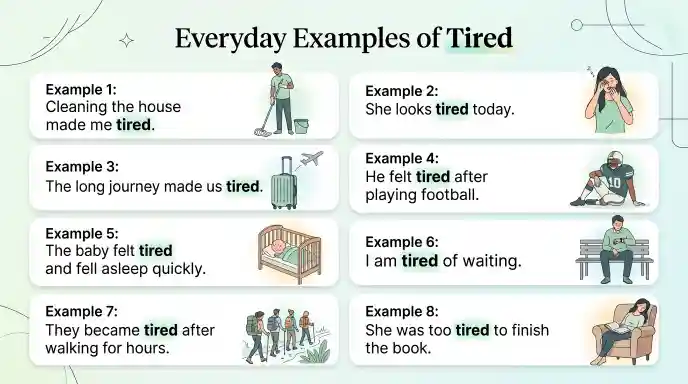
Example 1
Cleaning the house made me tired.
Example 2
She looks tired today.
Example 3
The long journey made us tired.
Example 4
He felt tired after playing football.
Example 5
The baby felt tired and fell asleep quickly.
Example 6
I am tired of waiting.
Example 7
They became tired after walking for hours.
Example 8
She was too tired to finish the book.
Key Takeaways
Remember These Points
- Tired is the correct spelling.
- Tierd is a misspelling.
- Tired describes a feeling of needing rest.
- The base word is tire.
- Tire + d = tired.
- Tired of can mean bored or annoyed with something.
- Tiring describes something that causes tiredness.
- British and American English both spell the word tired the same way.
FAQs About Tierd or Tired
1. Is it tierd or tired?
Tired is the correct spelling. Tierd is a misspelling.
I am tired after work. ✅
2. Why is tierd incorrect?
Tierd incorrectly places the e and i in the word. The correct spelling is tired, based on the word tire.
3. How do you spell tired?
The correct spelling is:
T-I-R-E-D
4. What does tired mean?
Tired means having little energy or needing rest. It can describe physical or mental exhaustion.
She felt tired after the long journey.
5. Is tired an adjective?
Yes. We commonly use “tired” as an adjective to describe someone’s condition or feeling.
He is tired.
6. What is the difference between tire and tired?
Tire is the base verb, while tired commonly describes a condition or feeling.
The long walk may tire me.
I am tired after the walk.
7. Is “tired of” correct?
Yes. Tired of is a common expression meaning bored, annoyed, or no longer interested in something.
I am tired of waiting.
8. Is “tiring” the same as “tired”?
No. Tired describes the person experiencing the feeling, while tiring describes something that causes tiredness.
The journey was tiring, and I was tired afterward.
9. Is tierd ever correct?
No. Tierd is not the standard spelling of the English word. The correct spelling is tired.
10. Is tired spelled differently in British and American English?
No. Tired is the standard spelling in both British and American English.
Conclusion
Tired is the correct spelling, while tierd is incorrect. The word tired describes someone who has little energy or needs rest.
It can describe physical tiredness, mental exhaustion, or boredom and annoyance when used with of.
The easiest way to remember the spelling is to connect it with the base word tire:
Tire → Tired
The letters i and e appear in that order, so tired is correct, not tierd.
If you are writing a school assignment, an email, an article, or a casual message, use tired whenever you want to describe this feeling.
Read More:
- Injust or Unjust: A Simple Guide With Examples
- Fead or Feed: How to Spell This Word Correctly
- Immerse or Emerse: Which Spelling Is Correct in 2026?





2 thoughts on “Tierd or Tired: Avoid This Common Spelling Error”