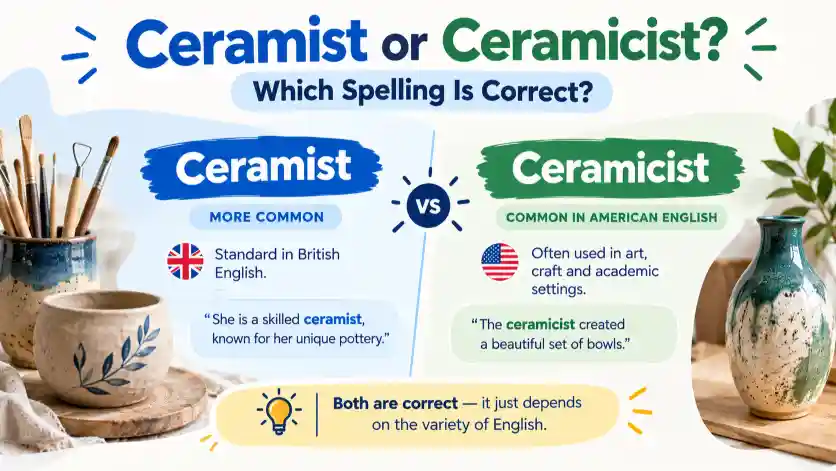
Ceramist and ceramicist are both correct and often used interchangeably, referring to someone who works with clay to create pottery, sculptures, or decorative ceramic objects.
“Ceramicist” is the more commonly used term overall, particularly in the United States and within art world contexts, often describing an artist who creates decorative or sculptural ceramic pieces.
“Ceramist” is considered the more general, and arguably older, term first recorded between 1850 and 1855 sometimes used more broadly across industrial or technical ceramics settings.
Interestingly, some ceramics professionals actually prefer “ceramist,” arguing that “ceramicist” is grammatically inconsistent since removing “-ist” would leave “ceramic,” not a proper root word.
In this guide, you’ll learn the difference between ceramist and ceramicist, which one is more widely used, and how to choose the right term for your writing in 2026.
Ceramist or Ceramicist: Quick Answer
| Word | Correct? | Meaning |
| Ceramist | ✅ Yes | A person who works with ceramics |
| Ceramicist | ✅ Yes | A person who works with ceramics, especially professionally or artistically |
Simple rule
Both “ceramist” and “ceramicist” are correct.
Examples
She is an experienced ceramicist who creates handmade pottery.
The museum invited a local ceramist to demonstrate pottery techniques.
Neither sentence is grammatically incorrect.
What Does Ceramist Mean?
A ceramist is a person who works with ceramics.
Ceramics are objects made from materials such as clay that are shaped and hardened, usually through heating or firing.
A ceramist may create:
- Pots
- Bowls
- Plates
- Cups
- Tiles
- Sculptures
- Decorative objects
- Ceramic artwork
Example
The ceramist created a beautiful clay vase.
The word can describe someone working with ceramics as a craft, profession, or artistic practice.
What Does Ceramicist Mean?
A ceramicist is also a person who works with ceramics.
The word is especially common when talking about someone involved in the artistic or professional practice of ceramics.
Example
The ceramicist displayed her sculptures at the art exhibition.
A ceramicist may work with:
- Clay
- Glazes
- Kilns
- Pottery
- Ceramic sculpture
- Decorative ceramics
- Functional ceramics
- Experimental ceramic materials
In many contexts, ceramicist sounds slightly more specific to the field of ceramic art.
Ceramist vs Ceramicist: What’s the Difference?
The main difference is usage and word formation, rather than meaning.
Both words describe someone who works with ceramics.
| Feature | Ceramist | Ceramicist |
| Correct English | ✅ Yes | ✅ Yes |
| Person who works with ceramics | Yes | Yes |
| Related to pottery | Yes | Yes |
| Related to ceramic art | Yes | Yes |
| Professional use | Yes | Yes |
| Artistic use | Yes | Yes |
| Meaning difference | Very small | Very small |
There is no strict rule saying that one word must be used for pottery while the other must be used for ceramic sculpture.
Which Word Is More Common?
Usage can vary depending on the country, publication, profession, and context.
Ceramicist is widely used in art-related writing because it directly contains ceramic and clearly identifies the person’s field.
Ceramist is also an established word and is commonly understood.
For example, an art gallery might describe someone as:
A contemporary ceramicist.
A general article might say:
The famous ceramist created hundreds of pottery pieces.
Both forms communicate essentially the same idea.
The Origin of Ceramist and Ceramicist
Both words are built from ceramic, which relates to objects made from clay and other materials hardened by heat.
The word ceramic ultimately comes from the Greek word keramos, meaning pottery or potter’s clay.
English later developed words describing people who work with ceramics.
Ceramist
ceramic + -ist
This produces the occupational noun ceramist.
Ceramicist
ceramic + -ist
The form ceramicist keeps the full form of ceramic before the suffix.
The two forms developed as alternative ways of describing people working in the ceramic field.
Ceramist or Ceramicist in British English
Both forms can be found in British English.
For example:
The British ceramicist exhibited her work in London.
You may also see:
The British ceramist exhibited her work in London.
There is no simple British-versus-American spelling rule that makes one form universally correct and the other incorrect.
This is different from spelling pairs such as:
- colour / color
- centre / center
- favourite / favorite
With ceramist and ceramicist, the difference is mainly a matter of word choice and usage.
Ceramist or Ceramicist in American English
American English also uses both forms.
For example:
The American ceramicist specializes in contemporary pottery.
And:
The American ceramist teaches pottery classes.
Both are understandable and grammatically acceptable.
If you are writing for an American audience, choose the term that best matches your publication’s preferred style and the terminology used by the person or organization you are describing.
Which Should You Use: Ceramist or Ceramicist?
Because both words are correct, your choice depends on context.
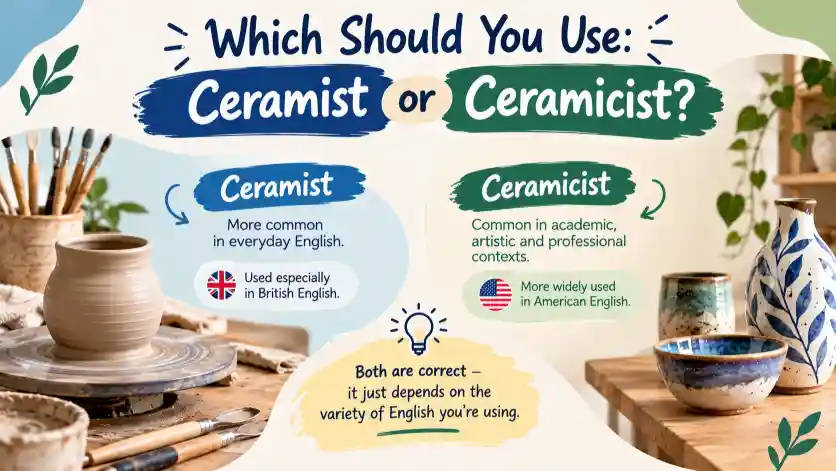
Use “Ceramicist” When:
Ceramicist can be a natural choice when discussing:
- Ceramic artists
- Art exhibitions
- Professional ceramic practices
- Contemporary ceramic art
- Ceramic sculpture
- Artists and designers
Example:
The young ceramicist creates abstract sculptures from clay.
Use “Ceramist” When:
Ceramist works well in general contexts involving:
- Pottery
- Ceramic production
- Clay work
- Ceramic crafts
- Ceramic manufacturing
- People who make ceramic objects
Example:
The local ceramist makes handmade bowls and plates.
However, these categories are not strict. Ceramist can describe an artist, and ceramicist can describe someone who makes pottery.
Common Mistakes With Ceramist or Ceramicist
1. Thinking One Word Is Incorrect
A common mistake is assuming that ceramist or ceramicist must be wrong.
Both are established English words.
❌ “Ceramicist is the only correct form.”
That is too absolute.
✅ Both ceramist and ceramicist are correct.
2. Confusing Ceramicist With Ceramic
Ceramic usually describes the material, object, or field.
Ceramicist describes the person.
Example:
This is a beautiful ceramic bowl.
She is a talented ceramicist.
3. Confusing Ceramist With Potter
A potter is specifically someone who makes pottery, traditionally using clay.
A ceramist or ceramicist can have a broader role and may create:
- Pottery
- Sculptures
- Tiles
- Decorative pieces
- Architectural ceramics
- Experimental ceramic works
Therefore, the terms can overlap but are not always exact synonyms.
4. Assuming Ceramicist Only Means an Artist
A ceramicist may work artistically, but the term can be used more broadly for someone professionally involved with ceramics.
Context determines the exact meaning.
Ceramist vs Potter
These words are related but not identical.
| Term | General Meaning |
| Potter | Person who makes pottery |
| Ceramist | Person who works with ceramics |
| Ceramicist | Person who works with ceramics, often professionally or artistically |
For example:
The potter made a clay vase on the wheel.
The ceramicist created a large ceramic sculpture.
A potter may be a ceramicist, but someone working with ceramics is not necessarily a traditional potter.
Everyday Examples
Example 1: Pottery
The ceramist makes handmade cups and bowls.
Example 2: Art
The ceramicist displayed her sculptures at the gallery.
Example 3: Education
The school invited a professional ceramist to teach students about clay.
Example 4: Exhibition
Several contemporary ceramicists participated in the exhibition.
Example 5: Studio
The ceramicist spent the afternoon working in her studio.
All of these examples use the words naturally.
Ceramist or Ceramicist: Singular and Plural
Both words have regular plural forms.
Ceramist
Singular: ceramist
Plural: ceramists
Example:
The exhibition featured several talented ceramists.
Ceramicist
Singular: ceramicist
Plural: ceramicists
Example:
The gallery represents several contemporary ceramicists.
The plural endings do not change the basic difference between the two words.
Ceramist or Ceramicist in Formal Writing
Both terms can be used in formal writing.
For example:
The museum presented an exhibition featuring contemporary ceramicists.
Or:
The museum presented an exhibition featuring contemporary ceramists.
When writing professionally, the most important thing is consistency.
If you are describing a specific artist, it can also be useful to follow the terminology that the artist uses for themselves.
Ceramist or Ceramicist for SEO
If you are writing an article targeting “ceramist or ceramicist,” you can naturally include related search terms such as:
- ceramist or ceramicist
- ceramicist vs ceramist
- is ceramist a word
- is ceramicist a word
- ceramist meaning
- ceramicist meaning
- ceramist definition
- ceramicist definition
- ceramic artist
- pottery artist
- person who makes ceramics
Avoid repeating the same keyword unnaturally. Explain the difference clearly and use examples instead.
Google Trends and Modern Usage
Searches for ceramist and ceramicist can vary by region and by the context in which people encounter the terms.
Art websites, museums, galleries, and professional profiles may use ceramicist, while general writing may use either ceramist or ceramicist.
Because both forms are established, search engines can understand them as closely related terms.
For content aimed at an international audience, mentioning both forms is useful:
Ceramist and ceramicist are both correct terms for someone who works with ceramics.
This directly answers the spelling question while also covering both search variants.
Ceramist or Ceramicist: Comparison Table
| Question | Ceramist | Ceramicist |
| Is it correct? | ✅ Yes | ✅ Yes |
| Refers to a person working with ceramics? | Yes | Yes |
| Can describe an artist? | Yes | Yes |
| Can describe a pottery maker? | Yes | Yes |
| Used in formal writing? | Yes | Yes |
| British English | Yes | Yes |
| American English | Yes | Yes |
| Meaning | Very similar | Very similar |
FAQs About Ceramist or Ceramicist
Is “ceramist” a correct word?
Yes. Ceramist is a correct English word for someone who works with ceramics.
Is “ceramicist” a correct word?
Yes. Ceramicist is also a correct English word for someone who works with ceramics.
What is the difference between ceramist and ceramicist?
The difference is very small. Both refer to people who work with ceramics. Ceramicist is often used in professional or artistic contexts, but there is no strict rule separating the two.
Is ceramicist better than ceramist?
Both are correct. The appropriate choice depends on context, style, and personal or professional preference.
Is a potter a ceramicist?
A potter can be considered a ceramicist because pottery is a form of ceramic work. However, ceramicist can cover a wider range of ceramic activities than traditional pottery.
What is the plural of ceramist?
The plural is ceramists.
What is the plural of ceramicist?
The plural is ceramicists.
Conclusion
When deciding between ceramist or ceramicist, remember that both words are correct.
A ceramist is someone who works with ceramics, while a ceramicist also refers to someone working in the ceramic field, often with an artistic or professional emphasis.
The difference is not like a British-versus-American spelling pair where one form belongs to one country and the other belongs to another. Both terms can be used in British and American English.
For art galleries, professional profiles, and discussions of contemporary ceramic art, ceramicist is a common choice. For general references to people who work with ceramics, ceramist is also perfectly acceptable.
Easy rule:
Ceramist ✅ | Ceramicist ✅
Both are correct. Choose the one that fits your context and keep your terminology consistent.
Read More:
- Optimise or Optimize: The Simple Rule for 2026 Writers
- Advertize or Advertise: The Spelling Mistake to Avoid in 2026
- Inquiring or Enquiring: American vs British English, Explained









1 thought on “Ceramist or Ceramicist: Both Are Correct in 2026”