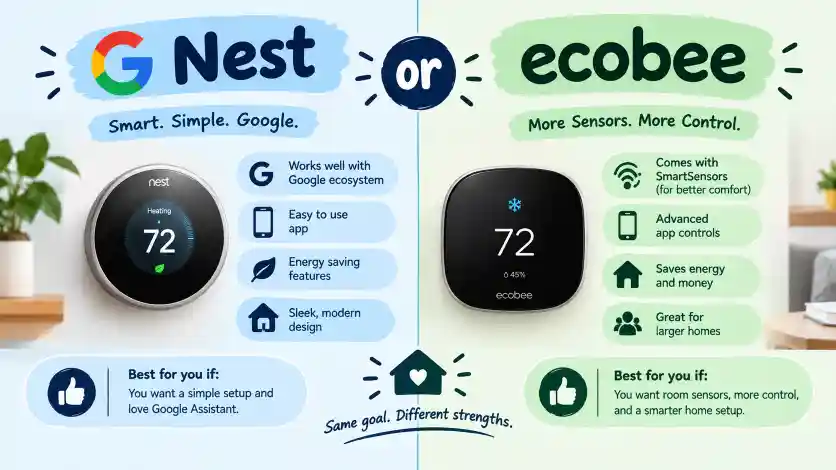
Nest and ecobee are both popular smart thermostat brands, but they approach temperature control, sensors, app features, and smart-home integration in different ways.
If you are comparing Nest or ecobee, the main differences usually come down to room sensors, smart-home compatibility, scheduling, installation, and the features you want from a thermostat.
Nest or ecobee: Quick Answer
Nest smart thermostats are designed around simple controls, automatic temperature adjustments, and integration with Google’s smart-home ecosystem.
ecobee
ecobee thermostats put more emphasis on room sensors, detailed scheduling, comfort settings, and broader smart-home features.
Simple Comparison
| Feature | Nest | ecobee |
| Brand | Google Nest | ecobee |
| Smart thermostat | Yes | Yes |
| Room sensors | Available on supported models | Available on supported models |
| Automatic temperature features | Yes | Yes |
| Smartphone control | Yes | Yes |
| Voice control | Available | Available |
| Scheduling | Yes | Yes |
| Smart-home integration | Strong Google integration | Broad smart-home integration |
What Is Nest?
Google Nest Thermostats
Nest is Google’s smart thermostat line. Nest thermostats are designed to let users control heating and cooling from the thermostat, phone, and compatible smart-home systems.
A Nest thermostat can provide features such as:
- Temperature control
- Scheduling
- Remote control
- Energy-saving features
- Smart-home integration
- Automatic temperature adjustments on supported models
Who Uses Nest?
Nest can be useful for people who already use Google products and want their thermostat to work within the same smart-home environment.
Its interface is also designed to make everyday temperature adjustments relatively simple.
What Is ecobee?
ecobee Smart Thermostats
ecobee is a Canadian smart-home company known for smart thermostats and room sensors.
Its thermostats can work with additional sensors that measure conditions in different rooms.
Room Sensors
One of ecobee’s notable features is its use of room sensors.
A sensor can help the thermostat understand conditions in another part of the home rather than relying only on the temperature near the main thermostat.
For example:
The thermostat is in the hallway, but the bedroom is warmer.
A room sensor can provide additional temperature information from the bedroom.
Nest vs ecobee: Room Sensors
Nest Sensors
Supported Nest thermostats can work with compatible temperature sensors.
These sensors can help monitor temperature in another room and can be useful when the main thermostat location does not represent the temperature of the entire home.
ecobee Sensors
ecobee also offers room sensors designed to monitor temperature and occupancy.
This can be useful in homes where different rooms have noticeably different temperatures.
Why Sensors Matter
Consider a two-story home.
The thermostat may be downstairs while bedrooms are upstairs. The temperature near the thermostat may not match the temperature upstairs.
Room sensors can provide additional information that helps with comfort management.
Nest vs ecobee: Smart-Home Integration
Nest and Google
It is closely connected with Google’s smart-home ecosystem.
This can make it a natural choice for households that already use Google Home and compatible Google devices.
ecobee and Smart Homes
ecobee supports several smart-home platforms and can connect with compatible devices and services.
The exact compatibility depends on the thermostat model and the smart-home platform being used.
Check Compatibility First
Before choosing a thermostat, check compatibility with the devices already in your home.
This is particularly important if you use:
- Smart speakers
- Smart displays
- Home automation systems
- Voice assistants
- Other connected heating and cooling equipment
Nest vs ecobee: Scheduling
Nest Scheduling
Thermostats can use schedules and automatic temperature features to help manage heating and cooling throughout the day.
For example, a schedule might use different temperatures for:
- Morning
- Daytime
- Evening
- Night
ecobee Scheduling
ecobee also supports detailed schedules and comfort settings.
You can create different temperature preferences for situations such as:
- Home
- Away
- Sleep
This can be useful when different periods of the day require different temperature settings.
Nest vs ecobee: Smartphone Control
Nest App Control
A compatible Nest thermostat can be controlled remotely using Google’s smart-home app.
This allows you to check or adjust the temperature without standing next to the thermostat.
ecobee App Control
ecobee also provides smartphone control through its app.
Users can adjust temperatures, manage settings, and interact with supported thermostat features remotely.
Nest vs ecobee: Energy Features
Nest thermostats include features designed to help users manage energy use.
Automatic temperature adjustments and scheduling can reduce unnecessary heating or cooling when the home does not need it.
ecobee
ecobee also provides energy-management features and scheduling options.
Its room sensors can be particularly useful when comfort needs vary between different rooms.
Your Heating and Cooling System Matters
A smart thermostat cannot automatically make every home more energy efficient.
Actual energy savings depend on factors such as:
- Home insulation
- Climate
- HVAC equipment
- Temperature settings
- Household schedule
- Thermostat configuration
Nest vs ecobee: Installation
Check Your HVAC System
Before buying either thermostat, make sure it is compatible with your heating and cooling system.
Compatibility can depend on the type of equipment installed in your home.
Common systems include:
- Central air conditioning
- Furnaces
- Heat pumps
- Multi-stage systems
- Heating and cooling combinations
Professional Installation
If you are unsure about your wiring or HVAC setup, professional installation can help prevent compatibility and wiring problems.
Do not assume that two thermostats will use the same wiring configuration simply because they perform similar functions.
Nest vs ecobee: Design and Controls
Nest thermostats are known for a clean, modern appearance and simple physical controls.
Depending on the model, users interact with the thermostat using a touch interface or another streamlined control system.
ecobee
ecobee thermostats generally use a touchscreen interface.
The display provides access to temperature controls and other thermostat settings.
The choice here largely comes down to personal preference and the specific model.
Common Mistakes When Choosing Nest or ecobee
Ignoring HVAC Compatibility
One of the biggest mistakes is buying a thermostat without checking the existing HVAC system.
Always verify compatibility before purchasing.
Comparing Brands Instead of Models
Not every Nest thermostat has the same features, and the same is true for ecobee.
Compare the specific models you are considering.
Forgetting About Room Sensors
If different rooms have major temperature differences, room sensors may be important.
Consider where your thermostat is located and which rooms matter most for comfort.
Overlooking Smart-Home Compatibility
If you already have a smart-home setup, check that the thermostat works with the platform and devices you use.
Nest or ecobee for Different Homes
For a Google-Focused Smart Home
Nest may fit naturally into a home that already uses Google’s smart-home products.
For Multi-Room Temperature Management
ecobee can be useful for households interested in using room sensors to monitor conditions in different areas.
For Simple Everyday Control
Both brands provide smartphone control, scheduling, and smart thermostat features, so the specific model and interface may matter more than the brand name alone.
Nest or ecobee: Key Differences
| Category | Nest | ecobee |
| Main ecosystem | ecobee and multiple smart-home platforms | |
| Room sensors | Supported models | Supported models |
| Remote control | Yes | Yes |
| Scheduling | Yes | Yes |
| Energy features | Yes | Yes |
| Smart-home features | Yes | Yes |
| Touchscreen experience | Model dependent | Common on current models |
| Best comparison method | Compare specific Nest model | Compare specific ecobee model |
FAQs About Nest or ecobee
1. What is the difference between Nest and ecobee?
Nest is Google’s smart thermostat line, while ecobee is an independent smart-home thermostat brand. Their differences include ecosystem integration, sensor options, interface, and scheduling features.
2. Can Nest and ecobee both control heating and cooling?
Yes. Compatible models from both brands can control many heating and cooling systems.
3. Do Nest and ecobee use room sensors?
Yes. Supported models from both brands can use compatible temperature sensors.
4. Can I control Nest from my phone?
Yes. Compatible Nest thermostats can be controlled remotely through Google’s smart-home app.
5. Can I control ecobee from my phone?
Yes. ecobee provides smartphone control for compatible thermostats.
6. Are Nest and ecobee compatible with every HVAC system?
No. Compatibility depends on the specific thermostat and HVAC equipment. Check the manufacturer’s compatibility information before installation.
7. Can a smart thermostat help save energy?
Smart thermostats can help manage energy through scheduling and temperature adjustments, but actual savings depend on the home, HVAC system, settings, climate, and usage.
8. Do I need room sensors?
Not necessarily. Room sensors can be useful when temperatures vary significantly between rooms, but they are not required for basic thermostat operation.
9. Are Nest and ecobee the same brand?
No. Nest is Google’s thermostat brand, while ecobee is a separate company.
10. What should I compare before buying?
Compare the specific models, HVAC compatibility, room-sensor support, smart-home compatibility, scheduling features, installation requirements, and app experience.
Conclusion
Nest and ecobee are both smart thermostat options, but their features and ecosystems differ.
Nest is closely connected with Google’s smart-home products, while ecobee places significant emphasis on room sensors, comfort settings, and broad smart-home compatibility.
The most useful comparison is between the specific Nest and ecobee models you are considering.
Check HVAC compatibility, sensor support, smart home integration, scheduling, and installation requirements before making a purchase.
Read More:
- Mazda CX 5 vs CX 50: What’s the Difference in 2026?
- Inches or Feet: Which Measurement Is Correct?
- Stigmatism or Astigmatism: Which Spelling Is Correct in 2026?







1 thought on “Nest or Ecobee: Which Smart Thermostat Is Right for You?”