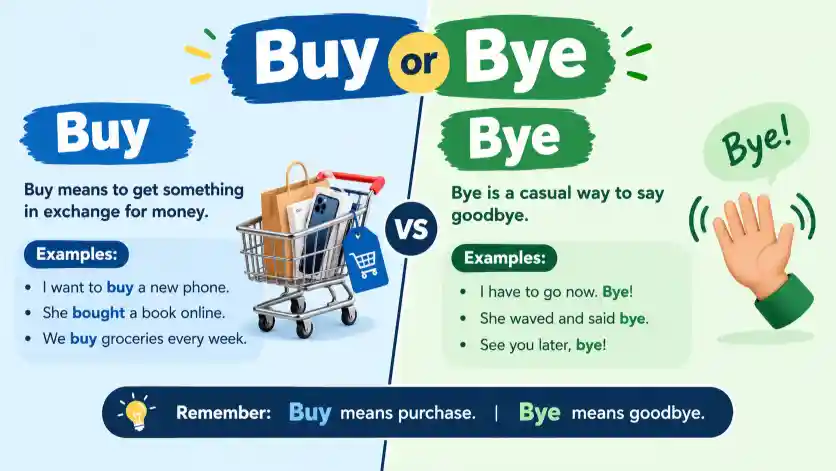
Buy and bye are both correct English words, but they have completely different meanings. Buy is a verb related to purchasing something, while bye is mainly used when saying goodbye.
In sports and competitions, bye can also mean a player or team gets a round without competing.
These words are easy to confuse because they sound exactly the same in most varieties of English. However, their spellings and meanings are different.
You use buy when someone purchases a product, service, or item. For example, “I want to buy a new laptop.”
You use bye when leaving or ending a conversation. For example, “Bye, see you tomorrow.”
The two words can also appear in common expressions such as buy it, buy back, say bye, and bye bye. Learning the meaning behind each spelling makes the difference much easier to remember.
Quick Answer
Buy means to purchase something.
Bye means goodbye. It can also describe a free round in a competition.
| Word | Meaning | Example |
| Buy | Purchase something | I will buy a book. |
| Bye | Goodbye | Bye, see you later. |
Easy rule:
If money is involved, use buy. If someone is leaving, use bye.
What Does Buy Mean?
Buy is a verb that means to get something by paying money for it.
You can buy:
- Food
- Clothes
- Books
- Cars
- Phones
- Furniture
- Tickets
- Services
Buy as a Verb
Buy is the base form of the verb.
I want to buy a new phone.
They plan to buy a house.
She went to the store to buy some milk.
Past Tense of Buy
The past tense of buy is bought.
I bought a new laptop yesterday.
She bought a dress last week.
The past form is not buyed.
What Does Bye Mean?
Bye is commonly used to say goodbye to someone.
It is an informal and very common expression in everyday English.
Bye When Leaving
Bye! See you tomorrow.
She waved and said bye.
Everyone!
Bye Bye
Bye bye is another way to say goodbye. It often sounds more casual or friendly.
The child waved and said bye bye.
Bye bye! Have a nice day.
Bye as a Sports Term
Bye has another meaning in sports and competitions.
A bye occurs when a player or team advances to the next round without playing a match in the current round.
Example
The top ranked team received a bye in the first round.
She got a bye and moved directly to the next stage.
This meaning is different from the everyday use of bye, but the spelling remains the same.
Buy vs Bye: Main Difference
The easiest way to understand the difference is to focus on their meanings.
Buy = Purchase
Use buy when someone pays for something.
I want to buy a new computer.
Bye = Goodbye
Use bye when someone leaves or ends a conversation.
**Bye! See you soon.
Bye = Free Round
In competitions, bye means a player or team advances without playing that round.
The team received a bye in the opening round.
Buy or Bye in Different Situations
Shopping
Use buy.
I need to buy some groceries.
Online Shopping
Use buy.
She decided to buy the shoes online.
Saying Goodbye
Use bye.
Bye! Take care.
Ending a Phone Call
Use bye.
Okay, I have to go now. Bye!
Sports Competition
Use bye.
The team received a first round bye.
Common Mistakes With Buy and Bye
Writing Bye When You Mean Purchase
Incorrect:
I want to bye a new car.
Correct:
I want to buy a new car.
Writing Buy When You Mean Goodbye
Incorrect:
Buy, see you tomorrow.
Correct:
Bye, see you tomorrow.
Writing Buyed Instead of Bought
Incorrect:
I buyed a new phone.
Correct:
I bought a new phone.
The verb forms are:
buy → bought → bought
Everyday Examples of Buy
Here are some common examples using buy.
I need to buy some bread.
She wants to buy a new dress.
We bought tickets for the concert.
He plans to buy a used car.
They buy fresh vegetables every week.
Can you buy me a bottle of water?
Everyday Examples of Bye
Here are some common examples using bye.
Bye! See you later.
She said bye before leaving.
He waved and said bye to his friends.
Bye, Mom!
We said bye and walked home.
The children shouted bye bye as the bus left.
Buy in Common Expressions
Its appears in many everyday phrases.
Buy Something
I want to buy a new jacket.
Buy From Someone
I bought the book from a local store.
Buy Online
We usually buy clothes online.
Buy Back
Buy back means to purchase something again from someone who previously owned or sold it.
The company agreed to buy back the shares.
Buy Into
Buy into can mean to accept or believe an idea.
He did not buy into the argument.
Bye in Common Expressions
Say Bye
I forgot to say bye before leaving.
Bye Bye
The baby waved and said bye bye.
Say Goodbye
Goodbye is another common expression for leaving.
She said goodbye to her friends.
Bye for Now
Bye for now means goodbye temporarily.
I have to go. Bye for now!
Buy or Bye in American and British English
Buy and bye are spelled the same in American and British English.
There is no standard spelling difference between the two varieties.
| Meaning | American English | British English |
| Purchase | Buy | Buy |
| Goodbye | Bye | Bye |
| Sports free round | Bye | Bye |
Both forms are standard in international English.
Why Do Buy and Bye Sound the Same?
Buy and bye are homophones. This means they have the same pronunciation but different spellings and meanings.
The word by is also a homophone.
So these three words sound alike:
- Buy = purchase
- Bye = goodbye
- By = near, beside, or through
For example:
I will buy a gift.
Bye, see you later.
The store is by the station.
Their meanings come from the context.
Buy, Bye, and By
These three words are often confused because they sound alike.
| Word | Meaning | Example |
| Buy | Purchase | I will buy a shirt. |
| Bye | Goodbye | Bye, see you tomorrow. |
| By | Near, beside, or through | The shop is by the bank. |
Easy Memory Trick
Think:
Buy = money
Bye = leaving
By = location or method
This simple association can help you choose the correct spelling.
Buy or Bye Comparison Table
| Feature | Buy | Bye |
| Part of speech | Mainly verb | Interjection; also noun in sports |
| Main meaning | Purchase | Goodbye |
| Related to shopping | Yes | No |
| Used when leaving | No | Yes |
| Used in sports | No | Yes |
| Past tense | Bought | — |
| Example | I will buy it. | Bye, everyone! |
| Pronunciation | Same as bye | Same as buy |
Which Spelling Should You Use?
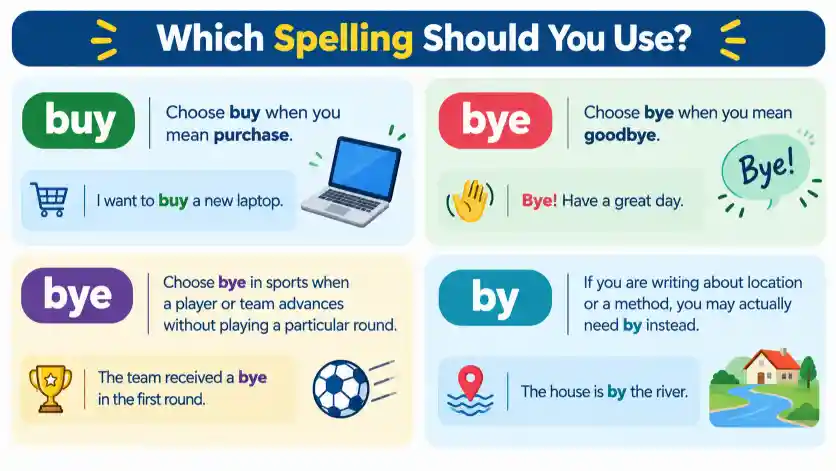
Choose buy when you mean purchase.
I want to buy a new laptop.
Choose bye when you mean goodbye.
Bye! Have a great day.
Choose bye in sports when a player or team advances without playing a particular round.
The team received a bye in the first round.
If you are writing about location or a method, you may actually need by instead.
The house is by the river.
FAQs About Buy or Bye
Is buy and bye the same word?
No. Buy and bye are different words with different meanings, although they sound the same.
Is buy used for shopping?
Yes. Buy is used when someone purchases something.
I want to buy a new phone.
Is bye used for goodbye?
Yes. Bye is a common informal way to say goodbye.
Bye! See you tomorrow.
What is the past tense of buy?
The past tense of buy is bought.
She bought a new bag yesterday.
Is bye used in sports?
Yes. In competitions, a bye can allow a player or team to advance to the next round without playing.
Are buy and bye pronounced the same?
Yes. They are homophones and normally have the same pronunciation.
What is the difference between buy, bye, and by?
Buy means purchase, bye means goodbye or a free round in a competition, and by has meanings related to location, method, or agency.
Conclusion
Buy and bye are both correct words, but they have different meanings.
Use buy when you mean purchase something:
I want to buy a new computer.
Use bye when you mean goodbye:
Bye! See you tomorrow.
In sports and competitions, bye can also mean a player or team advances without competing in a particular round.
The easiest way to remember the difference is simple: buy involves purchasing, while bye involves leaving.
Read More:
- Waving or Waiving: Which Word Should You Use?
- Ran or Run: When Should You Use Each Word?
- Fetuses or Feti: Which Plural Is Correct?


1 thought on “Buy or Bye: What’s the Difference in 2026?”