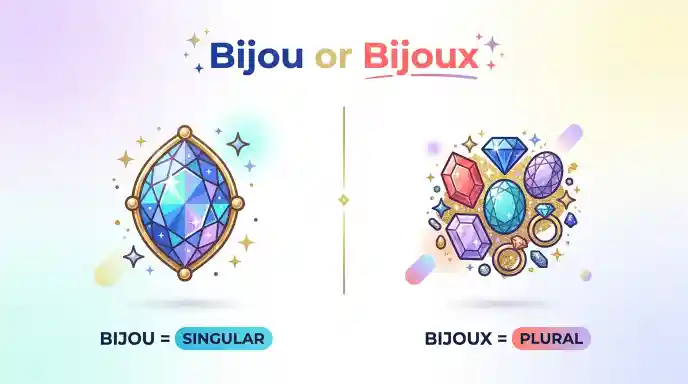
Bijoux is the plural of bijou, the French word for jewels and small, pretty ornaments. If you saw both words and felt unsure, you are not alone.
English speakers meet these words in fashion blogs, jewelry stores, restaurant menus, and home decor ads. The two forms look almost the same, so many people mix them up. Some ask which one is singular. Others ask how to spell the plural.
Some wonder if they can use the word in English at all. Many also ask if “bijoux” means the same as “jewelry.” This guide answers all of it. You will learn the exact meaning, the simple spelling rule, the French origin, and when to use each form.
You will also see real examples from emails, news, and social media. This guide solves that confusion with a clear rule, simple examples, and advice for US, UK, and global readers. By the end, you will know how to use bijou and bijoux with full confidence.
Bijou or Bijoux : Quick Answer
Use bijou for one. Use bijoux for more than one.
- “She wore a single gold bijou on a thin chain.” (one piece)
- “The box was full of silver bijoux.” (many pieces)
That is the whole rule. Bijou is singular. Bijoux is plural. Pronounce bijou as “bee-ZHOO” and bijoux as “bee-ZHOOZ.”
Definition and Meaning of Bijou or Bijoux
Clear definition: A bijou is a jewel, or a small and delicately made ornament such as a trinket. Bijoux is its plural.
Simple meaning: A small, pretty, and valuable thing. It can be a real jewel or just something small and fine.
Context and usage: People use the word in jewelry, fashion, art, and home decor. It adds a French, elegant feel to the writing.
Different meanings: The word has more than one use:
- Jewel or trinket – “She kept her bijoux in a velvet box.”
- Adjective meaning “small and elegant” – mostly in British English, “a bijou apartment” means a small but charming flat.
- In French, “bijoux” also means jewelry in general – for example, “bijoux en or” means “gold jewelry.”
The Origin of Bijou or Bijoux
The word comes from French. French borrowed it from the Breton word bizou, which meant a jeweled ring. That came from biz, the Breton word for finger. English started using “bijou” in the 1660s.
So why do the two spellings look different? Because French makes plurals in its own way. In French, words that end in “-ou” often take “-x” in the plural: bijou becomes bijoux. English borrowed the word with this French plural. That is why “bijous” and “bijouxes” are wrong. The spelling difference is not American vs British. It is simply singular vs plural, and it follows a French rule.
British English vs American English Spelling
Here is good news: bijou and bijoux are spelled the same in American and British English. The word is French, so both countries use the French spelling.
The US/UK difference shows up in the English translation of the word:
- Americans write jewelry.
- British people write jewellery.
| Word | American Spelling | British Spelling | Same or Different? |
| Bijou (one) | bijou | bijou | Same |
| Bijoux (many) | bijoux | bijoux | Same |
| English word for jewels | jewelry | jewellery | Different |
| Jewelry store | jewelry store | jewellery shop | Different |
So if your question is “bijou or bijoux,” the answer has nothing to do with the US or UK. It is only about singular vs plural.
Which Spelling Should You Use?
Pick based on your audience:
- US audience: Use “jewelry.” Americans know this word best. Example: “Fine jewelry sale this weekend.”
- UK and Commonwealth audience: Use “jewellery.” Example: “Fine jewellery sale this weekend.”
- Global or fashion audience: Use “bijoux.” It sounds elegant and works everywhere. Example: “Handcrafted bijoux from Paris.”
- Formal business writing: Use the English form your readers expect, and stay consistent. Do not mix “jewelry” and “jewellery” in one document.
- Menus, brands, and ads: “Bijoux” adds style and a French touch. Many luxury brands choose it on purpose.
Common Mistakes with Bijou or Bijoux
| Wrong | Right | Why |
| a bijoux | a bijou | Bijoux is plural; “a” needs a singular word |
| bijouxs | bijoux | The plural already ends in x; no extra s |
| bijouxes | bijoux | Same reason; the x is the plural marker |
| bijous | bijoux | French rule uses x, not s |
| two bijou | two bijoux | Use the plural after a number above one |
| jewelry and jewellery in one text | pick one and stay consistent | Mixing them looks careless |
The most common error is writing “a bijoux.” Remember: a = bijou, many = bijoux.
Bijou or Bijoux in Everyday Examples
Email:
“Hi Anna, the new bijoux collection arrives on Friday. Please update the product page before noon.”
News:
“Paris Exhibition Showcases Rare Bijoux From the 1800s”
Social media:
“New drop! Handmade bijoux inspired by vintage Paris. Link in bio.”
Formal writing:
“The museum holds a fine collection of bijoux, including rings, brooches, and pendants from the 19th century.”
Bijou or Bijoux : Google Trends & Usage Data
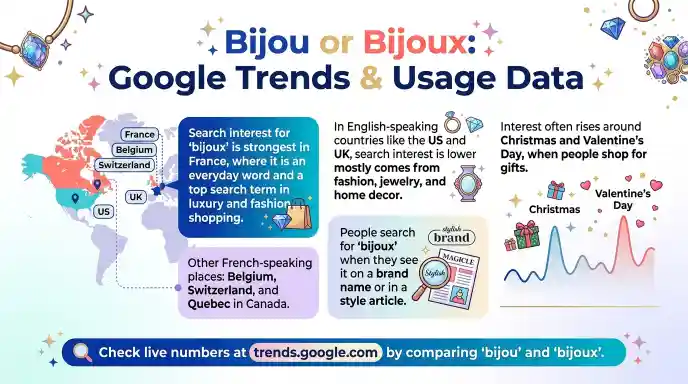
Search interest for “bijoux” is strongest in France, where it is an everyday word and a top search term in luxury and fashion shopping. It is also popular in other French-speaking places: Belgium, Switzerland, and Quebec in Canada.
In English-speaking countries like the US and UK, search interest is lower and mostly comes from fashion, jewelry, and home decor. People there search for “bijoux” when they see it on a brand name or in a style article.
Interest often rises around holidays such as Christmas and Valentine’s Day, when people shop for gifts. You can check the live numbers any time at trends.google.com by comparing “bijou” and “bijoux.”
Bijou vs Bijoux : Quick Comparison Table
| Bijou | Bijoux | Jewelry | Jewellery | |
| Meaning | One jewel or small ornament | Many jewels or small ornaments | Jewels (US) | Jewels (UK) |
| Number | Singular | Plural | Both | Both |
| Used in | US, UK, global | US, UK, global | United States | UK, Canada, Australia |
| Style | French, elegant | French, elegant | Plain, everyday | Plain, everyday |
| Example | “a gold bijou” | “gold bijoux” | “gold jewelry” | “gold jewellery” |
FAQs
1. Is it bijou or bijoux?
It depends on number. Use bijou for one and bijoux for more than one.
2. What is the plural of bijou?
The plural is bijoux. It follows a French rule: add x, not s.
3. What does bijoux mean in English?
It means jewels, or small and pretty ornaments.
4. Is bijoux an English word?
It is a French word, but English dictionaries include it, and English speakers use it in fashion and jewelry.
5. How do you pronounce bijoux?
Say “bee-ZHOOZ.” The singular bijou is “bee-ZHOO.”
6. Should I use bijoux or jewelry in my writing?
For a US audience, use “jewelry.” For a UK audience, use “jewellery.” Its fashion or a global audience, “bijoux” sounds more elegant.
7. Can bijou describe a house?
Yes, in British English. A “bijou apartment” means a small but elegant flat.
Conclusion
The choice between bijou and bijoux is simple once you know the rule. Use bijou for one jewel or one small, elegant thing. Use bijoux for more than one. The word comes from French, and French adds x to make the plural.
That is why the English-style plurals like “bijous” or “bijouxes” are wrong. Both spellings are the same in American and British English. The real US/UK difference is only in the English translation: “jewelry” for the US and “jewellery” for the UK. If you write for a global or fashion audience, “bijoux” adds a touch of style.
In formal or business writing, pick the English form your readers expect and stay consistent. Avoid the common traps: never write “a bijoux,” and never add an extra s to the plural.
Keep this guide near you, and you will never mix them up again. With the right form in the right place, your writing sounds clean, correct, and confident.
Read More:
- Nest or Ecobee: Which Smart Thermostat Is Right for You?
- Stigmatism or Astigmatism: Which Spelling Is Correct in 2026?
- Copyright or Copywrite: Don’t Make This Common Mistake








2 thoughts on “Bijou or Bijoux: Guide to Meaning, Spelling, and Correct Use”