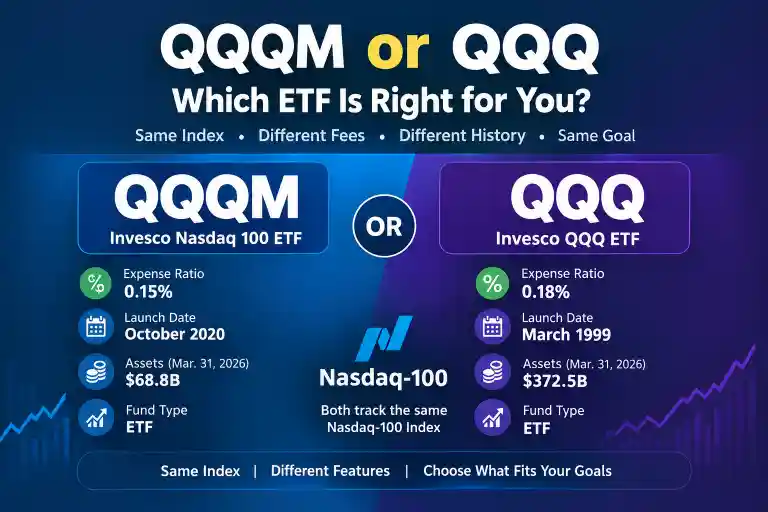
QQQM or QQQ, both ETFs track the Nasdaq-100 Index, but they differ mainly in fees, structure, trading history, and typical use.
Investors often search “QQQM or QQQ” because the two funds can look almost identical at first glance, both offered by Invesco and covering the same broad group of 100 large non-financial companies listed on Nasdaq.
The main question usually comes down to why someone would choose QQQ when QQQM has a lower expense ratio an answer that involves trading liquidity, fund history, and personal investing needs, not just the annual fee.
In this guide, you’ll learn the key differences between QQQM and QQQ, including their fees, structure, and which one fits your investment strategy in 2026.
QQQM or QQQ : Quick Answer
QQQM and QQQ are both Invesco ETFs designed to provide exposure to the Nasdaq-100 Index. The biggest practical difference is their expense ratio: as of 2026, QQQM’s total expense ratio is 0.15%, while QQQ’s is 0.18%.
Both funds follow the same underlying Nasdaq-100 Index, which contains 100 of the largest non-financial companies listed on Nasdaq.
Simple comparison
| Feature | QQQM | QQQ |
| Full name | Invesco Nasdaq 100 ETF | Invesco QQQ |
| Underlying index | Nasdaq-100 | Nasdaq-100 |
| Expense ratio | 0.15% | 0.18% |
| Launch | October 2020 | March 1999 |
| Provider | Invesco | Invesco |
| Exchange | Nasdaq | Nasdaq |
| Main exposure | Large Nasdaq-listed non-financial companies | Large Nasdaq-listed non-financial companies |
In simple terms, QQQM is the newer, lower-cost version of Nasdaq-100 exposure, while QQQ is the older and more established fund.
Definition and Meaning of QQQM
QQQM is the ticker symbol for the Invesco Nasdaq 100 ETF.
An ETF, or exchange-traded fund, is a basket of investments that trades on a stock exchange. QQQM is designed to follow the Nasdaq-100 Index.
According to Invesco, QQQM invests at least 90% of its total assets in securities that make up the Nasdaq-100 Index. The index represents 100 of the largest domestic and international non-financial companies listed on Nasdaq.
What does QQQM mean?
QQQM is not a normal English word. It is a stock ticker symbol.
You may see it written as:
- QQQM
- QQQM ETF
- Invesco QQQM
- Invesco Nasdaq 100 ETF
All of these generally refer to the same ETF.
What is QQQ?
QQQ is the ticker symbol for the Invesco QQQ ETF.
It also tracks the Nasdaq-100 Index. Invesco says QQQ has provided access to the Nasdaq-100 for more than 25 years and began in March 1999.
So the basic relationship is:
QQQM → Invesco Nasdaq 100 ETF → Nasdaq-100
QQQ → Invesco QQQ ETF → Nasdaq-100
The Origin of QQQM and QQQ
Unlike words such as neighbourhood and neighborhood, QQQM and QQQ are not alternative spellings.
They are financial ticker symbols.
The history of QQQ
QQQ was launched in March 1999 and was created to provide investors with exposure to the Nasdaq-100 Index through a single exchange-traded product.
The Nasdaq-100 itself dates back to 1985. It measures the performance of large non-financial companies listed on Nasdaq.
The history of QQQM
QQQM launched in October 2020. Invesco created it as another way for investors to access the Nasdaq-100. I
The two ETFs therefore have different histories even though they follow the same underlying index.
QQQ has the much longer live track record, while QQQM was introduced more recently with a lower expense ratio.
QQQM vs QQQ: Key Differences
The two ETFs are closely related, but several details are worth understanding.
1. Expense ratio
This is one of the clearest differences.
As of 2026:
The difference is 0.03 percentage points, or three basis points.
For example, ignoring market performance and other costs:
- $10,000 at 0.15% = about $15 per year
- $10,000 at 0.18% = about $18 per year
The actual cost can vary with the value of the investment.
2. Fund history
QQQ began in 1999, while QQQM began in 2020.
That makes QQQ the fund with the much longer operating history.
3. Trading activity
QQQ has a long history as a heavily traded ETF and has substantial assets under management. Invesco reported QQQ assets of approximately $372.5 billion and QQQM assets of approximately $68.8 billion as of March 31, 2026.
This difference can matter to traders who care about market liquidity and trading conditions.
4. Structure
QQQ underwent a structural modernization in 2025. Invesco says the fund moved to a more flexible open-ended ETF structure and its expense ratio fell from 0.20% to 0.18%.
Its core Nasdaq-100 exposure remained the same.
QQQM or QQQ: Comparison Table
| Category | QQQM | QQQ |
| Fund | Invesco Nasdaq 100 ETF | Invesco QQQ |
| Ticker | QQQM | QQQ |
| Index | Nasdaq-100 | Nasdaq-100 |
| Expense ratio | 0.15% | 0.18% |
| Inception | October 2020 | March 1999 |
| Provider | Invesco | Invesco |
| Main objective | Nasdaq-100 exposure | Nasdaq-100 exposure |
| Listed on | Nasdaq | Nasdaq |
| Fund age | Newer | Older |
| Assets, Mar. 31, 2026 | $68.8B | $372.5B |
| Typical discussion point | Lower annual expense | Long history and high liquidity |
The funds’ shared benchmark means their investment exposure is closely related, but fees, structure, liquidity, and trading characteristics can still differ.
British English vs American English Spelling
There is no British-vs-American spelling difference between QQQM and QQQ.
This section is different from a normal grammar comparison because QQQM and QQQ are financial ticker symbols, not English vocabulary words.
For example:
| Term | British English | American English |
| QQQM | QQQM | QQQM |
| QQQ | QQQ | QQQ |
| ETF | ETF | ETF |
| Nasdaq-100 | Nasdaq-100 | Nasdaq-100 |
Ticker symbols generally remain unchanged across English-speaking markets.
So you should not write:
- ❌ QQQM as a British spelling
- ❌ QQQ as an American spelling
- ❌ QQQM/QQQ as spelling variants
Instead, treat them as fund identifiers.
Which One Should You Use?
There is no single choice that fits every investor.
Instead, the relevant factors depend on how you plan to use the ETF.
For someone focused on lower fund expenses
QQQM has the lower stated expense ratio, at 0.15% compared with QQQ’s 0.18%.
A long-term investor may therefore pay attention to the difference in annual fund expenses.
For someone focused on trading
QQQ’s much larger asset base and long trading history can make liquidity an important part of the comparison. Invesco reported approximately $372.5 billion in QQQ assets versus $68.8 billion for QQQM as of March 31, 2026.
For someone building a long-term portfolio
An investor may compare:
- expense ratio
- bid-ask spread
- trading costs
- account type
- investment horizon
- tax considerations
- desired trading flexibility
The lower expense ratio alone does not answer every question.
Common Mistakes with QQQM or QQQ
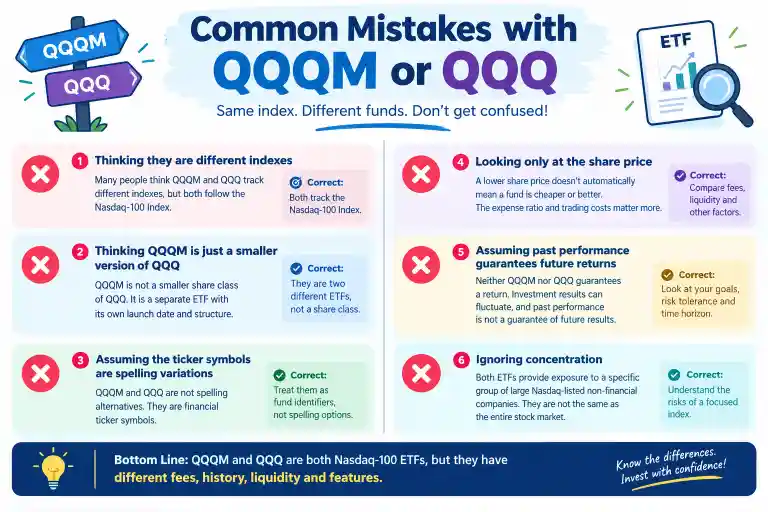
Mistake 1: Thinking they are different indexes
They both provide exposure to the Nasdaq-100 Index. Invesco
Mistake 2: Thinking QQQM is simply a smaller version of QQQ
QQQM is a separate ETF. It is not simply a smaller share class of QQQ.
Mistake 3: Assuming the ticker symbols are spelling variations
QQQM and QQQ are financial symbols, not spelling alternatives.
Mistake 4: Looking only at the share price
A lower share price does not automatically mean an ETF is cheaper or better.
The important costs include the expense ratio and trading-related costs.
Mistake 5: Assuming past performance guarantees future returns
Neither ETF guarantees a particular return.
Invesco specifically notes that investment returns and principal value can fluctuate and that past performance does not guarantee future results.
Mistake 6: Ignoring concentration
Both funds track the Nasdaq-100, so they provide exposure to a specific group of large Nasdaq-listed non-financial companies rather than the entire stock market.
QQQM or QQQ in Everyday Examples
Example 1: A finance article
“The investor compared QQQM and QQQ before choosing a Nasdaq-100 ETF.”
Here, the writer is comparing two funds with similar underlying exposure.
Example 2: A financial newsletter
“QQQM has a 0.15% expense ratio, while QQQ has a 0.18% expense ratio.”
This is a common way to explain their cost difference.
Example 3: Social media
“Is QQQM or QQQ better for a long-term portfolio?”
This question is usually asking about differences in fees, liquidity, structure, and intended use.
Example 4: Formal writing
“QQQM and QQQ both provide exposure to the Nasdaq-100 Index, but their fund characteristics differ.”
This wording is suitable for financial education content.
Example 5: A portfolio discussion
“Before buying either ETF, compare the expense ratio, trading costs, and how the fund fits your portfolio.”
This avoids assuming that one fund is appropriate for everyone.
QQQM or QQQ : Google Trends & Usage Data
People searching “QQQM or QQQ” are usually looking for a comparison rather than a definition of an English word.
Common search intents include:
- QQQM vs QQQ
- QQQM or QQQ for long term
- QQQM vs QQQ fees
- QQQ vs QQQM expense ratio
- QQQM vs QQQ performance
- QQQM or QQQ Reddit
- Is QQQM the same as QQQ?
Google Trends measures relative search interest rather than the number of ETF shares traded or the size of a fund. Google’s Trends platform describes itself as a tool for exploring what people are searching for.
For this topic, search interest can also change when:
- technology stocks receive more attention;
- Nasdaq-100 performance changes;
- ETF fees change;
- investors compare long-term portfolio options;
- market volatility increases.
It is important not to confuse Google search popularity with investment demand. Search volume does not tell you if an ETF is financially suitable for an individual investor.
QQQM vs QQQ: What Do They Actually Hold?
Both ETFs are connected to the Nasdaq-100.
The index includes large domestic and international non-financial companies listed on Nasdaq.
That means the funds can provide exposure to major companies across areas such as:
- technology
- communications
- consumer businesses
- healthcare
- industrial companies
The exact portfolio weights can change over time as the underlying index changes.
The Nasdaq-100 is reconstituted annually and rebalanced quarterly, according to Invesco’s QQQM fund information.
Is QQQM Cheaper Than QQQ?
Yes, based on the stated expense ratios available in 2026.
QQQM: 0.15%
The difference is relatively small on a percentage basis, but expenses can become more noticeable over long periods or larger investment amounts.
For example, on $100,000:
- QQQM’s stated expense ratio equals approximately $150 annually.
- QQQ’s stated expense ratio equals approximately $180 annually.
This is a simplified illustration. It does not account for changes in investment value, trading costs, taxes, or other factors.
FAQs About QQQM or QQQ
1. Is QQQM the same as QQQ?
They are separate ETFs, but both track the Nasdaq-100 Index. Their expense ratios, fund histories, assets, and trading characteristics differ.
2. Which has the lower expense ratio, QQQM or QQQ?
As of 2026, QQQM has the lower expense ratio at 0.15%, compared with 0.18% for QQQ.
3. When did QQQM start?
4. When did QQQ start?
QQQ launched in March 1999 and has more than 25 years of history.
5. Do QQQM and QQQ track the same index?
Yes. Both provide exposure to the Nasdaq-100 Index.
6. Is QQQM a stock?
No. QQQM is an exchange-traded fund (ETF). It holds a portfolio designed to provide exposure to the Nasdaq-100.
7. Is QQQM or QQQ better?
The answer depends on what you are comparing. QQQM has a lower stated expense ratio, while QQQ has a much longer operating history and substantially larger assets. Investors may also consider liquidity, spreads, taxes, account type, and investment goals.
Conclusion: QQQM or QQQ?
QQQM and QQQ are two closely related ETFs that provide exposure to the Nasdaq-100 Index, but they are not identical funds. QQQ has been available since 1999 and has a much larger asset base, while QQQM launched in 2020 and has a lower stated expense ratio.
The main difference many investors notice is cost: QQQM charges 0.15%, while QQQ charges 0.18% as of 2026.
However, expense ratios are only one part of an ETF comparison. Trading liquidity, bid-ask spreads, investment horizon, taxes, account type, and personal financial goals can also matter.
If you see “QQQM or QQQ” in an article, forum, or search result, remember that the question is not about spelling. These are two ticker symbols for ETFs connected to the same Nasdaq-100 benchmark.
Before investing, check the latest fund documents and consider your own financial circumstances.
Read More:








3 thoughts on “QQQM or QQQ: Which Nasdaq 100 ETF Fits Your Strategy in 2026”