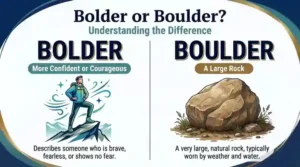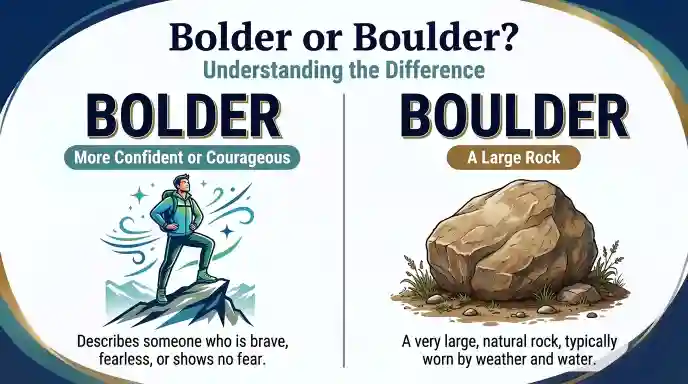
Bolder is the comparative form of “bold,” meaning more courageous, confident, or noticeable, while boulder is a large rock. Although these words sound similar, they have different meanings and uses. Choosing the correct spelling depends on what you want to describe.
People often confuse bolder and boulder because their pronunciation is very similar. However, bolder describes a person, action, idea, or appearance that shows greater confidence or strength, whereas boulder refers to a large natural rock.
Understanding the difference between bolder or boulder can help you avoid spelling mistakes in everyday conversations, school assignments, professional writing, and online content. In this guide, you will learn the definitions, origins, common mistakes, and practical examples of both words.
Bolder or Boulder : Quick Answer
Bolder means more bold, brave, confident, or striking. Boulder means a large rock, usually one that is too big to move easily by hand.
| Word | Meaning | Example |
| Bolder | More courageous, confident, or noticeable | She made a bolder decision. |
| Boulder | A large rock | A huge boulder blocked the road. |
Quick tip: If you are describing confidence, use bolder. If you are describing a rock, use boulder.
Definition and Meaning of Bolder and Boulder
What Does Bolder Mean?
Bolder is the comparative form of the adjective bold. It describes someone or something that is more courageous, confident, daring, or visually striking than another.
The word can describe people, decisions, designs, colors, statements, and actions.
Examples:
- “She became bolder after gaining experience.”
- “The artist chose a bolder color for the background.”
- “He made a bolder move during the competition.”
- “We need a bolder approach to solve this problem.”
In each example, bolder expresses a greater degree of confidence, daring, or visual impact.
What Does Boulder Mean?
Boulder is a noun referring to a large rock. Boulders occur naturally in mountains, rivers, forests, deserts, and other landscapes. They can be rounded, angular, smooth, or rough, depending on how they formed and weathered.
Examples:
- “A large boulder lay beside the hiking trail.”
- “The climber carefully moved around the boulder.”
- “Heavy rain caused a boulder to roll down the hillside.”
- “The children sat on a flat boulder near the river.”
Remember: A boulder is something you can see in a landscape; bolder describes a greater degree of boldness.
Origin and History of Bolder and Boulder
Origin of Bolder
Bolder comes from the adjective bold, which has Germanic roots and has long been associated with courage, confidence, and willingness to take risks.
The ending -er is added to form the comparative adjective. This follows the usual pattern seen in words such as tall → taller and fast → faster.
Examples:
- Bold: He is a bold speaker.
- Bolder: He is a bolder speaker than before.
Origin of Boulder
Boulder comes from older English forms associated with large stones or rocks. It developed into the modern geological term for a large rock fragment.
Today, boulder is widely used in geology, geography, outdoor recreation, and everyday descriptions of natural landscapes.
Although the two words look and sound similar, their origins and grammatical functions differ.
British English vs. American English Spelling
The words bolder and boulder have the same spellings and meanings in British and American English. There is no regional spelling difference between them.
| Feature | American English | British English |
| Comparative of bold | Bolder | Bolder |
| Large rock | Boulder | Boulder |
| Spelling difference | None | None |
| Common context for bolder | Confidence, design, decisions | Confidence, design, decisions |
| Common context for boulder | Geology, hiking, landscapes | Geology, hiking, landscapes |
Both varieties use bolder for greater boldness and boulder for a large rock.
Which Spelling Should You Use?
Use Bolder When Comparing Confidence or Appearance
Choose bolder when you mean more courageous, confident, daring, or noticeable.
Examples:
- “The company needs a bolder marketing strategy.”
- “She gave a bolder answer during the interview.”
- “This design uses bolder colors.”
- “He became bolder after practicing his speech.”
Use Boulder When Referring to a Large Rock
Choose boulder when describing a large natural stone.
Examples:
- “A boulder blocked the narrow path.”
- “The hikers rested beside a large boulder.”
- “The river flowed around the boulder.”
- “The workers removed the boulder from the construction site.”
Check the Meaning Before Writing
If your sentence describes an attitude, decision, or design, bolder is likely correct. If it describes a physical rock, use boulder.
Compare these sentences:
- “She chose a bolder design.” The design is more striking.
- “She climbed onto a boulder.” She climbed onto a large rock.
Common Mistakes With Bolder and Boulder
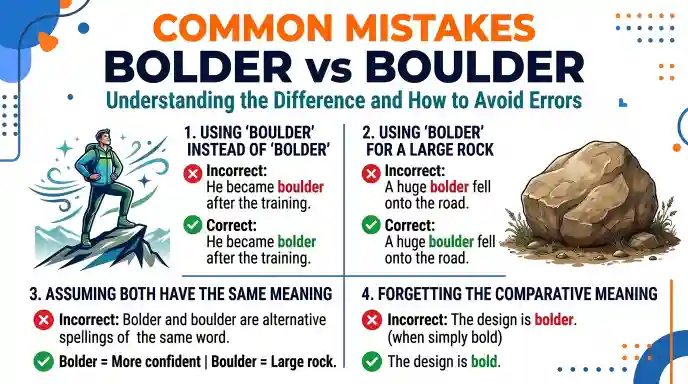
1. Using Boulder When You Mean More Confident
Incorrect: “He became boulder after the training.”
Correct: “He became bolder after the training.”
Why? The sentence describes increased confidence, so the comparative form bolder is correct.
2. Using Bolder for a Large Rock
Incorrect: “A huge bolder fell onto the road.”
Correct: “A huge boulder fell onto the road.”
Why? A large rock is a boulder, not bolder.
3. Assuming Both Words Have the Same Meaning
Incorrect assumption: “Bolder and boulder are alternative spellings of the same word.”
Correct understanding: Bolder describes greater boldness, while boulder names a large rock.
4. Forgetting the Comparative Meaning of Bolder
Incorrect: “The design is bolder” when no comparison or greater degree is intended and the writer simply means “bold.”
Better: “The design is bold.”
Why? Bold describes a quality, while bolder usually indicates a greater degree of that quality compared with something else.
Bolder or Boulder in Everyday Examples
1. In Everyday Conversations
- “You should be bolder when sharing your ideas.”
- “We stopped to take a picture beside the boulder.”
- “Her new haircut looks bolder than her previous style.”
2. In School and Study
- “The student gave a bolder presentation this year.”
- “The geography book showed a large boulder near a mountain.”
- “The artist used bolder lines in the second drawing.”
3. In Emails and Workplace Communication
- “We should consider a bolder approach to the project.”
- “The construction team reported a large boulder at the site.”
- “The new campaign uses bolder visual elements.”
4. In Nature and Outdoor Activities
- “A massive boulder rested at the foot of the cliff.”
- “The climber carefully stepped around the boulder.”
- “The trail passed between two enormous boulders.”
5. In Social Media Posts
- “Trying a bolder look this season!”
- “Found this amazing boulder during our hike.”
- “Choosing bolder colors for my next design.”
6. Incorrect and Correct Examples
| Incorrect Sentence | Correct Sentence |
| She made a boulder decision. | She made a bolder decision. |
| A large bolder blocked the road. | A large boulder blocked the road. |
| His voice sounded boulder during the speech. | His voice sounded bolder during the speech. |
| The climber sat on a bolder. | The climber sat on a boulder. |
Usage Trends and Modern Writing
Bolder is common in discussions about confidence, personal growth, design, business strategy, fashion, and communication. It often appears when comparing two choices or describing a change toward greater confidence or stronger visual impact.
For example, a designer may choose bolder colors, a speaker may become bolder, or a company may adopt a bolder strategy.
Boulder is more common in descriptions of landscapes, geology, hiking, climbing, and construction. It refers to a physical object rather than a quality or behavior.
Because the words sound alike, spelling mistakes can occur when people rely on pronunciation alone. Understanding the meaning of each word is the easiest way to choose correctly.
Bolder vs. Boulder: Comparison Table
| Feature | Bolder | Boulder |
| Part of speech | Adjective | Noun |
| Main meaning | More bold or confident | A large rock |
| Related word | Bold | Rock or stone |
| Describes a person | Yes | No, not normally |
| Describes a physical rock | No | Yes |
| Example | A bolder decision | A huge boulder |
Easy Trick to Remember Bolder and Boulder
Use this simple memory trick:
- Bolder = Bold + er. It means more bold or confident.
- Boulder = Big rock. It refers to a large stone.
Think of the “u” in boulder as part of the longer word for a physical object. When comparing courage, confidence, or visual impact, use bolder.
Bolder people take risks; boulders are rocks.
Frequently Asked Questions
1. Is it bolder or boulder?
Both are correct words, but they have different meanings. Bolder means more courageous, confident, or striking, while boulder means a large rock.
2. What does bolder mean?
Bolder is the comparative form of bold. It describes someone or something that is more confident, courageous, daring, or visually noticeable.
3. What does boulder mean?
A boulder is a large rock or stone found naturally in places such as mountains, rivers, forests, and hillsides.
4. Are bolder and boulder pronounced the same?
They are pronounced very similarly and are often treated as homophones in everyday speech. Their meanings and spellings are different.
5. Is bolder a real word?
Yes. Bolder is the standard comparative form of the adjective bold.
6. Is a boulder bigger than a rock?
In everyday English, a boulder is a large rock. In geology, the term has a more specific size classification based on its diameter.
7. Can bolder describe colors?
Yes. Bolder can describe colors that appear stronger, brighter, or more striking than other colors.
Example: “The designer selected bolder shades for the new logo.”
8. How do I remember the difference between bolder and boulder?
Remember that bolder comes from bold and describes greater confidence or impact. Boulder refers to a large rock.
Conclusion
The difference between bolder and boulder is easy to understand once you focus on meaning. Bolder is the comparative form of bold and describes something more courageous, confident, or striking. Boulder is a noun referring to a large rock.
Use bolder when describing people, choices, ideas, or design. Use boulder when talking about rocks, landscapes, or outdoor environments.
Read More:
- Stuffing or Dressing? The Answer May Surprise You
- Axel or Axle: The Spelling Difference You Need to Know!
- Taped vs. Tapped: Don’t Make This Common Writing Error