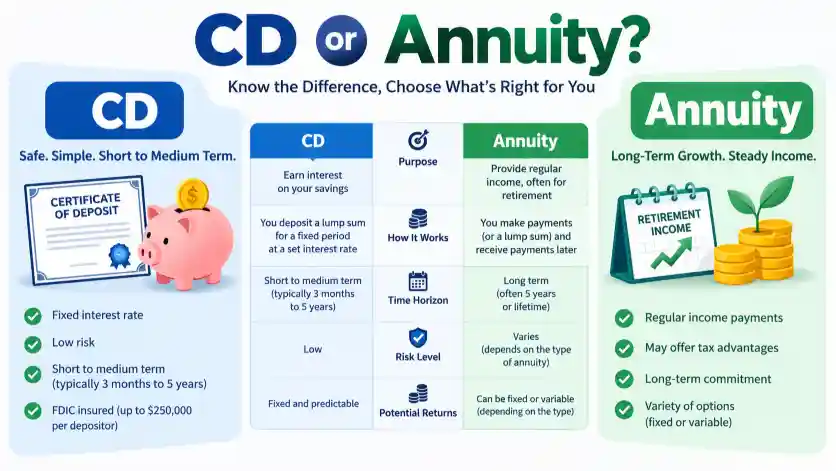
A CD (Certificate of Deposit) is a bank deposit that earns interest for a set period, while an annuity is an insurance product designed to provide income or help grow money over time. The better choice depends on your savings goals, need for access to cash, and plans for retirement.
People often search for CD or annuity because both options can help protect money or generate income. However, they work in different ways. A CD is usually easier to understand and has a fixed term. An annuity can offer different payment choices, including income that continues for a set period or for life, depending on the contract.
For example, someone saving money for a short-term goal may prefer a CD. Someone planning for retirement may consider an annuity to help create a steady income stream. Both options have benefits, costs, and limitations that deserve careful attention.
The main difference is that a CD is a bank deposit, while an annuity is an insurance contract. Understanding how each works can help you choose an option that fits your financial needs.
CD or Annuity : Quick Answer
A CD may be better for short-term savings and predictable interest. An annuity may be better for people who want retirement income, including payments that can last for life under certain contracts.
The right choice depends on your financial goals.
- Choose a CD if you want a set interest rate, a defined savings term, and access to your money at maturity.
- Consider an annuity if you want long-term growth or a regular retirement income stream.
- Compare both carefully if you need to balance safety, access to cash, and future income.
In the United States, CDs at FDIC-insured banks are generally insured up to applicable limits. Annuities are insurance contracts and are not covered by FDIC deposit insurance.
Definition and Meaning of CD and Annuity
Understanding each product is the first step toward making a sound financial decision.
What Is a CD?
A Certificate of Deposit (CD) is a savings product offered by banks and credit unions. You deposit money for a specific period and earn interest according to the account’s terms.
CD terms can range from a few months to several years. Many CDs offer a fixed interest rate for the full term.
For example, you deposit $10,000 into a one-year CD with a 4% annual interest rate. If the rate stays fixed and interest is paid annually, you would earn $400 over one year before taxes.
The actual interest depends on the compounding method and account terms.
Main features of a CD:
- A set term and maturity date.
- A stated interest rate.
- A possible penalty for early withdrawal.
- FDIC or NCUA protection for eligible deposits within applicable limits in the United States.
A CD is often useful for money you do not need to spend right away.
What Is an Annuity?
An annuity is a contract sold by an insurance company. You pay money into the contract, either as a lump sum or through several contributions, according to its terms.
In return, an annuity may help your money grow or provide payments in the future. Some annuities can provide income for a set period, while others can provide payments for life.
For example, a person nearing retirement might use part of their savings to purchase an immediate annuity. In return, the insurance company may pay them a regular amount based on the contract.
Annuities come in several forms:
- Fixed annuity: Offers a stated interest rate or contractual guarantees.
- Variable annuity: Provides investment options whose value can rise or fall.
- Indexed annuity: Links some interest credits to a market index under specific contract rules.
- Immediate annuity: Generally starts payments within a year of purchase.
- Deferred annuity: Allows money to accumulate before income payments begin.
The terms, guarantees, fees, and withdrawal rules differ by product.
How Do CDs and Annuities Work?
Although both products can support financial planning, they work in different ways.
How a CD Works
You deposit money with a bank or credit union for an agreed period. The institution pays interest according to the CD’s terms.
Suppose you deposit $5,000 into a one-year CD paying 3% annual interest. With annual compounding, the balance would become $5,150 after one year, before taxes.
At maturity, you can usually withdraw the balance or renew the CD. Check the renewal deadline because some banks automatically renew CDs if you take no action.
Taking money out before maturity may result in an early withdrawal penalty.
How an Annuity Works
You purchase an annuity through an insurance company. Depending on the contract, your money may earn interest, be linked to investment performance, or be converted into regular income payments.
For example, a retiree might purchase an annuity that pays a set monthly amount for life. The payment depends on factors such as the purchase amount, age, interest rates, and contract features.
Some annuities let you withdraw money, but surrender charges or other restrictions may apply.
Important difference: A CD has a bank-defined maturity date, while an annuity may have a long accumulation period, a payout period, or both.
CD vs. Annuity: Key Differences
The table below compares the main features of these two financial products.
| Feature | CD | Annuity |
| Provider | Bank or credit union | Insurance company |
| Main purpose | Savings and interest | Growth or retirement income |
| Interest or return | Often fixed for the term | Depends on the annuity type |
| Typical time frame | Months to years | Often long term |
| Access to money | Early withdrawal penalties may apply | Withdrawal restrictions or surrender charges may apply |
| Income for life | No | Available with certain contracts |
| FDIC insurance | Eligible bank CDs are covered within limits | Not covered as an insurance product |
| Fees | Often low or none, depending on terms | May include several types of fees |
| Tax treatment | Interest is generally taxable in the year earned in a standard taxable account in the US | Depends on the contract and tax status |
| Common use | Short- or medium-term savings | Retirement planning and income |
The most important distinction is the purpose of each product. A CD focuses on a deposit earning interest, while an annuity can help create long-term income.
Benefits of a CD
A CD can be a useful option for people who want a clear savings plan.
1. Predictable Interest
Many CDs provide a fixed interest rate for the full term. This helps you estimate how much interest you may earn.
2. Deposit Protection
In the United States, eligible CDs at FDIC-insured banks are covered up to the applicable insurance limit. Eligible credit union CDs may receive NCUA protection.
Coverage rules and limits apply, so check the institution and account ownership category.
3. Simple Terms
A CD usually has a clear deposit amount, interest rate, maturity date, and withdrawal policy.
4. Useful for Short-Term Goals
You might use a CD to save for a future car purchase, tuition payment, home project, or another expense with a known date.
5. No Market Investment Required
A traditional fixed-rate CD does not depend on stock market performance to determine its stated interest rate.
CD limitation: Your money may be difficult or costly to access before maturity. Also, inflation can reduce the buying power of your savings.
Benefits of an Annuity
Annuities can serve different financial goals, especially during retirement.
1. Potential Retirement Income
Some annuities provide regular payments for a specified period or for life. This can help people plan for expenses during retirement.
2. Different Contract Options
You can choose among fixed, variable, indexed, immediate, and deferred products. Each option has different features and risks.
3. Long-Term Growth Potential
Some annuities allow money to grow before payments begin. Fixed annuities may offer contractual interest guarantees, while variable annuities involve investment risk.
4. Tax-Deferred Growth in Certain Accounts
In the United States, earnings in many annuities can grow tax-deferred until withdrawn, subject to applicable tax rules. Tax treatment differs for qualified retirement accounts and nonqualified annuities.
Income Planning
A lifetime income option can help reduce the risk of outliving your savings. However, the value of this benefit depends on the contract and the insurer’s ability to meet its obligations.
Annuity limitation: Some contracts have high fees, surrender charges, complex terms, or limited access to your money. Review these costs before buying.
Common Mistakes When Comparing CDs and Annuities
People can make poor financial choices when they focus on just one feature.
1. Comparing Only the Interest Rate
A CD may advertise a clear annual rate, while an annuity may offer a rate that applies only for an introductory period or under certain conditions.
Compare the full contract, fees, guarantees, and expected access to money.
2. Ignoring Early Withdrawal Rules
A CD may charge an early withdrawal penalty. An annuity may impose surrender charges that can last for several years.
Always check how much it could cost to access your money early.
3. Assuming Every Annuity Is Guaranteed
Fixed annuities and variable annuities work differently. Variable annuity values can fall because of investment performance, and guarantees depend on the contract and the insurer.
4. Confusing FDIC Insurance With Insurance Company Guarantees
FDIC insurance protects eligible deposits at insured banks within applicable limits. It does not protect annuities against loss.
An annuity’s contractual guarantees depend on the issuing insurer, and state guaranty association protection varies by state and circumstance.
5. Forgetting Taxes
CD interest and annuity earnings may have different tax treatments. Rules depend on your account type, residence, and circumstances.
Do not assume that the entire return from either product will be tax-free.
CD or Annuity in Everyday Financial Situations
The best option depends on when you need the money and what you expect it to do.
1. Saving for a House Deposit
A CD may suit someone saving for a house deposit needed in one or two years, provided the maturity date matches the expected purchase and emergency cash is available elsewhere.
2. Building an Emergency Fund
A regular savings account may be more suitable than either option for emergency money because it generally offers easier access. A CD may restrict access, and an annuity may have costly withdrawal rules.
3. Planning for Retirement
An annuity may be worth considering if you want a regular income stream. Compare its payment options, costs, inflation protection, and death benefits before deciding.
4. Protecting a Lump Sum
A CD may be suitable for money you want to keep in an eligible insured deposit while earning interest for a set period.
An annuity may be appropriate for a longer-term plan, but it is important to understand its surrender rules and insurer guarantees.
5. Seeking Higher Returns
Neither product automatically provides the highest return. A CD offers a stated rate under its terms, while annuity returns vary by product and contract.
Choose based on your goal, not just the advertised rate.
CD or Annuity : Google Trends and Usage Data
The phrase CD or annuity relates to searches about savings, retirement planning, interest rates, and financial product comparisons.
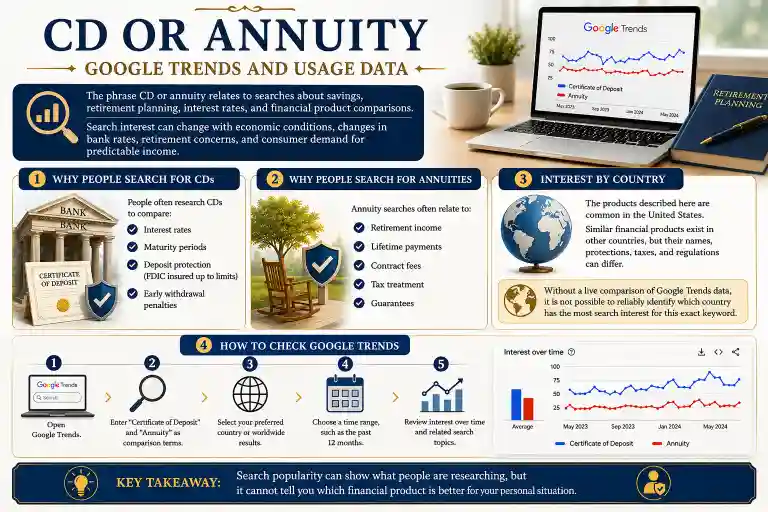
Search interest can change with economic conditions, changes in bank rates, retirement concerns, and consumer demand for predictable income.
1. Why People Search for CDs
People often research CDs to compare interest rates, maturity periods, deposit protection, and early withdrawal penalties.
2. Why People Search for Annuities
Annuity searches often relate to retirement income, lifetime payments, contract fees, tax treatment, and guarantees.
3. Interest by Country
The products described here are common in the United States. Similar financial products exist in other countries, but their names, protections, taxes, and regulations can differ.
Without a live comparison of Google Trends data, it is not possible to reliably identify which country has the most search interest for this exact keyword.
4. How to Check Google Trends
To compare interest in these topics:
- Open Google Trends.
- Enter “Certificate of Deposit” and “Annuity” as comparison terms.
- Select your preferred country or worldwide results.
- Choose a time range, such as the past 12 months.
- Review interest over time and related search topics.
Google Trends reports relative search interest, not exact search counts. Results can also change based on the selected location, time range, and search term.
Key takeaway: Search popularity can show what people are researching, but it cannot tell you which financial product is better for your personal situation.
How to Choose Between a CD and an Annuity
Before making a decision, consider your time frame, need for cash, and financial goals.
Choose a CD If:
- You want a predictable interest rate.
- You expect to need the money on a known date.
- You prefer a straightforward savings product.
- You want eligible deposit protection within applicable limits.
- You can leave the money untouched until maturity.
Consider an Annuity If:
- You are planning for retirement.
- You want the option of regular income payments.
- You understand the contract’s fees and restrictions.
- You have enough accessible savings for emergencies.
- You have compared the insurer’s financial strength and contractual guarantees.
Questions to Ask Before Buying
- What return is guaranteed, and for how long?
- What fees or penalties could apply?
- When can I access my money?
- How are earnings taxed?
- What happens to the money if I die?
- Who protects the funds if the bank or insurer fails?
If your circumstances are complex, consider speaking with a qualified financial adviser who can compare the products against your goals.
Frequently Asked Questions
1. Is a CD better than an annuity?
A CD may be better for short-term savings and predictable interest. An annuity may be more suitable for long-term retirement income. Neither option is best for everyone.
2. Are CDs safer than annuities?
Eligible CDs at FDIC-insured banks receive federal deposit insurance within applicable limits. Annuities are not FDIC-insured, and their guarantees depend on the contract and issuing insurer.
3. Can an annuity pay income for life?
Yes. Certain annuities offer lifetime payments. The amount and conditions depend on the contract, the selected payout option, and other factors.
4. Can you lose money in an annuity?
Yes, depending on the product. Variable annuities involve investment risk, and withdrawals from some contracts can trigger surrender charges. Fixed annuities also carry insurer-related risks.
5. Are CD earnings and annuity earnings taxed the same way?
No. In the United States, CD interest in a standard taxable account is generally taxable as interest income. Annuity taxation depends on the contract, account type, and distribution rules.
Internal Revenue Service
+1
6. Can I withdraw my money early from a CD or annuity?
Usually, some form of early access may be possible, but the costs differ. CDs may impose early withdrawal penalties, while annuities may have surrender charges and contractual restrictions.
7. Can I own both a CD and an annuity?
Yes. Some people keep short-term savings in CDs while using an annuity for retirement income. Maintaining a suitable balance of accessible cash and long-term savings can help meet different financial needs.
Conclusion
Choosing between a CD or annuity starts with understanding what you want your money to do. A CD is generally a straightforward savings product that offers interest over a set period. It may be useful for short-term goals, planned expenses, and money you can leave untouched until maturity.
An annuity is an insurance contract that may help you accumulate money or receive regular income during retirement. Certain contracts offer lifetime payments, but they can also include fees, withdrawal restrictions, and conditions that require careful review.
A CD may be the better fit for predictable savings, while an annuity may be worth considering for long-term retirement income. The right choice depends on your time frame, need for access to cash, tolerance for risk, and financial plans.
Before committing your money, compare interest rates, contractual guarantees, penalties, fees, tax treatment, and the protections available in your country. Remember that an advertised return alone does not tell the whole story.
If you need flexibility, keep enough accessible money for emergencies. For a major financial decision, consider getting advice from a qualified professional who understands your circumstances.
The best financial choice is the one that supports your goals without creating unnecessary costs or limiting access to money you may need.
Read More:
- CSM or UEFI: The Right Choice for Windows Installation
- Suica vs. PASMO: 7 Key Differences Every Traveler Should Know
- Domestic or International: What’s the Difference?