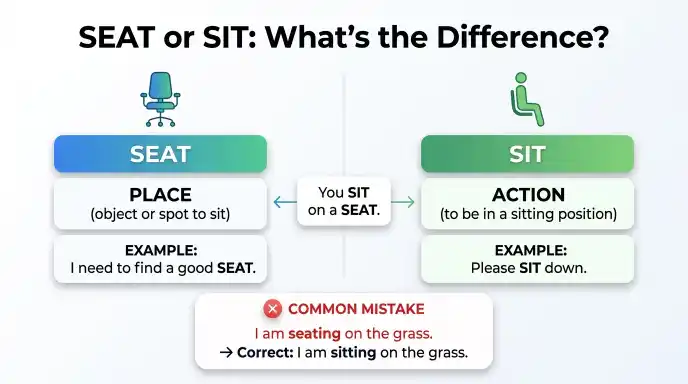
If you are talking about a place where someone sits, use seat. If you mean the action or position of resting your body, use sit.
These two words are closely related, so it is easy to confuse them, especially in phrases such as “take a seat,” “sit down,” and “sit in a seat.”
People often search seat or sit because both words are connected with sitting, but they do different jobs in a sentence.
Seat is most often a noun for a place or object used for sitting, although it can also be a verb. Sit is mainly a verb that describes being or moving into a sitting position.
Cambridge and Oxford both make this basic distinction in their dictionary entries.
In this guide, you will learn the meanings, grammar, origins, regional usage, common mistakes, and everyday examples of seat and sit. By the end, choosing the right word should feel simple.
Quick Answer:
Seat usually means a place or object designed for someone to sit on, such as a chair, car seat, or airplane seat. Sit is a verb meaning to be in or move into a sitting position. For example, “Please take a seat” refers to the place, while “Please sit down” describes the action.
Seat or Sit Quick Difference
The easiest way to remember the difference is:
- Seat = a place or object for sitting.
- Sit = the action or position of sitting.
- Seat can also be a verb meaning to give someone a place to sit.
- Sit is an irregular verb: sit → sat → sat.
Examples
- Please take a seat.
- Please sit down.
- My seat is near the window.
- We sat in the front row.
- The restaurant will seat our group shortly.
A useful memory trick is: You sit on a seat.
What Does Seat or Sit Mean?
What Does “Seat” Mean?
Seat is most commonly a noun. It means a place designed for someone to sit.
Examples include:
- a chair seat
- a car seat
- an airplane seat
- a bicycle seat
- a theater seat
Cambridge defines a seat as a piece of furniture or part of a vehicle designed for someone to sit on. Oxford similarly describes it as a place where you can sit.
Examples:
I saved a seat for you.
Is this seat free?
My seat is next to the window.
Seat can also be a verb:
The waiter seated us near the door.
As a verb, seat means to give someone a place to sit or put someone in a sitting position. It is especially common in formal or service-related language.
What Does “Sit” Mean?
Sit is primarily a verb. It describes being in a position where your body is supported while you are sitting.
For example:
Please sit here.
She sat beside me.
They are sitting at the table.
Cambridge lists sit as a verb meaning to be in a position in which the lower part of the body rests on a seat or another support.
Its main forms are:
| Form | Word |
| Present | sit |
| Third person | sits |
| Past | sat |
| Past participle | sat |
| -ing form | sitting |
So you should write:
I sit here every morning.
Yesterday, I sat here.
Not:
Yesterday, I sitted here. ❌
The Origin of Seat or Sit
Seat and sit are related words with a long history in English. Their connection makes sense because a seat is something associated with the action of sitting.
The modern English verb sit developed from older Germanic forms associated with being in a seated position. Seat developed from a related word referring to a place or position for sitting.
Over time, both words developed several meanings.
Today, seat can refer to:
- a physical place for sitting
- the part of a chair or vehicle used for sitting
- an official position, such as a seat in Parliament
- the act of providing someone with a place to sit
Sit remains mainly a verb describing a person’s position or action.
The important point for modern writers is not the historical spelling but the grammatical difference: seat normally names the place, while sit normally describes the action or position.
British English vs American English
There is no major British-versus-American spelling difference between seat and sit. Both forms are standard in British and American English.
The main difference is pronunciation:
| Word | British English | American English | Example |
| seat | /siːt/ | /siːt/ | Take your seat. |
| sit | /sɪt/ | /sɪt/ | Sit here. |
| sat | /sæt/ | /sæt/ | She sat down. |
| seated | /ˈsiːtɪd/ | /ˈsiːtɪd/ | We were seated inside. |
Both British and American English use phrases such as take a seat, sit down, sit on a chair, and be seated.
The same distinction is also useful in Canadian and Australian English.
A Small Usage Point
You may hear:
Please be seated.
This is correct in both major varieties of English. It is a more formal way to tell someone to sit down.
Which Version Should You Use?
The answer depends on what you are trying to say, not on your country.
United States
Use seat for the place:
My seat is in Row 12.
Use sit for the action:
Please sit down.
United Kingdom
The same basic rule applies:
Is this seat taken?
You can sit here.
Canada
Canadian English also follows the same standard distinction.
I reserved a seat.
We sat near the entrance.
Australia
Use seat when referring to the place and sit when describing the action.
There is an empty seat.
Come and sit with us.
International Writing
For international readers, keep the distinction simple:
seat = place
sit = action
This rule works well in educational, business, and general English writing.
Academic Writing
Academic writing may use both words, depending on meaning:
Participants were seated in separate rooms.
Students sat quietly during the test.
Business Writing
Both are common:
Please take a seat in the waiting area.
The guests were seated before the presentation began.
Common Mistakes
Mistake 1: Using “seat” when you mean “sit”
Incorrect:
Please seat here.
Correct:
Please sit here.
Why?
Here, you are asking someone to perform the action of sitting. Therefore, sit is the correct verb.
Memory tip: If you are telling someone what to do with their body, sit is usually the word you need.
Mistake 2: Using “sit” for the object
Incorrect:
Is this sit available?
Correct:
Is this seat available?
Why?
You are asking about a place where someone can sit. That place is a seat.
Mistake 3: Saying “sitted”
Incorrect:
I sitted on the chair yesterday.
Correct:
I sat on the chair yesterday.
Why?
Sit is an irregular verb. Its past tense is sat, not “sitted.”
Mistake 4: Confusing “take a seat” with “take a sit”
Correct:
Please take a seat.
Not:
Please take a sit. ❌
The phrase take a seat is a standard expression meaning “sit down.”
Mistake 5: Confusing “seat” and “sit” in restaurants
Correct:
The host seated us near the window.
Also correct:
We sat near the window.
The first sentence focuses on the host placing or giving the guests a place to sit. The second focuses on the guests’ action or position.
Everyday Examples
Seeing the words in real situations makes the difference easier to remember.
In Emails
Please take a seat in the reception area when you arrive.
You may sit in the waiting room until your name is called.
In Business Writing
The conference room has enough seats for 50 people.
Please remain seated until the meeting begins.
In News Headlines
New seating plan adds more seats to the hall.
Passengers told to sit until the aircraft stops.
In Blogs
Choose a comfortable seat before starting your work.
Try to sit with your back straight.
On Social Media
Found the perfect seat by the window!
Just sit back and enjoy the view.
In Academic Writing
Students were asked to sit quietly during the examination.
Each student was assigned a seat.
In Daily Conversation
“Where should I sit?”
“You can take that seat.”
“Is anyone sitting in this seat?”
“No, it is free.”
Google Trends & Modern Usage
Searches for seat or sit are usually driven by a grammar question rather than a regional spelling issue. Learners often see the two words together because both relate to the same basic idea of being in a sitting position.
The confusion is especially common in sentences such as:
- “Please seat here.”
- “Please sit here.”
- “Take a seat.”
- “Sit down.”
- “I sat in my seat.”
- “We were seated at the table.”
Modern dictionary usage confirms that seat and sit remain distinct in meaning and grammar. Cambridge identifies seat as both a noun and a verb, while sit is primarily used as a verb.
There is also no need to choose one word based on British or American spelling. Both varieties use seat and sit.
Because exact Google Trends numbers can change over time and depend on the selected country, date range, and search category, it is better not to claim a specific regional popularity figure without checking the current Google Trends dataset.
Quick Comparison Table
| Version | Meaning | Correct? | Region | Example |
| seat | A place for sitting | ✅ | All major varieties | Take a seat. |
| sit | To be in a sitting position | ✅ | All major varieties | Sit here. |
| seated | Given or placed in a sitting position | ✅ | All major varieties | We were seated inside. |
| sat | Past tense of sit | ✅ | All major varieties | She sat beside me. |
| sitted | Incorrect past form of sit | ❌ | None | ❌ I sitted there. |
Another Useful Comparison
| If you mean… | Use | Example |
| A place to sit | seat | This seat is free. |
| The action of sitting | sit | Please sit down. |
| Past action | sat | We sat outside. |
| Giving someone a place to sit | seat | They seated the guests. |
| Someone already in a sitting position | sitting | She is sitting there. |
| Formal instruction to sit | be seated | Please be seated. |
Key Takeaways
- Seat usually means a place or object for sitting.
- Sit is mainly a verb describing the action or position.
- You sit on a seat.
- The past tense of sit is sat, not “sitted.”
- Seated can mean placed or positioned in a seat.
- Take a seat means sit down.
- British and American English use the same basic forms.
- When in doubt, remember: seat = place, sit = action.
FAQs About Seat or Sit
Is it “sit” or “seat” in a chair?
Use sit when describing the action. For example, “Please sit in the chair.” Use seat when referring to the chair or place itself: “The chair has a comfortable seat.” You can also say “Please take a seat,” which means “Please sit down.”
Is it correct to say “Please seat down”?
No. The correct phrase is “Please sit down.” The verb sit describes moving into or being in a sitting position. Seat has a different use and normally refers to a place for sitting or, as a verb, to giving someone a place to sit.
What is the difference between “take a seat” and “sit down”?
Both usually tell someone to sit, but they have slightly different structures. Take a seat uses seat as a noun and sounds polite. Sit down uses sit as a verb and is a direct instruction. Both are natural in everyday English.
Is “I sat on the seat” correct?
Yes. “I sat on the seat” is grammatically correct. Sat is the past tense of sit, while seat is the place or object on which you sat. For example: “I sat on the front seat of the car.”
What is the past tense of “sit”?
The past tense of sit is sat. The past participle is also sat. For example: “I sit here every day,” “I sat here yesterday,” and “I have sat here many times.” “Sitted” is not the standard past form.
Can “seat” be used as a verb?
Yes. Seat can be a verb meaning to give someone a place to sit or put someone into a sitting position. For example, “The host seated the guests near the window.” The verb is common in restaurants, theaters, formal settings, and descriptions of arrangements.
Is “Please be seated” the same as “Please sit down”?
Yes. “Please be seated” is a formal way to tell people to sit down. It is often used at ceremonies, meetings, restaurants, and other formal settings. Cambridge and Oxford both list be seated as an expression connected with sitting down.
Should I say “sit in the seat” or “sit on the seat”?
Both can be correct, depending on the type of seat and context. “Sit in the seat” is common for car, airplane, or other enclosed seats. “Sit on the seat” can describe sitting on a chair or seat surface. The natural preposition depends on the object.
Is “seat” a noun or a verb?
Seat can be both a noun and a verb. As a noun, it means a place for sitting. As a verb, it means to give someone a place to sit or place someone in a sitting position.
How can I remember the difference between seat and sit?
Use this simple rule: You sit on a seat. Think of seat as the place and sit as the action. For example, “The seat is empty” describes the place, while “Please sit here” describes what the person should do.
Conclusion
The difference between seat or sit is simple once you focus on their roles in a sentence. Seat usually refers to a place or object where someone can sit, such as a chair, car seat, airplane seat, or theater seat. Sit is mainly a verb that describes being or moving into a sitting position.
The words are closely related, which explains why English learners often confuse them. Still, they are not interchangeable. You sit on a seat, you take a seat, and you sit down. When you need the past tense of sit, use sat, not “sitted.” Both British and American English follow these basic rules.
For everyday writing, the easiest memory tip is:
Seat = the place. Sit = the action.
Read More:
- Manners or Manors: Commonly Confused Words Explained
- Lessee or Lessor: What’s the Difference? (2026 Guide)
- Could or Would: What’s the Difference?





3 thoughts on “Seat or Sit: Which One Should You Use in 2026?”