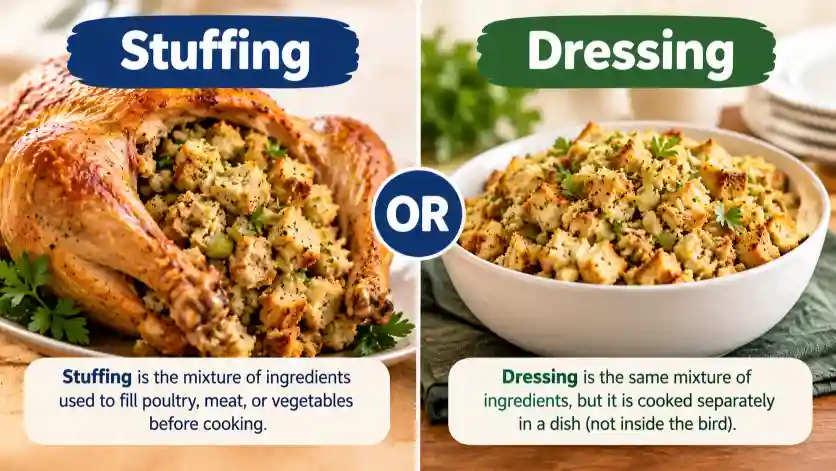
Stuffing and dressing are both names for a seasoned bread based side dish commonly served with turkey, chicken, and other meals. The main difference is how each dish is cooked. Cooks traditionally prepare stuffing inside poultry, while they bake dressing separately in a dish.
However, people sometimes use both terms interchangeably, depending on their region and family traditions.
In the United States, people in some Northern states often say stuffing, while people in parts of the South often say dressing.Both dishes can contain bread, herbs, vegetables, broth, and other ingredients, although recipes vary considerably.
These words can be confusing because they sometimes describe the same dish, even when the cooking methods differ. Understanding their meanings, regional usage, and traditional preparation methods will help you use them correctly in recipes, food articles, holiday menus, and everyday conversations.
In this guide, you will discover the definitions of stuffing and dressing, learn about their origins, compare British and American usage, explore common mistakes, and review practical examples. You will also find a simple memory trick to help you remember the difference.
Stuffing or Dressing : Quick Answer
Stuffing traditionally refers to a seasoned mixture cooked inside poultry, while dressing traditionally refers to a similar mixture cooked separately in a pan.
- Stuffing: The cook placed the bread mixture inside the turkey before roasting it.
- Dressing: The cook baked the seasoned bread mixture in a casserole dish.
In everyday American English, the terms often overlap. Some families call the dish stuffing even when it is baked separately, while others prefer dressing.
Easy rule: Stuffing goes inside the bird; dressing is baked separately. Remember that regional usage can differ.
Definition and Meaning of Stuffing and Dressing
What Does Stuffing Mean?
Stuffing is a mixture of ingredients used to fill meat, poultry, vegetables, or other foods before cooking.In holiday meals, it commonly refers to a bread based mixture seasoned with herbs, vegetables, broth, and sometimes sausage, fruit, or nuts.
Traditional stuffing is placed inside a turkey or chicken before roasting. However, people also use the term for similar mixtures that are cooked separately.
Examples:
- We prepared traditional stuffing for Thanksgiving dinner.
- The turkey was filled with bread stuffing and fresh herbs.
- My grandmother adds celery and onions to her stuffing.
- The stuffing absorbed the flavors of the herbs and broth.
Stuffing can vary by region, family recipe, and personal preference.
What Does Dressing Mean?
Dressing can refer to a seasoned bread based side dish, particularly in American cooking. In the traditional stuffing versus dressing distinction, dressing is prepared and baked separately from the poultry.
It may contain bread cubes, cornbread, onions, celery, broth, herbs, eggs, and other ingredients. Recipes differ according to local traditions.
Examples:
- We served cornbread dressing with the roasted turkey.
- The dressing was baked until the top became golden.
- My family prepares sausage dressing every holiday season.
- She added sage and celery to the dressing mixture.
The word dressing has other meanings in cooking, including salad dressing, so the context determines which meaning is intended.
Stuffing vs. Dressing: Key Differences
| Feature | Stuffing | Dressing |
| Traditional preparation | Cooked inside poultry or another food | Cooked separately |
| Common ingredients | Bread, herbs, vegetables, broth | Bread or cornbread, herbs, vegetables, broth |
| Typical occasion | Holiday meals and roast dinners | Holiday meals and roast dinners |
| Regional use in the US | Common in many Northern areas | Common in many Southern areas |
| Meaning in everyday speech | May also describe a separately baked dish | May also describe a stuffing like dish |
| Example | Turkey stuffing | Cornbread dressing |
Origin and History of Stuffing and Dressing
Where Does the Word Stuffing Come From?
The word stuffing comes from the verb stuff, meaning to fill something with material or ingredients. The term describes the practice of placing a mixture inside meat, poultry, or other foods before cooking.
The practice of filling animals with seasoned ingredients dates back centuries. Cooks used bread, herbs, vegetables, and other available ingredients to add flavor and make meals more substantial.
Over time, stuffing became associated with roast poultry and special meals, especially Thanksgiving and Christmas dinners in the United States.
Where Does the Word Dressing Come From?
The word dressing comes from dress, which has long meant to prepare or arrange something. In cooking, dressing can refer to a mixture used to prepare or accompany a dish.
In American food traditions, dressing developed into a common name for a baked bread based side dish, particularly in Southern cuisine. Cornbread dressing became especially associated with regional home cooking and holiday meals.
Today, both words remain common, and their meanings can overlap depending on the cook, region, and family tradition.
British English vs. American English
Stuffing and dressing are both used in English, but their meanings and usage vary by region and cooking tradition.
| Context | British English | American English |
| Mixture placed inside poultry | Stuffing is common | Stuffing is common |
| Bread mixture baked separately | Often called stuffing | Often called dressing or stuffing |
| Southern style cornbread dish | Less common as a regional tradition | Commonly called cornbread dressing |
| Holiday meal | Stuffing is widely used | Both stuffing and dressing are used |
| Salad accompaniment | Dressing commonly means a sauce | Dressing commonly means a sauce |
In British English, stuffing is the more common term for a seasoned mixture served with roast poultry, whether cooked inside the bird or separately.
In American English, the choice often reflects regional vocabulary and family custom. Many people use stuffing and dressing interchangeably, while others reserve each word for a particular cooking method.
Which Word Should You Use: Stuffing or Dressing?
The best choice depends on the dish, the preparation method, and the audience you are writing for.
When to Use Stuffing
Use stuffing when referring to a mixture placed inside poultry, meat, or vegetables. Also widely understood as the name of a seasoned side dish served with a holiday meal.
Examples:
- The chef prepared herb stuffing for the turkey.
- We made sausage stuffing for Christmas dinner.
- The recipe calls for bread cubes, onions, celery, and broth.
- She served the stuffing alongside roasted chicken.
If you are writing for a British audience, stuffing is usually the most familiar term for the traditional side dish.
When to Use Dressing
Use dressing for a bread-based dish baked separately from the poultry, especially in American cooking traditions.
Examples:
- The cornbread dressing baked in a casserole dish.
- We served Southern style dressing with the turkey.
- The recipe includes sage, celery, onions, and chicken broth.
- She prepared the dressing a day before the holiday meal.
The word dressing is also correct for sauces served with salads, so make sure the surrounding sentence makes the intended meaning clear.
Can You Use Stuffing and Dressing Interchangeably?
Yes, in many everyday situations, especially in the United States. Some cooks call a dish stuffing regardless of where it is cooked, while others use dressing for a separately baked version.
For clear writing, explain the cooking method if it matters to the recipe. For example, “baked bread stuffing” or “Southern cornbread dressing” tells readers more about the dish than the name alone.
Common Mistakes With Stuffing and Dressing
Although these words can overlap, understanding their traditional uses helps avoid confusion.
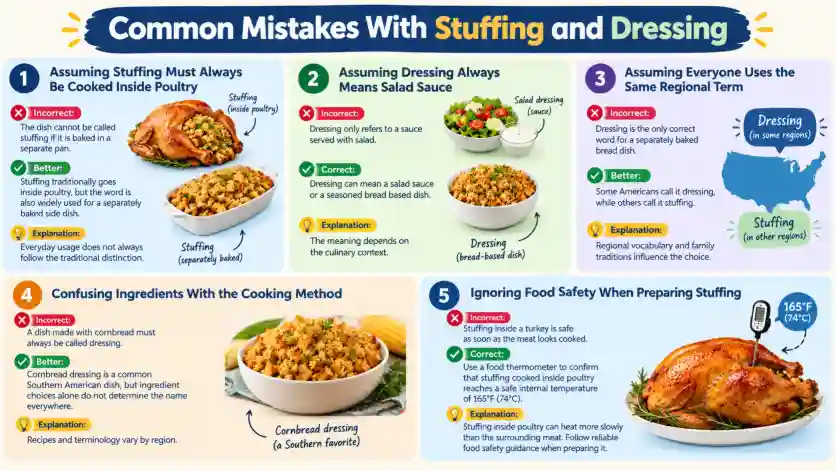
1. Assuming Stuffing Must Always Be Cooked Inside Poultry
Incorrect: The dish cannot be called stuffing if it is baked in a separate pan.
Better: Stuffing traditionally goes inside poultry, but the word is also widely used for a separately baked side dish.
Explanation: Everyday usage does not always follow the traditional distinction.
2. Assuming Dressing Always Means Salad Sauce
Incorrect: Dressing only refers to a sauce served with salad.
Correct: Dressing can mean a salad sauce or a seasoned bread based side dish.
Explanation: The meaning depends on the culinary context.
3. Assuming Everyone Uses the Same Regional Term
Incorrect: Dressing is the only correct word for a separately baked bread dish.
Better: Some Americans call it dressing, while others call it stuffing.
Explanation: Regional vocabulary and family traditions influence the choice.
4. Confusing Ingredients With the Cooking Method
Incorrect: A dish made with cornbread must always be called dressing.
Better: Cornbread dressing is a common Southern American dish, but ingredient choices alone do not determine the name everywhere.
Explanation: Recipes and terminology vary by region.
5. Ignoring Food Safety When Preparing Stuffing
Incorrect: Stuffing inside a turkey is safe as soon as the meat looks cooked.
Correct: Use a food thermometer to confirm that stuffing cooked inside poultry reaches a safe internal temperature of 165°F (74°C).
Explanation: Stuffing inside poultry can heat more slowly than the surrounding meat. Follow reliable food safety guidance when preparing it.
Everyday Examples of Stuffing and Dressing
These examples show how the words appear in common food related situations.
1. Thanksgiving Dinner
Stuffing: “We served traditional bread stuffing with the roasted turkey.”
The word names a seasoned bread based side dish.
Dressing: “We prepared Southern cornbread dressing for Thanksgiving.”
The word identifies a regional style of baked side dish.
2. Cooking Instructions
Stuffing: “Fill the chicken loosely with the prepared stuffing immediately before roasting.”
Here, the mixture is placed inside the poultry.
Dressing: “Transfer the mixture to a baking dish and bake until the top is golden.”
The dish is prepared separately.
3. Family Recipes
Stuffing: “My father adds apples and sausage to his stuffing.”
The sentence describes a family’s preferred recipe.
Dressing: “My grandmother uses cornbread to make her dressing.”
The sentence refers to a traditional preparation style.
4. Restaurant Menus
Stuffing: “Roasted turkey served with herb stuffing and vegetables.”
The word describes a side dish accompanying the main course.
Dressing: “Roast turkey with homemade cornbread dressing.”
The term identifies the dish and suggests a particular culinary tradition.
5. Food Blogs
Stuffing: “This easy stuffing recipe combines bread cubes, celery, onions, and herbs.”
The word appears in a recipe title and description.
Dressing: “Southern dressing is a popular side dish at many family gatherings.”
The word describes a regional food tradition.
6. Salad Recipes
Dressing: “Whisk olive oil, lemon juice, mustard, and herbs to make a simple salad dressing.”
Here, dressing refers to a sauce, not a bread based side dish.
Stuffing or Dressing: Usage Trends and Modern Writing
Stuffing and dressing remain widely recognized terms, particularly in discussions of Thanksgiving, Christmas, roast poultry, and traditional family recipes.
In the United States, stuffing is common across many regions, while dressing is especially associated with Southern cooking and dishes such as cornbread dressing. However, these patterns are not absolute, and many households use the words interchangeably.
In British English, stuffing is generally the more familiar term for the mixture served with roast poultry. The word dressing is often associated with sauces, particularly salad dressings, although it can also describe other prepared dishes.
For modern writing, the clearest approach is to describe the dish and its preparation. Terms such as “bread stuffing baked separately,” “turkey stuffing,” and “Southern cornbread dressing” give readers useful information without relying on regional assumptions.
There is no single naming rule followed by every cook. Regional traditions, ingredients, and family preferences all influence the terminology.
Stuffing vs. Dressing: Comparison Table
| Situation | Common term | Example |
| Seasoned mixture cooked inside a turkey | Stuffing | The turkey was filled with herb stuffing. |
| Bread mixture baked in a separate dish | Dressing or stuffing | We baked the dressing in a casserole dish. |
| Southern style cornbread side dish | Dressing | Cornbread dressing was served with dinner. |
| British roast dinner | Stuffing | The chicken was served with sage and onion stuffing. |
| Sauce served with salad | Dressing | She made a lemon and olive oil dressing. |
| Family recipe with regional naming | Either may be used | Our family calls the holiday side dish stuffing. |
Easy Trick to Remember Stuffing or Dressing
Use this simple memory trick:
Stuffing = Stuffed inside.
Think of a turkey or chicken filled with a seasoned mixture before cooking.
Dressing = Dish baked separately.
Think of a casserole dish containing bread, herbs, vegetables, and broth.
Remember that this is a traditional guideline, not a strict rule. Many people call a separately baked dish stuffing, too.
For example:
- “The turkey was filled with stuffing.” — Traditional use of stuffing.
- “The cornbread dressing was baked in a pan.” — Traditional use of dressing.
If you are writing a recipe, mentioning how the dish is prepared can remove any confusion.
Frequently Asked Questions (FAQs)
1. What is the difference between stuffing and dressing?
Traditionally, stuffing is cooked inside poultry, while dressing is cooked separately in a baking dish. In everyday American English, the words are often used interchangeably.
2. Is stuffing or dressing the correct word?
Both are correct. The best choice depends on the preparation method, regional tradition, and intended meaning.
3. Is dressing the same as stuffing?
They can refer to very similar bread based side dishes. The traditional distinction is based on cooking method, but many families use the names interchangeably.
4. Why do Southerners call it dressing?
In parts of the Southern United States, dressing is a traditional name for a separately baked side dish, particularly one made with cornbread. The term is part of regional food culture.
5. Do British people say stuffing or dressing?
Stuffing is generally the more familiar term in British English for the seasoned mixture served with roast poultry. Dressing is also used for sauces, especially salad dressings.
6. Can stuffing be cooked outside the turkey?
Yes. Stuffing can be baked separately in a casserole dish. Many people still call the finished dish stuffing, even when it is not cooked inside poultry.
7. What is cornbread dressing?
Cornbread dressing is a seasoned baked side dish commonly associated with Southern American cooking. It often contains crumbled cornbread, vegetables, herbs, broth, and sometimes eggs or meat.
8. Is stuffing safe to cook inside a turkey?
It can be prepared safely when handled and cooked correctly. The center of stuffing cooked inside poultry should reach 165°F (74°C), measured with a food thermometer.
9. What ingredients are commonly used in stuffing and dressing?
Common ingredients include bread or cornbread, onions, celery, broth, herbs, and seasonings. Some recipes also include sausage, apples, dried fruit, nuts, or eggs.
10. How can I remember the difference between stuffing and dressing?
Remember the traditional rule: stuffing goes inside the bird, while dressing is baked separately. Keep in mind that regional usage often overlaps.
Conclusion
Traditionally, the difference between stuffing and dressing depends on how the dish is cooked. Stuffing is cooked inside poultry or another food, while dressing is baked separately in a dish. However, the terms often overlap, especially in American English, where regional traditions influence which word people prefer.
Stuffing is generally the more familiar term in British English, while dressing is especially associated with Southern American dishes such as cornbread dressing. Both can describe delicious seasoned side dishes served with holiday meals.
Remember the simple rule: stuffing goes inside, and dressing is traditionally baked separately. When writing recipes or food articles, describe the ingredients and cooking method to make your meaning clear.
Read More:
- Bit or Bite: The Simple Trick to Remember the Difference
- Halve or Half: Stop Making This Common Grammar Mistake
- Knick or Nick: One Is Correct, but What About the Other?








1 thought on “Stuffing or Dressing? The Answer May Surprise You”