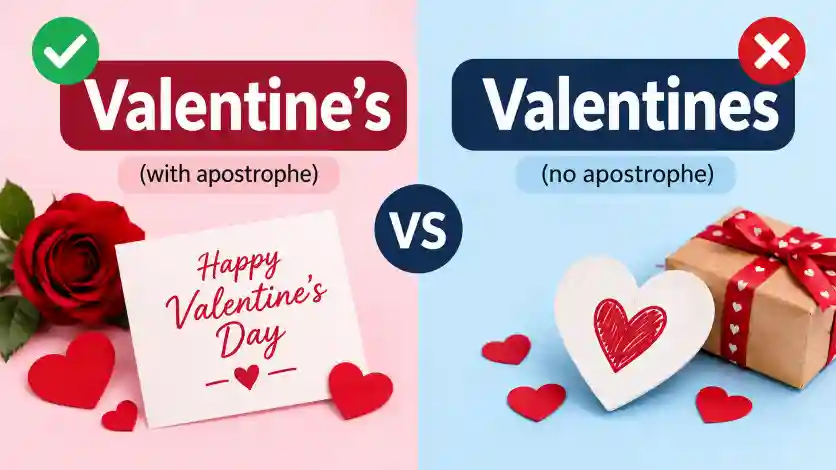
Valentine’s Day is the standard spelling for the holiday celebrated on February 14, while valentines is the plural form of valentine, referring to cards, messages, or gifts exchanged to express affection. The correct choice depends on what you want to say.
People often confuse Valentine’s and Valentines because the words look almost identical. The apostrophe in Valentine’s indicates possession or association, as in Valentine’s Day. Without the apostrophe, valentines usually refers to multiple romantic cards, greetings, or people who are someone’s valentine.
Both forms can be correct, but they are not interchangeable in every sentence. Understanding the difference helps you write holiday greetings, social media captions, invitations, and personal messages correctly.
Valentine’s or Valentines : Quick Answer
Valentine’s is used in the holiday name Valentine’s Day, while valentines is the plural of valentine.
| Word | Correct Usage | Example |
| Valentine’s | Possessive form; used in the holiday name | We are celebrating Valentine’s Day. |
| Valentines | Plural noun referring to cards, greetings, or romantic partners | The children exchanged valentines. |
| Valentine | Singular noun for a romantic partner or greeting card | She gave her valentine a gift. |
Quick tip: Write Valentine’s Day when naming the holiday, but write valentines when talking about multiple cards or greetings.
Definition and Meaning of Valentine’s and Valentines
What Does Valentine’s Mean?
Valentine’s is the possessive form of Valentine. It is most familiar in the name Valentine’s Day, the holiday associated with love, romance, friendship, and affection.
The apostrophe followed by s indicates a possessive or traditional association with Saint Valentine and the holiday named after him.
Examples:
- “We exchanged gifts on Valentine’s Day.”
- “She planned a special Valentine’s Day dinner.”
- “The shop is offering discounts for Valentine’s Day.”
In the holiday name, the apostrophe is essential. Writing Valentines Day is a common spelling error in standard edited English.
What Does Valentines Mean?
Valentines is the plural form of valentine. A valentine can be a greeting card, a romantic message, or a person to whom someone expresses affection.
Examples:
- “The students made handmade valentines.”
- “He bought several valentines for his friends.”
- “The shop displayed colorful valentines in February.”
Here, the word refers to more than one card or greeting, so no apostrophe is needed.
What Does Valentine Mean?
Valentine is the singular form. It can refer to a romantic partner, a person receiving an expression of affection, or a card sent for Valentine’s Day.
Examples:
- “Will you be my valentine?”
- “He gave his valentine a bouquet of flowers.”
- “She wrote a sweet valentine for her partner.”
Origin and History of Valentine’s and Valentines
The words Valentine’s and valentines are connected to the name Valentine, traditionally associated with Saint Valentine. The modern holiday developed through historical religious traditions and later customs involving romantic love and expressions of affection.
Over time, February 14 became associated with exchanging flowers, chocolates, handwritten notes, and greeting cards. These cards came to be known as valentines.
The distinction between the spellings follows ordinary English grammar:
- Valentine’s Day uses the possessive form in the established name of the holiday.
- Valentines is a plural noun referring to multiple cards, messages, or romantic recipients.
The apostrophe is not simply decorative. It changes the grammatical form of the word.
British English vs. American English Spelling
Both British and American English generally use Valentine’s Day for the holiday and valentines for the plural noun. The spelling distinction is not a major regional difference.
| Feature | American English | British English |
| Holiday name | Valentine’s Day | Valentine’s Day |
| Multiple greeting cards | Valentines | Valentines |
| One romantic partner | Valentine | Valentine |
| Apostrophe in holiday name | Required | Required |
| Spelling variation | No major difference | No major difference |
Use Valentine’s Day in both American and British English. Use valentines when referring to multiple cards or greetings.
Which Spelling Should You Use?
Use Valentine’s for Valentine’s Day
Choose Valentine’s when writing the name of the holiday.
Examples:
- “Happy Valentine’s Day!”
- “We are planning a Valentine’s Day party.”
- “The restaurant has a special Valentine’s Day menu.”
The apostrophe is part of the conventional holiday name.
Use Valentines for Multiple Cards or Greetings
Choose valentines when referring to more than one valentine card, message, or token of affection.
Examples:
- “The children exchanged valentines at school.”
- “She made homemade valentines for her classmates.”
- “We sent valentines to friends and family.”
Use Valentine for One Person or Card
Use valentine when referring to a single romantic partner, recipient, or greeting card.
Examples:
- “He asked her to be his valentine.”
- “I wrote a valentine for my partner.”
- “She gave her valentine a box of chocolates.”
Common Mistakes With Valentine’s and Valentines
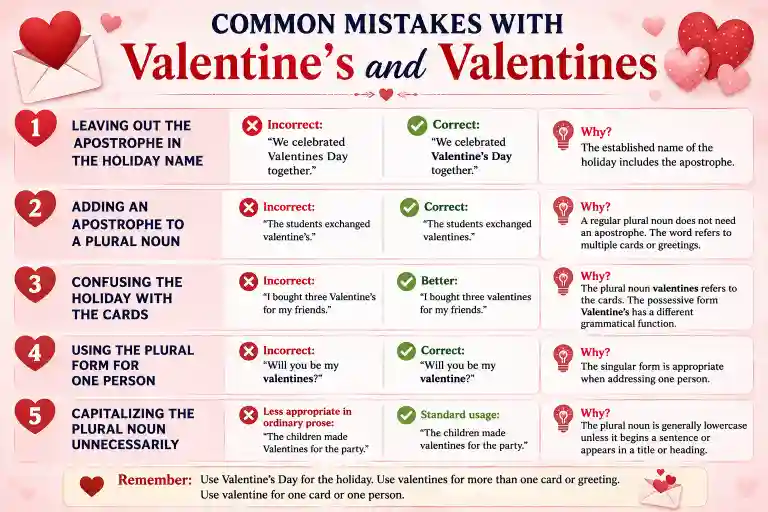
1. Leaving Out the Apostrophe in the Holiday Name
Incorrect: “We celebrated Valentines Day together.”
Correct: “We celebrated Valentine’s Day together.”
Why? The established name of the holiday includes the apostrophe.
2. Adding an Apostrophe to a Plural Noun
Incorrect: “The students exchanged valentine’s.”
Correct: “The students exchanged valentines.”
Why? A regular plural noun does not need an apostrophe. The word refers to multiple cards or greetings.
3. Confusing the Holiday With the Cards
Incorrect: “I bought three Valentine’s for my friends.”
Better: “I bought three valentines for my friends.”
Why? The plural noun valentines refers to the cards. The possessive form Valentine’s has a different grammatical function.
4. Using the Plural Form for One Person
Incorrect: “Will you be my valentines?”
Correct: “Will you be my valentine?”
Why? The singular form is appropriate when addressing one person.
5. Capitalizing the Plural Noun Unnecessarily
Less appropriate in ordinary prose: “The children made Valentines for the party.”
Standard usage: “The children made valentines for the party.”
Why? The plural noun is generally lowercase unless it begins a sentence or appears in a title or heading.
Valentine’s or Valentines in Everyday Examples
1. In Everyday Conversations
- “Are you doing anything special for Valentine’s Day?”
- “I bought some valentines for my classmates.”
- “Will you be my valentine?”
2. In School and Study
- “Our class made valentines during the art lesson.”
- “The teacher organized a Valentine’s Day activity.”
- “Each student wrote a valentine for a friend.”
3. In Emails and Invitations
- “You are invited to our Valentine’s Day celebration.”
- “Please bring handmade valentines for the card exchange.”
- “Join us for a special Valentine’s Day dinner.”
4. In Social Media Posts
- “Wishing everyone a happy Valentine’s Day!”
- “Making homemade valentines for the people I love.”
- “Looking for the perfect Valentine’s Day gift?”
5. In Shopping and Marketing
- “Explore our Valentine’s Day gift collection.”
- “These handmade valentines are perfect for friends.”
- “Order your Valentine’s Day flowers early.”
6. Incorrect and Correct Examples
| Incorrect Sentence | Correct Sentence |
| Happy Valentines Day! | Happy Valentine’s Day! |
| We exchanged valentine’s at school. | We exchanged valentines at school. |
| Will you be my valentines? | Will you be my valentine? |
| She made several Valentine’s for her friends. | She made several valentines for her friends. |
Usage Trends and Modern Writing
Valentine’s Day is widely used in holiday promotions, greeting cards, invitations, news articles, and social media posts. The possessive spelling is standard when naming the holiday.
The plural noun valentines appears when people discuss greeting cards, handmade messages, or small gifts exchanged on or around February 14.
In digital communication, people sometimes omit apostrophes in phrases such as Valentines Day. This may be understandable in casual typing, but Valentine’s Day is the standard form for polished writing.
When creating website content, product descriptions, school notices, or holiday invitations, use the form that matches the meaning.
Valentine’s vs. Valentines: Comparison Table
| Feature | Valentine’s | Valentines |
| Contains an apostrophe | Yes | No |
| Common use | Holiday name | Plural noun |
| Example | Valentine’s Day | Handmade valentines |
| Refers to multiple cards | No, not by itself | Yes |
| Used in the standard holiday name | Yes | No |
| Correct in the right context | Yes | Yes |
Easy Trick to Remember Valentine’s and Valentines
Use this simple memory trick:
- Valentine’s Day = holiday.
- Valentines = multiple cards or greetings.
- Valentine = one person or card.
Remember that an apostrophe is not used to make an ordinary noun plural.
For example, write Valentine’s Day when referring to the holiday, but write “I bought three valentines” when referring to three cards.
Frequently Asked Questions
1. Is it Valentine’s or Valentines?
Both forms can be correct. Valentine’s is used in the holiday name Valentine’s Day, while valentines is the plural of valentine.
2. Is Valentine’s Day written with an apostrophe?
Yes. Valentine’s Day is the standard spelling of the holiday, and the apostrophe should be included.
3. Is Valentines Day incorrect?
In standard edited English, Valentines Day is missing the apostrophe. Write Valentine’s Day instead.
4. What does valentines mean?
Valentines is the plural of valentine. It can refer to multiple greeting cards, messages, or expressions of affection.
5. Should Valentines be capitalized?
The plural noun valentines is generally lowercase in ordinary sentences. The holiday name Valentine’s Day is capitalized.
6. Is Valentine’s possessive?
Grammatically, Valentine’s is a possessive form. In the established holiday name Valentine’s Day, it is traditionally written with an apostrophe and s.
7. What is the plural of valentine?
The plural is valentines, without an apostrophe. For example: “The students exchanged valentines.”
8. Is the spelling different in British and American English?
No significant spelling difference exists. Both varieties use Valentine’s Day for the holiday and valentines for the plural noun.
Conclusion
The difference between Valentine’s and Valentines comes down to grammar and meaning. Valentine’s Day is the standard name of the February 14 holiday, while valentines refers to multiple cards, greetings, or expressions of affection.
Use Valentine’s Day when naming the holiday, valentines when referring to several cards, and valentine when talking about one person or card. Remembering these three forms will help you avoid common spelling mistakes in messages, invitation, and everyday writing.
Read More:
- Siked or Psyched: One Is Standard English, but Which One?
- Gnarly or Narly: The Simple Trick to Remember the Correct Word
- Ither or Either? The Simple Trick to Remember the Spelling






1 thought on “Valentine’s vs. Valentines: Which One Should You Use in 2026?”