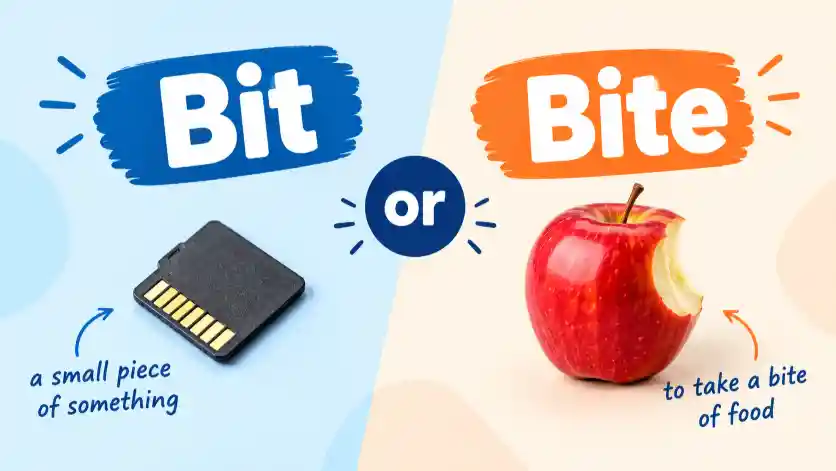
Bit and bite are both correct English words, but they have different meanings and uses. A bit can mean a small amount of something, a small piece, or a unit of digital information. A bite usually means the act of cutting or gripping something with the teeth, or a piece of food taken into the mouth.
These words look and sound similar, so people sometimes confuse them in everyday writing. However, the final e in bite changes the word’s meaning. For example, “I ate a bit of cake” means you ate a small amount of cake, while “I took a bite of cake” means you ate a mouthful or piece of it.
Understanding the difference between these helps you choose the right word in conversations, school assignments, emails, and other writing. Both words are used in British and American English, but the correct choice depends on the meaning you want to express.
In this guide, you will learn the definitions, origins, spelling differences, common mistakes, and everyday examples are both.
Quick Answer: Bit or Bite?
- Bit: A small amount or piece of something; also a unit of digital information or a small tool component.
- Bite: The act of using the teeth to cut or grip something, or a piece of food taken with the teeth.
- Example of bit: “I need a bit more time.”
- Example of bite: “She took a bite of the apple.”
Easy rule: Use bit for a small amount and for an action involving teeth or a mouthful of food.
Definition and Meaning of Bit
The word bit has several meanings. Its exact meaning depends on the sentence.
1. Bit as a Small Amount
Bit often means a small amount of something. It is common in everyday conversation.
Examples:
- “I am a bit tired today.”
- “Please add a bit of salt to the soup.”
- “We need a bit more time to finish the project.”
- “The weather is a bit colder this morning.”
In these sentences, bit means a small degree or amount.
2. Bit as a Small Piece
The word can also refer to a small piece or part of something.
Examples:
- “There is a bit of glass on the floor.”
- “He broke a bit off the chocolate bar.”
- “I found a bit of paper under the desk.”
3. Bit in Computing
In computing, a bit is the smallest basic unit of digital information. It can represent one of two values, commonly written as 0 or 1.
Examples:
- “A bit can represent a binary value.”
- “The system processes data one bit at a time.”
- “Eight bits make one byte.”
This technical meaning is different from the everyday meaning of a small amount.
4. Bit as Part of an Expression
Bit appears in many common expressions.
Examples:
- “Wait a bit.” : Wait for a short time.
- “Every little bit helps.” : Every small contribution is useful.
- “A bit of luck” : A small amount of good fortune.
Definition and Meaning of Bite
The word bite usually relates to using the teeth or taking food into the mouth. It can function as both a verb and a noun.
1. Bite as a Verb
As a verb, bite means to cut, grip, or hold something with the teeth.
Examples:
- “The dog may bite if it feels threatened.”
- “She bit into a crisp apple.”
- “Do not bite your nails.”
- “The baby tried to bite the toy.”
The past tense of bite is bit, which is an important reason these words can be confusing.
For example:
- Present: “The dog may bite.”
- Past: “The dog bit my shoe.”
2. Bite as a Noun
As a noun, bite can mean an act of biting or a portion of food taken into the mouth.
Examples:
- “He took a bite of the sandwich.”
- “That mosquito bite is itchy.”
- “Would you like a bite of my pizza?”
- “She took one bite and decided she liked the cake.”
3. Bite in Figurative Expressions
Bite also appears in expressions that do not always involve literal teeth.
Examples:
- “His words have a bite.” : His words are sharp or forceful.
- “The cold wind has a bite.” : The wind feels sharply cold.
- “That decision may come back to bite him.” : The decision may cause problems later.
Origin of the Words Bit and Bite
The words bit and bite have related spelling histories, but their modern uses differ.
Origin of Bit
Bit has been used in English for a small piece or amount for centuries. It is also the past-tense form of the verb bite. In computing, the term bit was formed from binary digit and became a standard term for digital information.
Origin of Bite
Bite comes from Old English bītan, meaning to bite or cut with the teeth. The word has retained this basic meaning over time and has developed additional uses in expressions involving food, animals, and figurative language.
Although the words share a close spelling and sound relationship, their grammatical roles and meanings determine which one you should use.
Bit vs Bite in British and American English
The meanings and spellings of bit and bite are the same in British and American English.
| Feature | British English | American English |
| Small amount | Bit | Bit |
| Action involving teeth | Bite | Bite |
| Past tense of bite | Bit | Bit |
| Piece of food taken with the teeth | Bite | Bite |
| Digital information unit | Bit | Bit |
There is no British-versus-American spelling difference here. Choose the word that matches your intended meaning.
Which Word Should You Use: Bit or Bite?
Choosing between bit and bite becomes easy when you identify what you want to say.
Use Bit When You Mean a Small Amount
Use bit when describing a small quantity, degree, or piece.
Examples:
- “I need a bit of help.”
- “The room is a bit messy.”
- “She saved a bit of money.”
Use Bite When You Mean Using the Teeth
Use bite when someone or something uses the teeth to cut, grip, or eat.
Examples:
- “The puppy tried to bite the ball.”
- “Please take a bite of the sandwich.”
- “The insect can bite people.”
Use Bit for the Past Tense of Bite
When describing a biting action that happened in the past, use bit.
Examples:
- Present: “The child bites his apple.”
- Past: “The child bit his apple.”
Remember that bit can mean a small amount and can also be the past tense of bite. The surrounding sentence tells you which meaning applies.
Common Mistakes with Bit and Bite
These words are often confused because they share similar sounds and spellings. Here are common mistakes and their corrections.
1. Using Bite Instead of Bit for a Small Amount
Incorrect: “I am a bite tired.”
Correct: “I am a bit tired.”
Use bit to describe a small degree of tiredness.
2. Using Bit Instead of Bite for a Mouthful of Food
Incorrect: “She took a bit of the sandwich with her teeth.”
This sentence is not always grammatically wrong, because bit can mean a small piece. However, if you mean one mouthful taken by biting, the clearer sentence is:
Better: “She took a bite of the sandwich.”
3. Using Bite Instead of Bit in the Past Tense
Incorrect: “The dog bite my shoe yesterday.”
Correct: “The dog bit my shoe yesterday.”
Bite is the base form, while bit is the simple past tense.
4. Confusing Bit with Byte
Incorrect: “A byte has eight bites.”
Correct: “A byte has eight bits.”
In computing, a byte is commonly made up of eight bits. Bite is not the correct technical term for a unit of digital information.
5. Choosing the Word Without Checking the Meaning
Incorrect: “Give me a bite more time.”
Correct: “Give me a bit more time.”
The sentence refers to a small amount of time, not an action involving teeth.
Everyday Examples of Bit and Bite
The following examples show how both words work in daily life.

1. In Conversations
Bit: “I am a bit busy right now.”
Bite: “Would you like a bite of my sandwich?”
2. In Cooking and Food
Bit: “Add a bit of pepper to the sauce.”
Bite: “Take a bite to see if the bread is ready.”
3. In School and Study
Bit: “I need a bit more time to finish my homework.”
Bite: “The child took a bite of his lunch before returning to class.”
4. In Technology
Bit: “The file contains digital data stored as bits.”
Bite: The word bite does not normally refer to a digital information unit.
5. When Talking About Animals
Bit: “The dog was a bit nervous around strangers.”
Bite: “A frightened dog may bite if it feels unsafe.”
6. When Describing the Past
Bit: “I was a bit late to the meeting.”
Bite: “The mosquito bit my arm last night.”
Notice that bit in the final example is the past tense of bite, not a reference to a small amount.
Bit or Bite: Comparison Table
| Feature | Bit | Bite |
| Main meaning | A small amount or piece | An action involving teeth or a mouthful |
| Part of speech | Noun; also past tense of bite | Noun and verb |
| Example | “Wait a bit.” | “Take a bite.” |
| Past-tense use | “The dog bit me.” | Not the simple past form |
| Computing meaning | Unit of digital information | No standard computing meaning of this kind |
| Correct phrase | “A bit tired” | “A bite of food” |
Frequently Asked Questions
1. Is it bit or bite?
Both are correct words. Bit means a small amount or piece and is also the past tense of bite. Bite refers to an action involving teeth or a portion of food taken with the teeth.
2. What is the difference between bit and bite?
Bit can describe a small amount, as in “a bit of water.” Describes an action or mouthful, as in “a bite of an apple.”
3. Is bit the past tense of bite?
Yes. The simple past tense of bite is bit. For example, “The dog bit the toy.”
4. Is it a bit or a bite of food?
Both phrases can be correct, but they may express different ideas. “A bit of food” means a small amount or piece of food. “A bite of food” usually means one mouthful taken by biting.
5. What does a bit mean in computing?
A bit is a basic unit of digital information that can represent a binary value, commonly 0 or 1.
6. Is bite a noun or a verb?
it can be both. As a verb, it describes using the teeth. As a noun, it can describe the act of biting or a mouthful of food.
7. Are bit and bite pronounced the same way?
No. They have different vowel sounds. Bit has a short vowel sound, while bite has a long vowel sound that glides toward an “ee” sound.
Conclusion: Bit or Bite?
The difference between bit or bite depends on the meaning and grammar of your sentence. Use bit when you mean a small amount, a small piece, or a unit of digital information. You also use bit as the past tense of bite. Use bite when you mean an action involving the teeth or a mouthful of food.
For example, “I need a bit more time” is correct because bit refers to a small amount. “I took a bite of the apple” is correct because bite describes eating a mouthful. Likewise, “The dog bit me” is correct because bit is the past tense.
The easiest way to remember the difference is to connect bite with teeth and eating, and bit with small amounts or past actions. With a little practice, you can use both words accurately in everyday conversations, schoolwork, and formal writing.
Read More:
- Halve or Half: Stop Making This Common Grammar Mistake
- Empathy or Sympathy? The Difference Most People Get Wrong
- Length or Girth: Stop Confusing These Two Measurements




4 thoughts on “Bit or Bite: The Simple Trick to Remember the Difference”