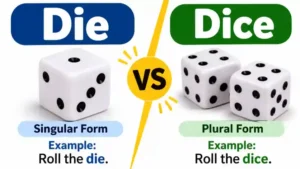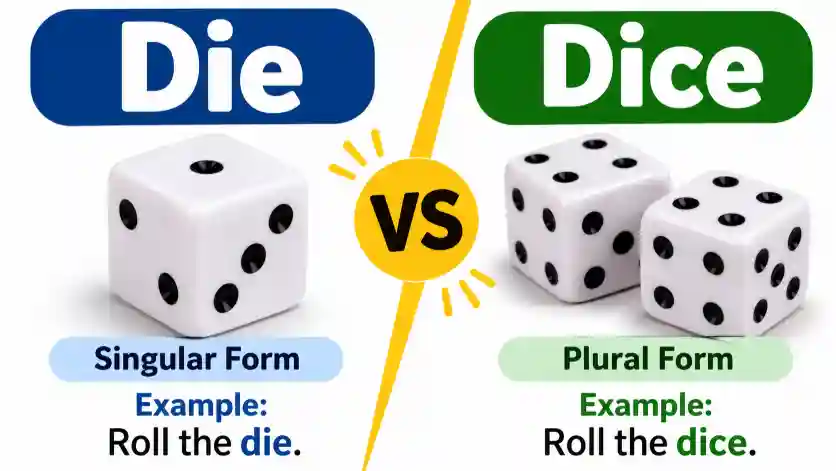
Die and dice are both correct English words, but they have different uses. A die is one small numbered cube used in games, while dice is the plural form referring to two or more of these cubes. In modern informal English, however, dice is also commonly used for a single cube.
The confusion usually occurs because people use these words interchangeably when talking about board games, gambling, and other activities. Traditionally, one cube is called a die, and multiple cubes are called dice.
For example, you can roll a die when playing a game with one cube, but you can roll dice when using two or more. Understanding this difference will help you choose the correct word in everyday conversations and formal writing.
Die or Dice : Quick Answer
- Die: The singular form of the noun. It refers to one numbered cube used in games.
- Dice: The plural form of die. It refers to two or more numbered cubes.
Quick tip: Use die for one cube and dice for more than one. In casual speech, people often use dice for a single cube too.
Examples:
- I need one die to play this game.
- She rolled two dice on the table.
Definition and Meaning of Die and Dice
Although these words are closely related, their traditional grammatical uses are different.
What Does Die Mean?
Die is the singular noun for a small cube with numbered sides, traditionally used in games of chance. A standard die has six sides, numbered from one to six.
It is commonly used in board games, mathematics, probability, and other activities involving random numbers.
Examples:
- He rolled a die and got a six.
- The die landed near the edge of the table.
- Each player needs one die to begin the game.
- She picked up the die and rolled it again.
Remember that die can also be a verb meaning to stop living. For example, “Plants may die without enough water.” However, when comparing die and dice in gaming, die is the singular noun.
What Does Dice Mean?
Dice is traditionally the plural form of die. It refers to two or more numbered cubes used in games.
Dice are commonly used in board games, casino games, role-playing games, and classroom activities.
Examples:
- The children rolled the dice together.
- Two dice were lying on the floor.
- He shook the dice before throwing them.
- The game requires three dice.
In informal modern English, dice is also widely used as a singular noun, especially in everyday conversation.
For example:
- Pass me a dice.
- I found a dice under the table.
Although this usage is common, die remains the traditional singular form in formal writing.
Origin and History of Die and Dice
The words die and dice have a long history connected with games and chance.
The singular word die comes from Old French dé, which developed from Latin datum, meaning something given or played. The word became associated with small objects used to generate random numbers.
The plural form dice developed from the older French plural form dés. Over time, English adopted dice as the plural of die.
For many years, the traditional distinction remained clear:
- One cube = die
- Two or more cubes = dice
However, everyday English gradually changed. Many speakers began using dice as both singular and plural, particularly in casual conversation.
Today, both forms are understood, but the traditional distinction is still preferred in formal and edited writing.
British English vs. American English Spelling
The distinction between die and dice is generally the same in British and American English. There is no major regional spelling difference.
| Feature | American English | British English |
| Singular form | Die | Die |
| Plural form | Dice | Dice |
| Casual singular use of dice | Common | Common |
| Formal singular preference | Die | Die |
| Meaning | Numbered game cube | Numbered game cube |
Both varieties traditionally use die for one cube and dice for multiple cubes.
The informal singular use of dice can also be found in both varieties.
Which Word Should You Use?
Choosing between die and dice depends mainly on the number of objects and the formality of your writing.
1. Use Die for One Cube
When referring to a single numbered cube, use die in traditional and formal English.
Examples:
- Roll one die to determine your score.
- The die stopped beside the board.
- I bought a new die for the game.
2. Use Dice for Two or More Cubes
When referring to multiple numbered cubes, use dice.
Examples:
- Roll the dice to move your game piece.
- The player picked up three dice.
- All the dice landed on the same number.
3. Use Dice for One Cube in Casual Conversation
In everyday English, many people say a dice when referring to one cube.
Examples:
- Can you give me a dice?
- I lost my favourite dice.
This usage is widely understood, but a die is the safer choice in formal writing, educational materials, and grammar exercises.
4. Follow the Context
If you are writing a school assignment, dictionary definition, or formal explanation, maintain the traditional distinction.
For casual conversations, dice as a singular noun is generally acceptable in everyday usage.
Common Mistakes With Die and Dice
Understanding the difference is simple, but some mistakes are common.
1. Using Dice as the Traditional Singular Form
Incorrect in traditional formal usage: I rolled one dice.
Correct: I rolled one die.
Why? The traditional singular form is die, not dice.
2. Using Die for Multiple Cubes
Incorrect: She rolled two die.
Correct: She rolled two dice.
Why? Dice is the traditional plural form of die.
3. Confusing Die With the Verb Die
Incorrect: He rolled a die because he wanted to stop living.
Correct: He rolled a die because he wanted to move his game piece.
Why? In the correct sentence, die is a noun referring to a game cube. As a verb, die means to stop living.
4. Adding an Unnecessary S to Dice
Incorrect: The player rolled three dices.
Correct: The player rolled three dice.
Why? Dice is already the plural form. It does not normally need another s.
5. Assuming Dice Can Never Be Singular
Incorrect assumption: Dice is always plural in every situation.
Correct understanding: Dice is traditionally plural, but its singular use is common in informal modern English.
Example: He picked up a dice and threw it across the table.
Die and Dice in Everyday Examples
These words are commonly used in games, conversations, classrooms, and written instructions.
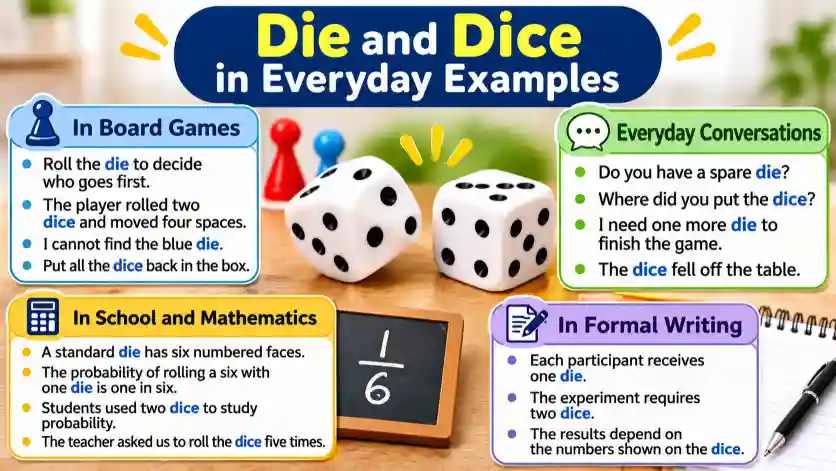
In Board Games
- Roll the die to decide who goes first.
- The player rolled two dice and moved four spaces.
- I cannot find the blue die.
- Put all the dice back in the box.
Everyday Conversations
- Do you have a spare die?
- Where did you put the dice?
- I need one more die to finish the game.
- The dice fell off the table.
In School and Mathematics
- A standard die has six numbered faces.
- The probability of rolling a six with one die is one in six.
- Students used two dice to study probability.
- The teacher asked us to roll the dice five times.
In Formal Writing
- Each participant receives one die.
- The experiment requires two dice.
- The results depend on the numbers shown on the dice.
Usage Trends and Modern Writing
The traditional distinction between die and dice remains important in dictionaries, educational materials, and formal writing.
However, everyday English has become more flexible. Many speakers use dice as a singular noun, particularly when talking about board games or casual activities.
For example, someone might naturally say, “Can I borrow a dice?” instead of “Can I borrow a die?”
Both expressions are generally understood, but the traditional singular form die is still preferred in formal contexts.
For clear and accurate writing, use die for one cube and dice for multiple cubes.
Die vs. Dice: Comparison Table
| Feature | Die | Dice |
| Grammatical number | Singular | Plural |
| Main meaning | One numbered cube | Two or more numbered cubes |
| Standard usage | Formal and informal | Formal and informal |
| Casual singular use | Traditional form | Common in conversation |
| Example | One die | Two dice |
| Extra plural ending | Not needed | Not needed |
Remember: One die, two dice, and three dice.
Easy Trick to Remember Die and Dice
Use this simple memory trick:
- Die = One: Think of one cube with six numbered sides.
- Dice = More: Think of multiple cubes being rolled together.
You can also remember the sentence:
“One die, two dice, three dice.”
This simple pattern makes the difference easy to remember.
Frequently Asked Questions (FAQs)
1. Is die or dice correct?
Both are correct. Die is traditionally the singular form, while dice is the plural form.
2. Is dice singular or plural?
Dice is traditionally plural, but it is also commonly used as a singular noun in informal English.
3. What is the plural of die?
The plural of die is dice.
4. Can I say a dice?
Yes. A dice is common in informal modern English. However, a die is preferred in traditional formal writing.
5. Is dices a correct word?
Dices is generally not the standard plural of the game cube. The correct plural is dice.
6. What is the difference between one die and two dice?
One die refers to a single numbered cube, while two dice refers to a pair of numbered cubes.
7. Do British and American English use die and dice differently?
No major difference exists. Both varieties traditionally use die as singular and dice as plural.
8. Is die also a verb?
Yes. Die can be a verb meaning to stop living. It can also be a noun referring to a game cube or certain tools used in manufacturing.
9. Why do people say dice instead of die?
Many English speakers use dice as a singular noun in everyday conversation. This informal usage has become widespread over time.
10. Which word should I use in formal writing?
Use die for one cube and dice for two or more cubes. This follows the traditional grammatical distinction.
Conclusion
Die and dice are both correct words, but their traditional grammatical uses are different. Die is the singular form used for one numbered cube, while dice is the plural form used for two or more cubes.
Although people commonly use dice for a single cube in everyday conversation, die remains the preferred singular form in formal writing. Remembering the simple rule of one die and two dice will help you use both words correctly.
Read More:
- Bolder or Boulder: Learn the Difference With Examples
- Stuffing or Dressing? The Answer May Surprise You
- Axel or Axle: The Spelling Difference You Need to Know!