
Nick is the correct word when referring to a small cut, a notch, or the act of making a small cut, while knick is not the standard spelling for these meanings. The word knick appears in the expression knick knack as part of a different word, but it is not a standard substitute for nick.
Many people confuse knick and nick because the silent letter k appears in several familiar English words, such as knife and knee. However, the word nick begins with n, and adding a k changes it into a nonstandard spelling for the meanings discussed in this guide.
For example, you might say, “I got a small nick on my finger while shaving,” or “The knife left a nick in the wooden table.” In both sentences, nick is the correct choice.
Understanding this difference helps you avoid spelling mistakes in everyday conversations, school assignments, professional writing, and online content. In this guide, you will learn the meanings of nick and knick, explore their origins, compare British and American usage, and discover common mistakes through practical examples.
Knick or Nick : Quick Answer
Nick is the correct spelling when you mean a small cut, a notch, or the act of making a small cut. Knick is not the standard spelling for these meanings.
- Correct: I accidentally nicked my finger while cooking.
- Incorrect: I accidentally knicked my finger while cooking.
The word nick also has several other meanings, including a prison, a particular condition or state, and the act of stealing something in informal British English.
Easy rule: Use nick for a small cut or notch, and do not add a k at the beginning.
Definition and Meaning of Nick and Knick
What Does Nick Mean?
Nick is a noun or verb with several meanings. As a noun, it can refer to a small cut, scratch, or notch in a surface. As a verb, to nick means to make a small cut or mark on something.
The word is also used in informal expressions. For example, in good nick means in good condition, particularly in British English. In British slang, to nick something can mean to steal it.
Examples:
- I got a nick on my finger while chopping vegetables.
- The carpenter noticed a small nick in the table.
- My old bicycle is still in good nick.
- Someone tried to nick my bag at the station.
The exact meaning depends on the sentence and context.
What Does Knick Mean?
Knick is not the standard spelling of nick when referring to a small cut, notch, or similar mark.
However, the spelling appears in the established word knick knack, which means a small decorative object or trinket. It is therefore important not to assume that knick is never used in English; rather, it is not the correct replacement for nick in the meanings discussed here.
Examples:
- Incorrect: There is a knick in my phone screen.
- Correct: There is a nick in my phone screen.
- Correct: She displayed several knick knacks on the shelf.
Knick vs. Nick: Key Differences
| Feature | Nick | Knick |
| Standard spelling for a small cut | Yes | No |
| Meaning as a small notch | Yes | Not standard |
| Used as a verb | Yes, as in nick the surface | Not standard for this meaning |
| Appears in knick knack | No | Yes |
| Recommended use | Use for a small cut or notch | Use in established expressions such as knick knack |
Origin and History of Nick and Knick
Where Does the Word Nick Come From?
The word nick has a long history in English. It developed as a term associated with a small cut, notch, or mark. Over time, it gained additional meanings and became part of several common expressions.
Today, nick is used in everyday English to describe small damage to an object or a minor cut on the skin. It also appears in informal expressions such as in the nick of time, meaning just in time, and in good nick, meaning in good condition.
Where Does the Word Knick Come From?
The spelling knick is familiar mainly through the established compound knick knack, which refers to a small decorative item. It should not be treated as a standard spelling variant of nick when discussing cuts or notches.
People may mistakenly add a k because English contains words beginning with silent k, including knee, knife, and knock. However, the correct spelling of the small cut word remains nick.
British English vs. American English
The word nick is used in both British and American English, although some of its informal meanings are more common in British usage.
| Context | British English | American English |
| A small cut | I have a nick on my hand. | I have a nick on my hand. |
| A notch in an object | There is a nick in the wood. | There is a nick in the wood. |
| Good condition | The car is in good nick. | The car is in good condition. |
| Informal word for stealing | Someone tried to nick my phone. | Someone tried to steal my phone. |
| Correct spelling | Nick | Nick |
In both varieties, nick is the correct word for a small cut or notch. British English also commonly uses nick in expressions such as in good nick and as an informal verb meaning to steal.
Which Word Should You Use: Knick or Nick?
The correct choice depends on what you want to say. If you mean a small cut, notch, or minor mark, use nick.
When to Use Nick
Use nick as a noun when referring to a small cut or notch. Use it as a verb when describing the act of making such a mark.
Examples:
- The razor left a small nick on his chin.
- I accidentally nicked the wooden surface.
- There is a tiny nick on the edge of the glass.
- She nicked her finger while opening the package.
You can also use nick in established expressions:
- In the nick of time: Just in time.
- In good nick: In good condition, especially in British English.
When to Use Knick
Use knick only when it appears in an established spelling such as knick knack. Do not use it instead of nick for a cut or notch.
Examples:
- Correct: The shelf was full of knick knacks.
- Incorrect: The blade left a knick on the handle.
- Correct: The blade left a nick on the handle.
If you are writing about a small cut, scratch, or notch, nick is the appropriate word.
Common Mistakes With Knick and Nick
1. Adding a K to Nick
Incorrect: I noticed a knick in the wooden door.
Correct: I noticed a nick in the wooden door.
Explanation: The standard spelling for a small notch or cut is nick, without an initial k.
2. Writing Knicked Instead of Nicked
Incorrect: He knicked his hand while shaving.
Correct: He nicked his hand while shaving.
Explanation: The past tense and past participle of nick are spelled nicked, with no initial k.
3. Confusing Nick With Knick Knack
Incorrect: She bought a nick knack for the shelf.
Correct: She bought a knick knack for the shelf.
Explanation: Knick knack is an established compound word with its own spelling. This does not make knick a standard substitute for nick.
4. Assuming Nick Only Means a Cut
Incorrect: Nick always refers to a small cut.
Correct: Nick can also appear in expressions such as in the nick of time and in good nick.
Explanation: The word has several meanings, and context determines which one applies.
5. Using the Wrong Spelling in Formal Writing
Incorrect: The technician found a knick in the metal surface.
Correct: The technician found a nick in the metal surface.
Explanation: Use the standard spelling in reports, assignments, instructions, and professional documents.
Everyday Examples of Knick and Nick
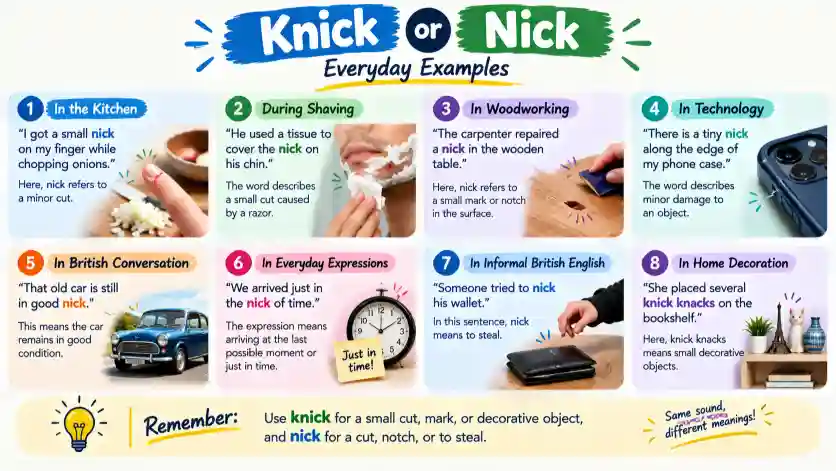
1. In the Kitchen
“I got a small nick on my finger while chopping onions.”
Here, nick refers to a minor cut.
2. During Shaving
“He used a tissue to cover the nick on his chin.”
The word describes a small cut caused by a razor.
3. In Woodworking
“The carpenter repaired a nick in the wooden table.”
Here, nick refers to a small mark or notch in the surface.
4. In Technology
“There is a tiny nick along the edge of my phone case.”
The word describes minor damage to an object.
5. In British Conversation
“That old car is still in good nick.”
This means the car remains in good condition.
6. In Everyday Expressions
“We arrived just in the nick of time.”
The expression means arriving at the last possible moment or just in time.
7. In Informal British English
“Someone tried to nick his wallet.”
In this sentence, nick means to steal.
8. In Home Decoration
“She placed several knick knacks on the bookshelf.”
Here, knick knacks means small decorative objects.
Knick or Nick: Usage Trends and Modern Writing
Nick is the standard spelling in modern English when referring to a small cut, notch, or minor mark. It also appears in common expressions and informal British usage.
The spelling knick is most familiar as part of knick knack. When people write knick while intending to describe a cut or notch, they are generally making a spelling mistake.
For clear modern writing, use nick in sentences about small cuts, scratches, or damage. Use knick knack when referring to a small decorative object.
Examples:
- Nick: The knife left a nick in the handle.
- Nicked: I nicked my finger while cooking.
- Knick knack: The cabinet displayed a collection of knick knacks.
These distinctions help readers understand the intended meaning without confusion.
Knick vs. Nick: Comparison Table
| Example sentence | Correct choice | Explanation |
| The razor left a small on his face. | Nick | A small cut |
| There is a in the wooden table. | Nick | A small notch or mark |
| I accidentally my finger. | Nicked | Past tense of nick |
| The car is still in good . | Nick | British expression for good condition |
| We arrived in the of time. | Nick | Part of the expression in the nick of time |
| She decorated the shelf with small . | Knick knacks | Small decorative objects |
| The blade made a in the surface. | Nick | Correct spelling for a small cut or notch |
| Someone tried to my bag. | Nick | Informal British English meaning to steal |
Easy Trick to Remember Knick or Nick
Use this simple memory trick:
Nick = No K.
When you mean a small cut, scratch, or notch, remember that nick begins with N, not K.
Keep these examples in mind:
- Nick: A small cut or notch.
- Nicked: Made a small cut.
- Knick knack: A small decorative object.
The key is to remember that knick knack has a special established spelling, but the word for a small cut remains nick.
Frequently Asked Questions (FAQs)
1. Is it knick or nick?
Nick is the correct spelling when referring to a small cut, notch, or minor mark. Knick is not the standard spelling for these meanings.
2. Is knick a real word?
The spelling appears in the established word knick knack, meaning a small decorative object. However, it is not the standard spelling of nick when referring to a cut or notch.
3. What does nick mean?
Nick can mean a small cut, notch, or mark. It can also appear in expressions such as in the nick of time and in good nick. In informal British English, it can mean to steal.
4. What does knick knack mean?
A knick knack is a small decorative object or trinket, often displayed on a shelf, desk, or cabinet.
5. Is it nicked or knicked?
Nicked is the correct spelling of the past tense of nick. For example, “I nicked my finger while preparing dinner.”
6. What does in the nick of time mean?
The expression in the nick of time means just in time, often at the last possible moment before something happens.
7. What does in good nick mean?
In good nick is an informal expression, especially common in British English, meaning in good condition.
8. Is nick used in British and American English?
Yes. Both British and American English use nick to mean a small cut or notch. Some other meanings and expressions are more common in British English.
9. Can nick be used as a verb?
Yes. As a verb, nick can mean to make a small cut or notch. In informal British English, it can also mean to steal.
10. How can I remember the spelling of nick?
Remember Nick = No K when you mean a small cut or notch. Keep knick knack separate as a different established word.
Conclusion
The difference between knick and nick is simple. Nick is the correct spelling for a small cut, notch, or minor mark, while knick is not the standard spelling for those meanings. The spelling knick does appear in the established word knick knack, which refers to a small decorative object.
For example, write “I got a nick on my finger,” but write “She displayed several knick knacks on the shelf.” Remember the simple trick Nick = No K, and you will be able to choose the correct word confidently in everyday conversations, school assignments, and professional writing.
Read More:
- Bit or Bite: The Simple Trick to Remember the Difference
- Halve or Half: Stop Making This Common Grammar Mistake
- Empathy or Sympathy? The Difference Most People Get Wrong




2 thoughts on “Knick or Nick: One Is Correct, but What About the Other?”