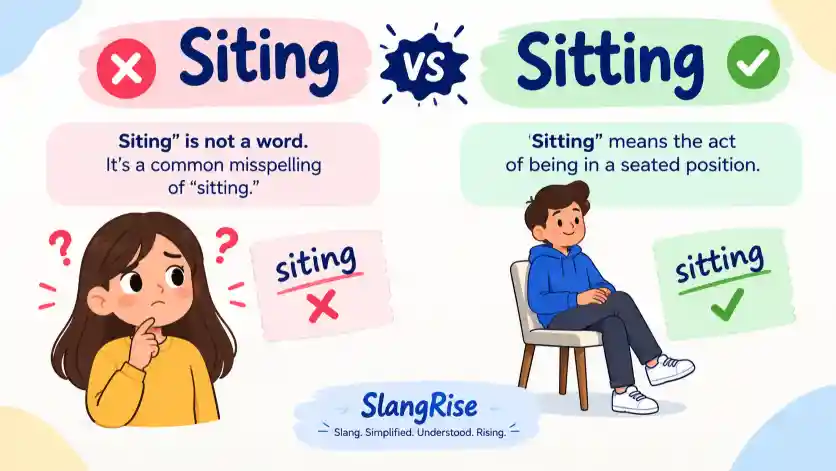
Siting and sitting are both correct English words, but they have different meanings. Sitting usually means being seated or resting on a chair, sofa, or another surface. Siting means choosing or establishing a location for something, such as a building, hospital, school, or factory.
The two words are easy to confuse because they differ by only one letter. However, using the wrong word can change the meaning of your sentence.
For example:
- She is sitting on the chair.
- The company is siting its new factory near the highway.
In the first sentence, sitting describes a person’s position. In the second sentence, siting describes the process of selecting a location for a factory.
Both words follow standard English spelling rules and are used in British and American English. The correct choice depends on what you want to express.
In this guide, you will learn the meanings of siting and sitting, their spelling rules, common mistakes, and examples to help you use each word correctly.
Quick Answer
Sitting means being seated, while siting means selecting or placing something at a particular location.
| Word | Meaning | Example |
| Sitting | Being seated | He is sitting on a bench. |
| Siting | Choosing a location | They are siting a new school near the village. |
Both spellings are correct. Neither word is a misspelling of the other.
What Does Sitting Mean?
Sitting is the present participle of the verb sit. It describes the action or state of being seated.
People commonly use this word when talking about chairs, sofas, benches, floors, or other places where someone can sit.
Examples of Sitting
- She is sitting beside her friend.
- The children are sitting quietly in the classroom.
- I was sitting near the window.
- He enjoys sitting outside in the evening.
The word can also describe a period spent in a particular role or activity.
For example:
The committee is sitting today.
Here, sitting refers to the committee meeting or being in session.
Sitting as a Noun
Sitting can also be a noun that refers to a period of time spent seated or a scheduled session.
Examples:
We completed the exam in one sitting.
The artist arranged a portrait sitting for Friday.
In these examples, sitting does not simply describe a person sitting on a chair. It refers to a session or continuous period of activity.
What Does Siting Mean?
Siting is the present participle of the verb site. It means selecting, planning, or establishing a location for something.
It is often used in construction, architecture, business, urban planning, and environmental discussions.
Examples of Siting
- The council is siting a new library near the town centre.
- Engineers are siting the wind turbines away from residential areas.
- The company is siting its factory close to major transport routes.
- Planners are carefully siting the new hospital.
In each sentence, siting describes the process of deciding where something should be located.
Siting in Construction and Planning
The word is particularly common when discussing buildings, infrastructure, and large projects.
For example:
The team is siting the new school on suitable land.
This means the team is choosing or establishing the school’s location.
Another example:
Proper siting of a building can improve access and safety.
Here, siting is used as a noun to describe the process of choosing a location.
Siting vs Sitting: Main Difference
The main difference is their meaning and the verbs from which they come.
Sitting Comes From Sit
The verb sit means to rest with your body supported, usually with your weight on a seat or another surface.
When adding -ing, the final t is doubled:
Sit + ing = Sitting
Example:
The boy is sitting on the floor.
Siting Comes From Site
The verb site means to place or locate something in a particular position.
When adding -ing, the final e is removed:
Site − e + ing = Siting
Example:
The developers are siting the building near the road.
These spelling patterns explain why one word has a double t while the other does not.
Why Is Sitting Spelled With Two Ts?
The word sitting follows a common English spelling rule.
When a short verb ends in a consonant after a short vowel, the final consonant is often doubled before adding -ing.
The verb sit becomes sitting because the final t is doubled.
Other examples include:
- Run → Running
- Stop → Stopping
- Get → Getting
- Swim → Swimming
Therefore, siting is not the correct spelling when you mean the action of sitting down.
Incorrect:
She is siting on the sofa.
Correct:
She is sitting on the sofa.
Why Is Siting Spelled With One T?
Siting comes from the verb site, which ends with a silent e.
When adding -ing, the final e is usually removed.
The spelling changes like this:
Site → Siting
Other examples of this spelling pattern include:
- Make → Making
- Write → Writing
- Drive → Driving
- Hope → Hoping
The final t in site is not doubled because the spelling rule for doubling the consonant does not apply in this case.
Incorrect:
The planners are sitting the new factory near the highway.
Correct:
The planners are siting the new factory near the highway.
British and American English
Both siting and sitting are standard in British and American English. Their meanings and spellings do not change between the two varieties.
| British English | American English |
| Sitting | Sitting |
| Siting | Siting |
| Sitting on a chair | Sitting on a chair |
| Siting a new hospital | Siting a new hospital |
For example, a British writer might say:
The council is siting a new school in the area.
An American writer could use the same sentence with the same spelling and meaning.
There is no major British-American spelling difference between these words.
Common Mistakes With Siting and Sitting
Using Siting When You Mean Sitting
This mistake happens when someone forgets to double the final t in sit.
Incorrect:
My brother is siting in the living room.
Correct:
My brother is sitting in the living room.
Using Sitting When You Mean Siting
This mistake changes the meaning of a sentence about choosing a location.
Incorrect:
The engineers are sitting the new power station near the coast.
Correct:
The engineers are siting the new power station near the coast.
Assuming One Word Is Always Wrong
Neither word is incorrect by itself. Both are standard English words, but they cannot replace each other in every sentence.
- Use sitting for being seated.
- Use siting for selecting or establishing a location.
Forgetting the Base Verb
Remembering the original verbs can help you choose the correct spelling.
- Sit → Sitting
- Site → Siting
Everyday Examples of Sitting
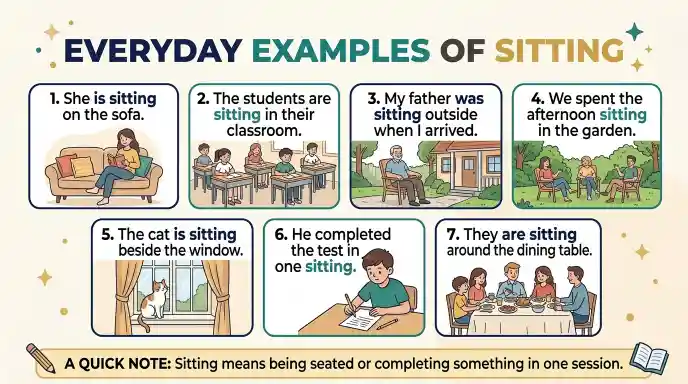
Here are examples of sitting in common situations.
- She is sitting on the sofa.
- The students are sitting in their classroom.
- My father was sitting outside when I arrived.
- We spent the afternoon sitting in the garden.
- The cat is sitting beside the window.
- He completed the test in one sitting.
- They are sitting around the dining table.
Each example describes being seated or a session spent doing something.
Everyday Examples of Siting
Here are examples of siting in planning and location-related situations.
- The council is siting a new library in the town.
- The company is siting its office near the city centre.
- Engineers are siting the turbines in an open area.
- The developers are siting the houses away from flood-prone land.
- Planners are siting the new hospital near the main road.
- The team is siting the equipment in a secure location.
- Careful siting of the building can improve accessibility.
Each example relates to selecting or establishing a location.
Siting or Sitting in Formal Writing
Both words are suitable for formal writing when used correctly.
Sitting is common in everyday writing, school assignments, reports, and descriptions of people or activities.
Example:
The students were sitting quietly during the presentation.
Siting is more common in technical or professional contexts involving planning, construction, infrastructure, and land use.
Example:
The proposed siting of the hospital requires careful environmental assessment.
Choosing the correct word makes your writing clearer and prevents readers from misunderstanding your meaning.
Siting or Sitting Comparison Table
| Feature | Sitting | Siting |
| Base verb | Sit | Site |
| Main meaning | Being seated | Choosing a location |
| Spelling pattern | Doubles the final t | Removes the final e |
| Common context | People, chairs, meetings | Buildings, factories, projects |
| British English | Correct | Correct |
| American English | Correct | Correct |
| Example | She is sitting outside. | They are siting a factory. |
How to Remember Siting and Sitting
A simple way to remember the difference is to connect each word with its base verb.
Sit → Sitting
Think of someone sitting on a chair. The final t doubles.
Site → Siting
Think of choosing a site for a building. The final e disappears before -ing is added.
You can also remember these short examples:
- The child is sitting on a chair.
- The team is siting a new school.
If the sentence is about a person being seated, use sitting. If it is about choosing where something belongs, use siting.
FAQs About Siting or Sitting
Is siting or sitting correct?
Both are correct words. Sitting means being seated, while siting means choosing or establishing a location for something.
What does sitting mean?
Sitting means resting in a seated position. It can also refer to a session, such as completing an exam in one sitting.
What does siting mean?
Siting means choosing or establishing a location for a building, facility, project, or other object.
Why does sitting have two Ts?
The verb sit doubles its final t before adding -ing, producing sitting.
Is siting the same as sitting?
No. Siting relates to location, while sitting relates mainly to being seated or taking part in a session.
Are siting and sitting spelled the same in British and American English?
Yes. Both words have the same spelling and meaning in British and American English.
How do you use siting in a sentence?
You can write: “The council is siting the new school near the town centre.” This means the council is choosing the school’s location.
Conclusion
Siting and sitting are both correct English words, but they have different meanings. Sitting describes being seated or taking part in a session. Siting describes selecting or establishing a location for something.
The spelling depends on the base verb:
- Sit → Sitting
- Site → Siting
Remember this simple rule to avoid confusion. Use sitting when talking about people or seated activities, and use siting when discussing locations, buildings, or planning.
Read More:
- Sense or Sence: The Spelling Mistake You Need to Avoid
- Grateful or Thankful? Are These Words Really the Same?
- Statistic vs Parameter: The Mix-Up That Costs You Marks





2 thoughts on “Siting or Sitting? The Correct Spelling May Surprise You”