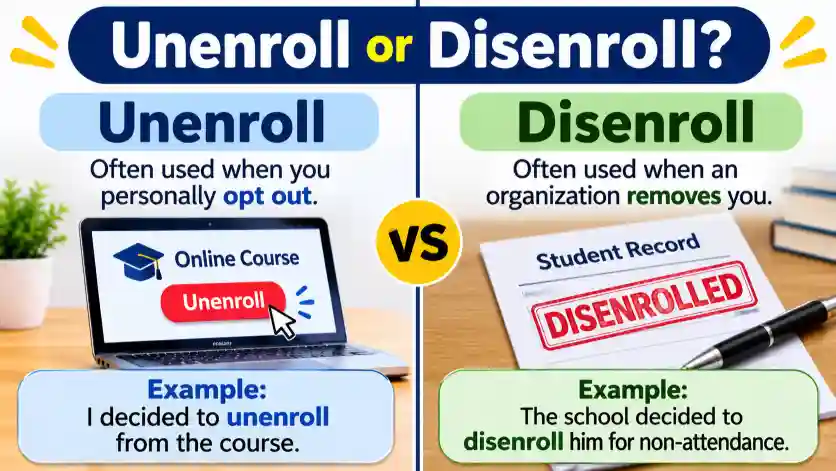
Unenroll and disenroll are both correct English words. They have nearly the same meaning: to remove someone from a course, program, school, or organized activity. However, unenroll is more commonly used in American English, while disenroll is also accepted, particularly in formal or administrative contexts.
Both words can describe the process of ending someone’s enrollment. The choice often depends on the context, writing style, and preferred terminology of an organization.
For example, a student may unenroll from an online course, or a school administrator may disenroll a student from a program. Both sentences communicate that the enrollment has ended.
Understanding how these words are used can help you choose the most natural option in emails, school documents, workplace communication, and everyday writing.
Unenroll or Disenroll : Quick Answer
- Unenroll: To withdraw from a course, school, program, or activity. It is a widely used term in American English.
- Disenroll: To remove someone from an enrollment list or end their participation in a program. It is also correct and often appears in administrative writing.
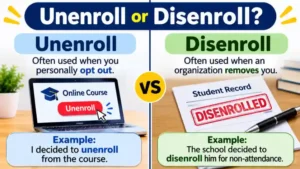
Quick tip: Use unenroll when talking about voluntarily leaving a course or program. Use disenroll when describing the removal of someone from an official enrollment record, especially in administrative contexts.
Definition and Meaning of Unenroll and Disenroll
Although both words describe ending enrollment, their usage can differ slightly depending on the situation.
What Does Unenroll Mean?
Unenroll means to withdraw from or stop participating in something that a person previously joined.
It is commonly used for educational courses, online learning platforms, training programs, and memberships.
Examples:
- I decided to unenroll from the online course.
- She wants to unenroll her child from the summer program.
- Students can unenroll before the registration deadline.
- He chose to unenroll from the training session.
In these examples, unenroll describes ending an existing registration or participation.
What Does Disenroll Mean?
Disenroll means to remove someone from an official enrollment list or terminate their participation in a program.
It is frequently found in formal, institutional, and administrative contexts.
Examples:
- The school decided to disenroll the student after reviewing the records.
- The administrator had to disenroll several participants.
- Members may be disenrolled if they no longer meet the program requirements.
- The organization will disenroll inactive participants.
In these examples, disenroll focuses on the removal of someone from an enrollment system or program.
Origin and History of Unenroll and Disenroll
Both words are formed from the verb enroll, which means to register or officially enter someone into a course, organization, or program.
The word enroll comes through French from a word associated with entering names on a roll or list.
The prefixes create the opposite action:
- Un- commonly expresses reversal or removal. Therefore, unenroll means to reverse an enrollment.
- Dis- can express separation, removal, or reversal. Therefore, disenroll means to remove someone from enrollment.
Both formations follow recognizable English word-building patterns. Their meanings overlap, but their usage depends on context and convention.
British English vs. American English Spelling
Unlike words such as colour and color, unenroll and disenroll are not primarily different because of British and American spelling rules.
| Feature | American English | British English |
| Unenroll | Used | Understood |
| Disenroll | Used | Understood |
| Main distinction | Context and preference | Context and preference |
| Meaning | End enrollment | End enrollment |
Both words are understood in major varieties of English. However, their frequency can vary between institutions, regions, and types of writing.
Important: Do not confuse the choice between these words with the spelling differences involving double consonants, such as enrollment and enrolment. Those forms do have a recognized American and British spelling distinction.
Which Word Should You Use?
Choosing between unenroll and disenroll depends on what you want to communicate.
1. Use Unenroll for Voluntary Withdrawal
When someone chooses to leave a course, class, or program, unenroll is a natural choice.
Examples:
- I need to unenroll from my photography class.
- She decided to unenroll from the online training program.
- Parents can unenroll their children before the new term begins.
2. Use Disenroll for Administrative Removal
When an institution or organization removes someone from an official enrollment list, disenroll may be appropriate.
Examples:
- The college may disenroll students who do not complete registration.
- The administrator will disenroll participants who are no longer eligible.
- The agency decided to disenroll the applicant from the program.
3. Follow the Organization’s Preferred Terminology
Schools, universities, online platforms, and government programs may have their own terminology.
If an institution uses disenroll in its official documents, follow that wording. If an online learning platform uses unenroll, use the same term when describing its process.
The safest approach is to match the language used by the organization you are writing about.
Common Mistakes With Unenroll and Disenroll
Although both words are correct, writers sometimes use them incorrectly or misunderstand their differences.
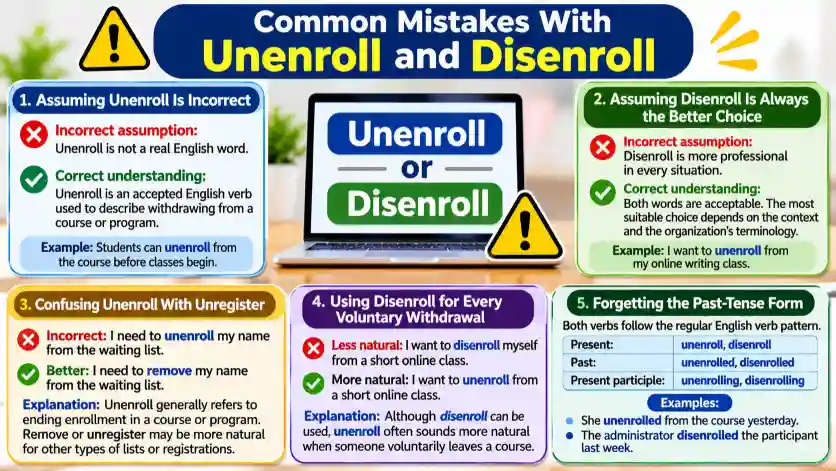
1. Assuming Unenroll Is Incorrect
Incorrect assumption: Unenroll is not a real English word.
Correct understanding: Unenroll is a correct English verb used when someone leaves a course or program.
Example: Students can unenroll from the course before classes begin.
2. Assuming Disenroll Is Always the Better Choice
Incorrect assumption: Disenroll is more professional in every situation.
Correct understanding: Both words are acceptable. The most suitable choice depends on the context and the organization’s terminology.
Example: I want to unenroll from my online writing class.
3. Confusing Unenroll With Unregister
Incorrect: I need to unenroll my name from the waiting list.
Better: I need to remove my name from the waiting list.
Explanation: Unenroll generally refers to ending enrollment in a course or program. Remove or unregister may be more natural for other types of lists or registrations.
4. Using Disenroll for Every Voluntary Withdrawal
Less natural: I want to disenroll myself from a short online class.
More natural: I want to unenroll from a short online class.
Explanation: Disenroll is also correct, but unenroll sounds more natural when someone chooses to leave a course.
5. Forgetting the Past-Tense Form
Both verbs follow the regular English verb pattern.
- Present: unenroll, disenroll
- Past: unenrolled, disenrolled
- Present participle: unenrolling, disenrolling
Examples:
- She unenrolled from the course yesterday.
- The administrator disenrolled the participant last week.
Unenroll and Disenroll in Everyday Examples
These words appear in educational, professional, and administrative situations.
In School and Education
- The student decided to unenroll from the mathematics course.
- The school may disenroll students who fail to meet its requirements.
- Parents can unenroll their children before the academic year begins.
Online Learning
- I accidentally unenrolled from my online class.
- You can unenroll from the course through your account settings.
- The platform may disenroll users who no longer qualify for the program.
In Workplace Communication
- Please let me know how to unenroll from the employee training session.
- The department will disenroll employees who are no longer eligible.
- I would like to unenroll from the optional workshop.
In Formal Emails
Example 1:
Subject: Request to Unenroll from a Course
Dear Administrator,
I would like to unenroll from the current course because I can no longer attend the scheduled sessions. Please let me know if any additional steps are required.
Thank you.
Example 2:
Subject: Disenrollment Confirmation
Dear Student,
This message confirms that your enrollment has ended. Your account has been removed from the program.
Regards.
Usage Trends and Modern Writing
Both unenroll and disenroll are used in modern English. They are common in schools, online courses, and membership programs.
Unenroll is often used when someone leaves an online course or program by choice. For example, a student may leave a course through their account.
Disenroll is often used when a school or organization removes someone from a course or program. It also appears in official records and policies.
There is no universal rule requiring one word in every situation. Writers should consider the intended meaning and follow the terminology used by the relevant institution.
Unenroll vs. Disenroll: Comparison Table
| Feature | Unenroll | Disenroll |
| Part of speech | Verb | Verb |
| Main meaning | Withdraw from enrollment | Remove from enrollment |
| Common context | Courses and programs | Administrative records |
| Voluntary withdrawal | Very natural | Possible |
| Institutional removal | Possible | Very natural |
| Past tense | Unenrolled | Disenrolled |
| Correct spelling | Yes | Yes |
The main difference is emphasis: unenroll often highlights withdrawal, while disenroll can emphasize removal from an official enrollment system.
Easy Trick to Remember Unenroll and Disenroll
Remember these simple associations:
- Unenroll = Undo enrollment. Think of someone reversing their decision to join a course.
- Disenroll = Remove from enrollment. Think of an administrator taking someone’s name off an official program list.
Both words are correct, so the trick is about remembering their common contexts rather than deciding that one spelling is wrong.
Frequently Asked Questions (FAQs)
1. Is unenroll a real word?
Yes. Unenroll is a recognized English verb meaning to withdraw from a course, school, program, or activity.
2. Is disenroll a correct word?
Yes. Disenroll is also correct. It means to remove someone from an enrollment list or end their participation in a program.
3. What is the difference between unenroll and disenroll?
Unenroll commonly describes voluntary withdrawal, while disenroll often emphasizes administrative removal. Their meanings overlap.
4. Is unenroll or disenroll more common?
Unenroll is common in everyday education and online learning. Disenroll is also used, especially in formal and administrative situations.
5. Can I use unenroll in a formal email?
Yes. Unenroll is appropriate in formal emails when requesting withdrawal from a course, training session, or program.
6. What is the past tense of unenroll?
The past tense is unenrolled.
Example: She unenrolled from the course last week.
7. What is the past tense of disenroll?
The past tense is disenrolled.
Example: The administrator disenrolled the participant from the program.
8. Are unenroll and disenroll interchangeable?
Both words have almost the same meaning and can be used in similar ways. The right word depends on the situation and the words used by the school or organization.
9. Is disenrollment the noun form of disenroll?
Yes. Disenrollment is the noun form of disenroll. Unenrollment is also used as the noun form of unenroll.
Conclusion
Both unenroll and disenroll are correct words. Both mean leaving a school, course, or program. Unenroll is used when someone leaves by choice. Disenroll is used when a school or group removes someone from its list.
Choose the word that best matches your situation, and follow the terminology used by the school, platform, or organization involved.
Read More:
- Honored or Honoured: Why Do Both Spellings Exist?
- Valentine’s vs. Valentines: Which One Should You Use in 2026?
- Siked or Psyched: One Is Standard English, but Which One?


1 thought on “Unenroll or Disenroll? Learn the Correct Word to Use”