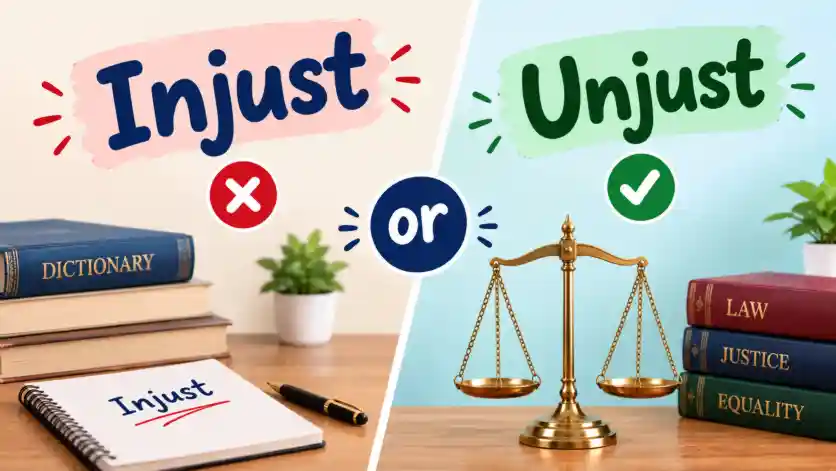
Unjust is the correct standard spelling. Injust is generally incorrect in modern standard English.
The word unjust means unfair, unreasonable, or not based on justice. It is commonly used when describing an action, decision, law, treatment, or situation that is considered unfair.
For example:
The decision was unjust.
They believed the punishment was unjust.
Injust or Unjust: Quick Answer
Correct Spelling: Unjust
Unjust is the standard English spelling.
The punishment was unjust. ✅
Incorrect Spelling: Injust
Injust is not normally used as the standard English word.
The punishment was injust. ❌
The correct form is:
Unjust = correct
Injust = incorrect
What Does Unjust Mean?
Unfair or Unreasonable
Unjust describes something that is unfair or unreasonable.
The workers considered the rule unjust.
She received an unjust punishment.
The decision seemed unjust to many people.
Not Based on Justice
The word can also describe something that does not follow principles of fairness or justice.
He spoke against the unjust treatment of the employees.
The judge rejected the unjust demand.
Why Is “Injust” Incorrect?
The confusion comes from the prefix in-, which is used in some English words to create an opposite meaning.
For example:
- Incorrect
- Incomplete
- Inactive
- Inaccurate
However, English does not use in- with every word. The established form is unjust, not injust.
The word is formed with un-:
un + just = unjust
So the correct spelling is unjust.
Unjust in Everyday English
Unfair Treatment
The employee complained about unjust treatment.
Unfair Decision
They thought the decision was unjust.
Unfair Rule
The students considered the rule unjust.
Unfair Punishment
The punishment seemed unjust.
Unfair Situation
He believed he had been placed in an unjust situation.
Unjust vs Just
Just and unjust have opposite meanings.
| Word | Meaning | Example |
| Just | Fair or reasonable | The decision was just. |
| Unjust | Unfair or unreasonable | The decision was unjust. |
Just
The judge made a just decision.
This means the decision was considered fair.
Unjust
The judge made an unjust decision.
This means the decision was considered unfair.
Common Mistakes With Injust or Unjust
Writing “Injust”
Incorrect:
The law was injust. ❌
Correct:
The law was unjust. ✅
Using the Wrong Prefix
It may seem natural to write injust because in- appears in many negative words. However, unjust is the established English form.
Confusing Unjust With Unjustly
Unjust is an adjective.
It was an unjust decision.
Unjustly is an adverb.
He was unjustly punished.
Unjust vs Unfair
Unjust and unfair are closely related, but unjust often has a stronger connection with justice, rights, or proper treatment.
Unfair
The game was unfair.
Unjust
The punishment was unjust.
Both words can describe something that is not fair, but unjust is often used in more serious or formal situations.
Unjust in Formal Writing
Unjust is common in formal and academic writing.
Examples include:
The policy was criticized as unjust.
The organization sought to challenge unjust practices.
The article discusses the effects of unjust treatment.
It can also appear in everyday conversation:
That’s unjust!
However, unfair is often more natural in casual speech.
British and American English
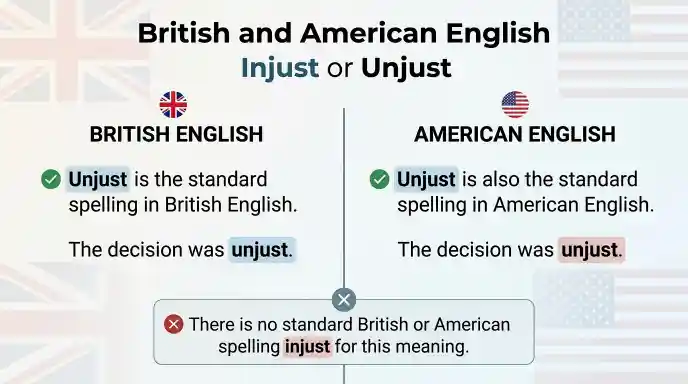
British English
Unjust is the standard spelling in British English.
The decision was unjust.
American English
Unjust is also the standard spelling in American English.
The decision was unjust.
There is no standard British or American spelling injust for this meaning.
Easy Way to Remember Unjust
A simple way to remember the word is:
Just = fair
Unjust = not fair
The prefix un- changes the meaning to its opposite:
just → unjust
Think of these examples:
happy → unhappy
fair → unfair
just → unjust
This makes unjust easier to remember.
Everyday Examples of Unjust
Example 1
The employee believed the decision was unjust.
Example 2
They protested against unjust treatment.
Example 3
The punishment was considered unjust.
Example 4
She felt that the rule was unjust.
Example 5
He described the system as unjust.
Example 6
The family believed they had suffered unjust treatment.
FAQs About Injust or Unjust
1. Is it injust or unjust?
Unjust is the correct spelling. Injust is generally incorrect in standard English.
2. What does unjust mean?
Unjust means unfair, unreasonable, or not based on justice.
3. Is unjust the opposite of just?
Yes. Just can mean fair or reasonable, while unjust means unfair or unreasonable.
4. Is injust a word?
Injust is not the standard English form used for the meaning “unfair.” Use unjust instead.
5. Why do we say unjust instead of injust?
English uses the prefix un- with just, giving the established form unjust.
6. What is an example of unjust?
The workers believed they received unjust treatment.
7. Is unjust formal English?
Yes. Unjust is commonly used in formal writing as well as everyday English.
8. What is the difference between unfair and unjust?
Both can mean not fair. Unjust is often used for situations involving justice, rights, treatment, decisions, or rules.
9. Is unjust the same in British and American English?
Yes. Unjust is the standard spelling in both varieties of English.
10. How can I remember the spelling of unjust?
Remember:
Just = fair
Unjust = not fair
Conclusion
Unjust is the correct spelling, while injust is generally incorrect in standard English.
Use unjust when describing something unfair, unreasonable, or contrary to justice. The easiest way to remember it is to connect it with just:
Just → Unjust
So when you need the word meaning not fair, choose unjust.
Read More:
- Fead or Feed: How to Spell This Word Correctly
- Immerse or Emerse: Which Spelling Is Correct in 2026?
- Tierd or Tired: Avoid This Common Spelling Error





2 thoughts on “Injust or Unjust: A Simple Guide With Examples”