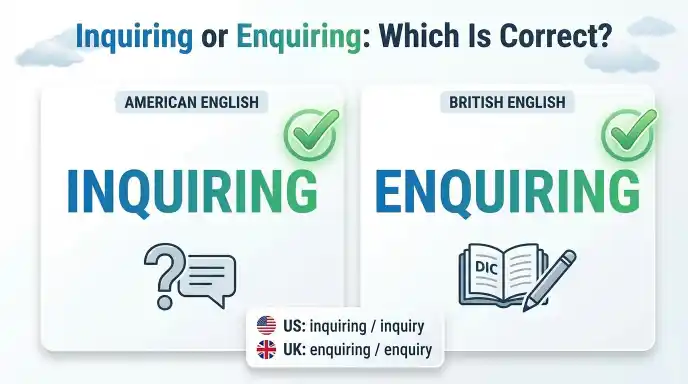
Inquiring and enquiring are both correct spellings of the same word, meaning to ask for information the difference comes down to regional preference rather than one being wrong.
American English strongly favors “inquiring” and “inquiry” in nearly all contexts, including formal, academic, and everyday writing.
British English traditionally distinguishes between the two: “enquire” for casual, general questions (“I’m enquiring about your weekend”) and “inquire” for formal, official investigations (“the police are inquiring into the incident”).
That said, modern British usage has grown more relaxed, with many UK writers and publications using “inquire” for both casual and formal contexts.
In this guide, you’ll learn the regional differences between inquiring and enquiring, when each is traditionally used, and which spelling fits your writing best heading into 2026.
Inquiring or Enquiring: Which Is Correct?
Both are correct. The preferred spelling depends mainly on the variety of English you are using.
- Inquiring is especially common in American English.
- Enquiring is common in British English.
- Both can mean asking for information.
- In traditional British usage, inquiring can sometimes suggest a formal investigation.
Quick rule: Use inquiring for American English and enquiring for British English when you mean “asking for information.”
Inquiring or Enquiring: Quick Answer
The simplest distinction is:
Inquiring = preferred in American English
Enquiring = commonly used in British English
Examples
- US: I am inquiring about the course.
- UK: I am enquiring about the course.
- US: She called to make an inquiry.
- UK: She called to make an enquiry.
Both versions communicate the same basic idea: asking for information.
However, British English has traditionally made a distinction between enquire and inquire. Enquire can mean to ask for information, while inquire can refer to a formal investigation. Modern usage is less strict, so context and regional style matter.
What Does Inquiring or Enquiring Mean?
Inquiring and enquiring are present participle forms of inquire and enquire.
They generally mean asking for information or trying to find something out.
Inquiring
Inquiring is the form associated especially with American English.
Example:
I am inquiring about your opening hours.
The speaker is asking for information.
Enquiring
Enquiring is commonly used in British English.
Example:
I am enquiring about your services.
Again, the person wants information.
As adjectives
The word can also describe someone who is curious or eager to learn.
She has an inquiring mind.
Here, inquiring means curious or interested in discovering information.
The same meaning can be expressed with enquiring in British English.
The Origin of Inquiring or Enquiring
The two forms have a shared history.
Inquire comes through French and Latin roots associated with asking, seeking, or investigating. Enquire developed as a variant influenced by French enquerre and related forms.
Over time, English developed both inquire and enquire. Their meanings remained closely connected, which is why modern dictionaries recognize both forms.
The spelling difference is therefore not simply a case of one being “wrong.” It reflects different historical and regional patterns in English.
Today, inquire/inquiring is strongly associated with American English, while enquire/enquiring remains common in British English.
British English vs American English
The biggest practical difference is regional preference.
| British English | American English | Example |
| enquire | inquire | I want to enquire/inquire about the job. |
| enquiring | inquiring | She is enquiring/inquiring about the price. |
| enquiry | inquiry | We received an enquiry/inquiry. |
| enquiries | inquiries | Customer enquiries/inquiries are welcome. |
| enquired | inquired | He enquired/inquired about the position. |
Is one more correct?
No. Both spelling systems are accepted.
The important thing is consistency. If your website follows British English, use enquire, enquiring, and enquiry according to your chosen style. If you write in American English, use inquire, inquiring, and inquiry.
Which Version Should You Use?
United States
Use inquiring.
I am inquiring about your application process.
For American readers, inquiry is also the normal noun:
We received your inquiry.
United Kingdom
Use enquiring when following the traditional British preference for asking for information.
I am enquiring about the available courses.
Enquiry is also common:
Please contact us with any enquiries.
Canada
Canadian English uses both patterns, but inquiry is widely used, especially in formal and institutional contexts. Follow the style guide used by your organization.
Australia
Australian English commonly uses enquiry/enquire, particularly in general communication. However, inquiry/inquire also appears in formal contexts.
International writing
If your audience includes both British and American readers, either form can work. The best approach is to choose one variety and use it consistently throughout the document.
Academic writing
Follow the English variety required by your university, journal, or publisher.
Business writing
Match your company’s preferred English style and the audience you are communicating with.
Common Mistakes with Inquiring or Enquiring
Mistake 1: Treating one spelling as universally correct
❌ Enquiring is always wrong.
✅ Enquiring is a standard British English spelling.
❌ Inquiring is only an American spelling and cannot be used elsewhere.
✅ Inquiring is also used in British English, especially in formal or investigative contexts.
Mistake 2: Mixing spelling styles
For example:
We received your enquiry and will respond to your inquiry shortly.
This is not necessarily grammatically wrong, but it creates an inconsistent style.
Better:
We received your enquiry and will respond shortly.
Or, in American English:
We received your inquiry and will respond shortly.
Memory tip
Think:
American → INquire → INquiring → INquiry
British → ENquire → ENquiring → ENquiry
Mistake 3: Confusing inquiry with investigation
In traditional British usage, inquiry can refer to a formal investigation.
For example:
The government launched an inquiry into the incident.
In everyday American English, inquiry can simply mean a request for information.
This difference is important because the surrounding context can change the meaning.
Everyday Examples
Emails
American English:
I am inquiring about the status of my application.
British English:
I am enquiring about the status of my application.
Business writing
American:
We are inquiring about your wholesale prices.
British:
We are enquiring about your wholesale prices.
Customer service
American:
Thank you for your inquiry.
British:
Thank you for your enquiry.
Academic writing
The researchers made inquiries about the participants’ experiences.
In formal academic writing, follow the spelling conventions of the publication or institution.
Social media
Just inquiring about tomorrow’s schedule.
A more natural casual version might simply be:
Just asking about tomorrow’s schedule.
Daily conversation
I was just inquiring about the price.
This is grammatically correct, although asking may sound more natural in casual conversation.
Formal letters
I am writing to enquire about the position advertised on your website.
This is especially natural in British English.
Google Trends & Modern Usage
Searches for “inquiring or enquiring” are understandable because both spellings appear in real English writing.
The difference is largely connected to regional spelling preferences:
- Inquiring is strongly associated with American English.
- Enquiring is common in British English.
- Both are recognized English forms.
- Inquiry and enquiry follow the same general regional pattern.
Exact Google Trends popularity can change depending on the country, time period, and search term. Therefore, it is better not to assume a global ranking from general search impressions.
The continued appearance of both spellings reflects the broader difference between British and American English.
Quick Comparison Table
| Version | Meaning | Correct? | Region | Example |
| inquiring | Asking for information | ✅ Yes | Mainly US | I am inquiring about the course. |
| enquiring | Asking for information | ✅ Yes | Mainly UK | I am enquiring about the course. |
| inquiry | Question/request or investigation | ✅ Yes | Mainly US | We received your inquiry. |
| enquiry | Question/request | ✅ Yes | Mainly UK | We received your enquiry. |
| inquiring | Investigating or asking | ✅ Yes | US/UK | The team is inquiring into the matter. |
Key Takeaways
- Inquiring and enquiring are both correct.
- Inquiring is especially common in American English.
- Enquiring is especially common in British English.
- Both can mean asking for information.
- British usage has traditionally distinguished enquire from inquire.
- American English generally uses inquire, inquiring, and inquiry.
- British English commonly uses enquire, enquiring, and enquiry.
- Choose one English variety and keep your spelling consistent.
FAQs
Is inquiring or enquiring correct?
Both inquiring and enquiring are correct English spellings. Inquiring is particularly common in American English, while enquiring is commonly used in British English. When you mean “asking for information,” either can be appropriate depending on your chosen English variety.
Is enquiring British or American?
Enquiring is mainly associated with British English. British writers often use enquire, enquiring, and enquiry when referring to asking for information. American English generally prefers inquire, inquiring, and inquiry.
Is inquiring American or British?
Inquiring is especially common in American English, but it is not exclusively American. It can also appear in British English, particularly when referring to a formal investigation or in contexts where inquire is preferred.
What is the difference between inquiring and enquiring?
The main difference is regional spelling. Inquiring is the usual American form, while enquiring is commonly preferred in British English. Both can mean asking for information, although traditional British usage sometimes gives inquire a more formal investigative meaning.
Should I use enquiry or inquiry?
Use inquiry if you are following American English. Use enquiry if you are following the common British convention for a request for information. For professional writing, follow the style guide or English variety used by your organization.
Is enquiring more formal than inquiring?
Not necessarily. The spelling itself does not make a sentence more formal. Enquiring is associated with British English, while inquiring is especially common in American English. Formality depends more on the wording and context than on the spelling.
Can I use inquiring in British English?
Yes. Inquiring is used in British English, especially in contexts involving investigation. British English also commonly uses enquiring when someone is simply asking for information. Your choice should match your intended meaning and style.
Is inquiring about correct English?
Yes. Inquiring about is a standard expression meaning to ask for information about something. For example: “I am inquiring about the available positions.” In British English, enquiring about is also commonly used.
Which is better for American English, inquiring or enquiring?
For American English, inquiring is the standard choice. The related noun is normally inquiry. For example: “I am inquiring about your services” and “Thank you for your inquiry.”
Which is better for British English, inquiring or enquiring?
For a general request for information, enquiring is a common British English choice. For example: “I am enquiring about your services.” However, inquiring also occurs in British English, particularly with investigative meanings.
Conclusion
When deciding between inquiring or enquiring, remember that both spellings are correct, but regional preference matters.
Inquiring is the usual choice in American English, while enquiring is commonly used in British English when someone is asking for information.
The related nouns follow the same pattern: American English generally uses inquiry, while British English commonly uses enquiry.
British English can also make a traditional distinction between enquire for asking and inquire for investigating, although modern usage is not always strict.
For websites, emails, academic papers, and business documents, the most important rule is consistency.
Choose the English variety that fits your readers and stick with it throughout the document.
Memorable takeaway: American English tends to “inquire,” while British English often “enquires.”
Read More:
- Misspell or Mispell : Only One Spelling Is Correct
- Neighbourhood or Neighborhood: One Letter, Two Countries Divided
- Mistakenly or Mistakingly: Which One Is Correct in 2026?



3 thoughts on “Inquiring or Enquiring: American vs British English, Explained”