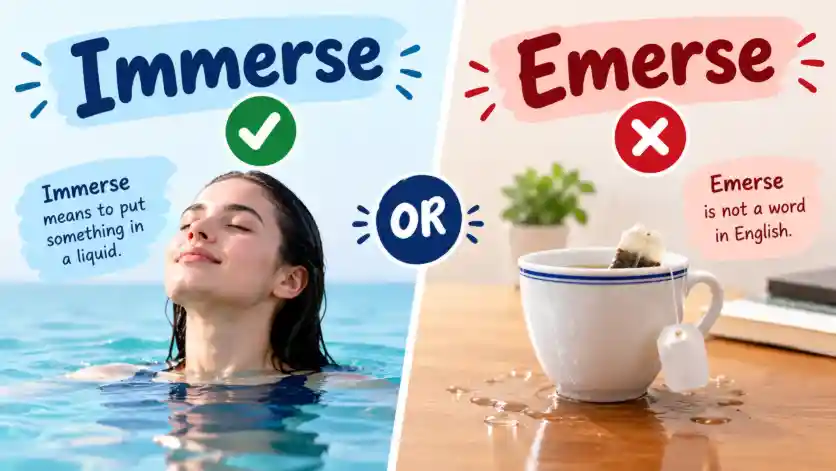
The correct word is immerse, not emerse, when you mean to put something deeply into a liquid, activity, subject, or experience.
Immerse is a standard English verb with several related meanings. You can immerse an object in water, immerse yourself in a book, or become deeply involved in an activity.
Emersed is a real word in some specialized contexts, but emerse is not the standard spelling people usually mean when they search for this comparison.
The confusion often happens because immerse and emerge look and sound somewhat similar.
Quick Answer
Immerse
Immerse is the correct word for becoming deeply involved in something or placing something completely into a liquid.
Examples:
Immerse the cloth in warm water.
She immersed herself in the book.
He became immersed in his studies.
Emerge
If you mean come out, appear, or become visible, the correct word is emerge, not emerse.
Examples:
The swimmer emerged from the water.
The sun emerged from behind the clouds.
She emerged from the building.
Simple Rule
Use immerse for deep involvement or putting something into a liquid.
Use emerge for coming out or becoming visible.
What Does Immerse Mean?
Definition of Immerse
Immerse means to put something completely into a liquid or to become deeply involved in an activity, subject, or experience.
Examples:
Immerse the vegetables in boiling water.
He immersed the cloth in water.
The word also has a figurative meaning:
She immersed herself in her studies.
Here, she is not physically entering anything. The sentence means that she became deeply involved in studying.
Immerse in Everyday English
You can use immerse when talking about:
- Water
- Reading
- Learning
- Work
- Culture
- Hobbies
- Experiences
Examples:
I like to immerse myself in a good book.
They immersed themselves in the local culture.
What Does Emerge Mean?
Definition of Emerge
Emerge means to come out of something, appear, or become known or visible.
Examples:
The bird emerged from its nest.
The moon emerged from behind the clouds.
New details emerged during the investigation.
The word usually describes movement from a hidden, enclosed, or less visible position into view.
Emerge From Something
Emerge is often followed by from.
Examples:
He emerged from the room.
The butterfly emerged from its cocoon.
The boat emerged from the fog.
Immerse vs Emerge: Main Difference
Immerse Means Going In
It suggests putting something into something else or becoming deeply involved.
She immersed herself in the project.
Emerge Means Coming Out
Emerge suggests coming out, appearing, or becoming visible.
She emerged from the building.
Easy Comparison
| Word | Main meaning | Example |
| Immerse | Put into or become deeply involved | He immersed himself in the book. |
| Emerge | Come out or become visible | He emerged from the room. |
| Emersed | Above the surface of water | The plant had emersed leaves. |
Is Emersed a Word?
Meaning of Emersed
Emersed is a real word, but it has a specialized meaning.
It is mainly used in botanical and aquatic contexts to describe something that rises above the surface of water.
For example:
The plant developed emersed leaves above the water.
This word should not normally be used as a replacement for immerse or emerge in ordinary English.
Emersed vs Immersed
These words can have almost opposite meanings in certain contexts.
Immersed means placed under or surrounded by something, especially liquid.
Emersed can describe something that rises above the water’s surface.
Why Are Immerse and Emerge Confused?
Similar Spelling
Both words begin with similar letters and contain -mer-.
- immerse
- emerge
This can make them easy to mix up.
Different Meanings
Their meanings are actually quite different.
Immerse = go deeply into something.
Emerge = come out or appear.
Similar Water Contexts
Water can make the confusion even greater.
The swimmer immersed himself in the water.
The swimmer emerged from the water.
The first sentence describes going into the water, while the second describes coming out.
Common Mistakes With Immerse and Emerge
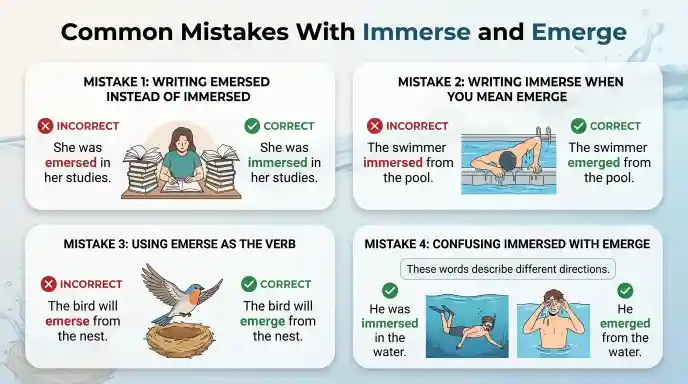
Mistake 1: Writing Emersed Instead of Immersed
Incorrect:
She was emersed in her studies.
Correct:
She was immersed in her studies.
Mistake 2: Writing Immerse When You Mean Emerge
Incorrect:
The swimmer immersed from the pool.
Correct:
The swimmer emerged from the pool.
Mistake 3: Using Emerse as the Verb
Incorrect:
The bird will emerse from the nest.
Correct:
The bird will emerge from the nest.
Mistake 4: Confusing Immersed With Emerge
These words describe different directions.
He was immersed in the water.
He emerged from the water.
Everyday Examples of Immerse
Reading
She immersed herself in a fascinating novel.
Learning
The students immersed themselves in the language.
Work
He immersed himself in the new project.
Culture
They immersed themselves in the local culture.
Water
Immerse the item in warm water.
Everyday Examples of Emerge
From a Building
She emerged from the building.
From Water
The swimmer emerged from the pool.
From Darkness
The car emerged from the darkness.
From a Crowd
The speaker emerged from the crowd.
New Information
New information emerged during the meeting.
Immerse or Emerge in Formal Writing
Immerse
It works well in formal writing when describing deep involvement.
The researchers immersed themselves in the study.
Students were encouraged to immerse themselves in the language.
Emerge
Emerge is commonly used when something appears or becomes known.
Several important findings emerged from the research.
A clear pattern emerged from the data.
Both words are standard and useful in formal writing, but they cannot normally replace each other.
British and American English
British English
Immerse and emerge are standard words in British English.
Examples:
She immersed herself in the course.
He emerged from the room.
American English
American English uses the same standard forms.
Examples:
She immersed herself in the course.
He emerged from the room.
There is no major spelling difference between American and British English for these words.
Immerse or Emerge: Comparison Table
| Feature | Immerse | Emerge |
| Correct standard word | Yes | Yes |
| Main meaning | Go deeply into something | Come out or appear |
| Used with water | Yes | Yes |
| Used figuratively | Yes | Yes |
| Common in formal writing | Yes | Yes |
| Example | Immerse yourself in learning. | Emerge from the room. |
How to Remember the Difference
Immerse = Go In
Think of immerse as moving deeply into something.
Immerse yourself in a book.
Immerse the object in water.
Emerge = Come Out
Think of emerge as coming out or appearing.
Emerge from the water.
Emerge from the building.
Simple Memory Trick
Immerse → In
Emerge → Exit
This simple connection can make the difference easier to remember.
Frequently Asked Questions
Is emerse a correct word?
Emerse is not the standard everyday English word people usually intend in this comparison. The correct word is normally immerse or emerge, depending on the meaning.
Is immerse correct?
Yes. Immerse is a standard English verb meaning to put something into a liquid or become deeply involved in something.
What is the difference between immerse and emerge?
Immerse means to put something into or become deeply involved in something. Emerge means to come out, appear, or become visible.
Is emersed a real word?
Yes. Emersed is a specialized word, especially in botanical and aquatic contexts, for something that rises above the water’s surface.
Should I say “immersed in” or “emerged from”?
Both are correct, but they have different meanings.
She was immersed in her work.
She emerged from the office.
What is the correct spelling for deep involvement?
The correct word is immersed.
He was immersed in his studies.
Conclusion
Immerse is the correct word when you mean putting something deeply into a liquid or becoming deeply involved in an activity, subject, or experience. Emerge means to come out, appear, or become visible.
The spelling emerse is not normally used for either of these everyday meanings. Emersed does exist as a specialized term, particularly in descriptions of plants or objects above the surface of water.
A simple way to remember the difference is:
Immerse = go in.
Emerge = come out.
Once you connect each word with its meaning, choosing between immerse or emerse becomes much easier.
Read More:
- Injust or Unjust: A Simple Guide With Examples
- Fead or Feed: How to Spell This Word Correctly
- Tierd or Tired: Avoid This Common Spelling Error









1 thought on “Immerse or Emerse: Which Spelling Is Correct in 2026?”