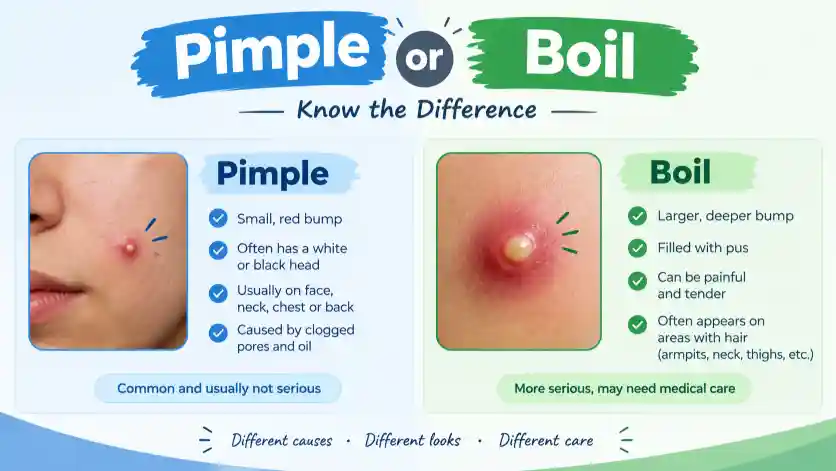
Pimple or Boil comes down to depth and cause a pimple happens when a pore becomes clogged with oil and dead skin, while a boil (furuncle) is a deeper, pus-filled bacterial infection of a hair follicle.
Pimples are typically smaller, more superficial, and cause mild or no pain, while boils start as tender, red lumps that grow larger, feel warmer, and become significantly more painful over time.
Boils are most commonly caused by Staphylococcus aureus bacteria entering through a cut or hair follicle, and unlike pimples, they often require medical drainage rather than over-the-counter treatment.
Squeezing either is risky, but popping a boil carries much higher danger it can spread infection into surrounding tissue or, in rare cases, the bloodstream.
In this guide, you’ll learn how to tell a pimple from a boil, when home treatment is safe, and when it’s time to see a doctor in 2026.
Pimple or Boil : Quick Answer
| Feature | Pimple | Boil |
| Main cause | Clogged pore | Bacterial infection |
| Usually affects | Hair follicles and pores | Hair follicles |
| Size | Usually small | Often larger |
| Pain | Mild or moderate | Often painful |
| Pus | Sometimes | Common |
| Common areas | Face, chest, back | Thighs, buttocks, armpits, neck |
| Acne-related | Yes | No |
| Can grow larger? | Usually limited | May become larger |
Simple rule: A small bump associated with acne is more likely to be a pimple. A painful, enlarging lump filled with pus may be a boil.
What Is a Pimple?
A pimple is a small skin lesion that develops when a pore becomes clogged with oil, dead skin cells, and sometimes bacteria.
Pimples are one of the most common signs of acne. They can appear as:
- Whiteheads
- Blackheads
- Red bumps
- Pus-filled spots
- Small tender bumps
Pimples commonly appear on areas where the skin produces more oil, including the face, forehead, chest, shoulders, and upper back.
Common Causes of Pimples
Pimples can develop because of:
- Excess oil production
- Dead skin cells
- Clogged pores
- Hormonal changes
- Certain cosmetics or skin products
- Friction or pressure on the skin
- Acne-causing bacteria
Not every red bump is necessarily a pimple, however.
What Is a Boil?
A boil is a painful skin infection that usually starts in a hair follicle or oil gland. It often develops when bacteria enter the skin through a small cut, irritated follicle, or damaged area.
A boil may begin as a red, tender lump. Over time, it can become larger and develop a center containing pus.
Boils commonly occur on areas where there is hair, friction, or sweating, such as:
- Armpits
- Neck
- Face
- Thighs
- Buttocks
- Groin area
Several connected boils can sometimes form a larger infected area called a carbuncle.
Pimple vs Boil: Main Differences
The biggest difference between a pimple and a boil is how they develop and how large and painful they become.
A pimple usually results from a clogged pore and is often part of acne. A boil is generally an infection involving a hair follicle and surrounding tissue.
1. Cause
Pimples: Usually result from clogged pores and acne-related changes.
Boils: Usually result from a bacterial infection of a hair follicle.
2. Size
Pimples are generally small, although some deeper acne lesions can become quite large.
Boils often grow into larger, more noticeable lumps.
3. Pain
A small pimple may cause little discomfort.
Boils are often noticeably painful, tender, or warm to the touch.
4. Appearance
Pimples can appear as whiteheads, blackheads, red bumps, or pustules.
Boils often start as a red or swollen lump and may develop a yellow or white center as pus collects.
5. Location
Pimples commonly occur on the face and other acne-prone areas.
Boils can occur almost anywhere but are often found in areas affected by hair, sweating, and friction.
Why Are Pimple and Boil Confused?
People often search for pimple or boil because both conditions can produce:
- Redness
- Swelling
- Tenderness
- A raised bump
- Pus
- Warmth around the area
The appearance alone may not always be enough to identify the problem. A large, painful pimple can sometimes look similar to a small boil.
Common Mistakes
Mistake 1: Squeezing the Bump
Trying to pop or squeeze a boil can worsen the infection or spread bacteria.
Similarly, repeatedly squeezing pimples can increase inflammation and may contribute to scarring.
Mistake 2: Assuming Every Pus-Filled Bump Is Acne
A pus-filled bump is not automatically a pimple. Its size, pain, location, and progression also matter.
Mistake 3: Using Harsh Products
Strong products or excessive scrubbing can irritate inflamed skin and make the area worse.
Mistake 4: Ignoring a Rapidly Growing Lump
A painful lump that continues getting larger should not simply be assumed to be an ordinary pimple.
Pimple or Boil: How Are They Treated?
Treatment depends on what is causing the bump.
For Pimples
Common acne-care approaches include:
- Gentle cleansing
- Avoiding unnecessary touching
- Using non-comedogenic skin products
- Over-the-counter acne treatments when appropriate
- Avoiding repeated squeezing
Some persistent or severe acne may require treatment from a healthcare professional.
For Boils
Small boils may sometimes improve with simple supportive care. A clean, warm, moist compress can help encourage natural drainage.
Keep the area clean and avoid squeezing or piercing the boil.
A healthcare professional may need to drain a larger boil or prescribe antibiotics in certain situations.
When Should You See a Doctor?
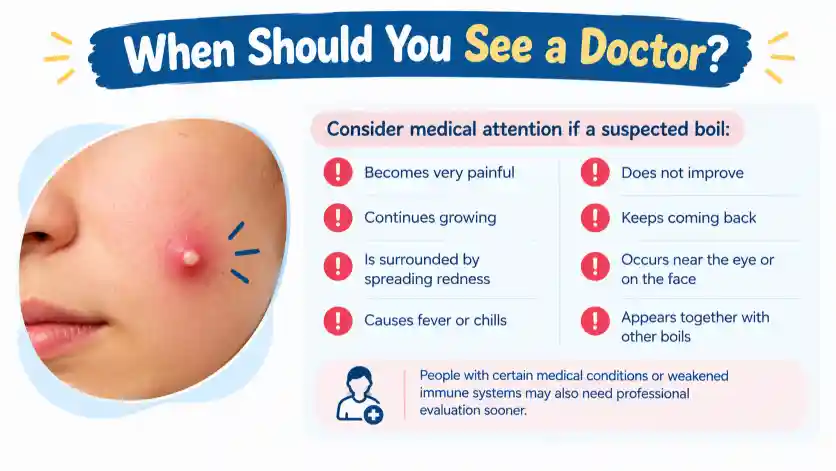
Consider medical attention if a suspected boil:
- Becomes very painful
- Continues growing
- Is surrounded by spreading redness
- Causes fever or chills
- Does not improve
- Keeps coming back
- Occurs near the eye or on the face
- Appears together with other boils
People with certain medical conditions or weakened immune systems may also need professional evaluation sooner.
Pimple or Boil: Everyday Examples
Example 1: Small Facial Spot
You notice several small red bumps and whiteheads on your forehead.
Likely explanation: These are more consistent with pimples or acne.
Example 2: Painful Lump on the Thigh
A single red lump becomes increasingly painful and develops a pus-filled center.
Possible explanation: This may be a boil rather than a typical pimple.
Example 3: Recurring Acne
Small bumps repeatedly appear on the face, chest, and back.
Likely explanation: Recurring acne is more consistent with pimples.
Pimple or Boil Comparison Table
| Question | Pimple | Boil |
| Is it usually acne-related? | Yes | No |
| Is it usually caused by a clogged pore? | Yes | No |
| Is infection involved? | Bacteria can contribute to acne | Usually a bacterial infection |
| Is it usually painful? | Sometimes | Often |
| Does it commonly become large? | Usually not | It can |
| Can it contain pus? | Yes | Yes |
| Should you squeeze it? | Avoid squeezing | Do not squeeze or pierce |
Pimple or Boil: Which One Do You Have?
The difference often comes down to pattern, size, pain, and progression.
A cluster of smaller bumps, blackheads, whiteheads, or recurring facial spots is more suggestive of acne and pimples. A single painful lump that becomes increasingly swollen and develops a pus-filled center may be more consistent with a boil.
However, skin conditions can look alike. If you are uncertain, especially when a lump is large, painful, spreading, or accompanied by fever, a healthcare professional can provide a proper diagnosis.
Google Trends & Modern Usage
The phrase “pimple or boil” reflects a common search intention: people want to understand whether a skin bump is related to acne or a possible infection.
Searches may also include questions such as:
- Is this a pimple or boil?
- How can you tell a boil from a pimple?
- Can a pimple turn into a boil?
- Why is my pimple so painful?
- What does a boil look like?
- How do you treat a boil?
Using clear distinctions between the two terms makes this topic useful for readers who are trying to understand unfamiliar skin symptoms.
FAQs About Pimple or Boil
Is a boil the same as a pimple?
No. A pimple is generally associated with clogged pores and acne, while a boil is usually an infection involving a hair follicle.
Can a pimple turn into a boil?
A pimple and a boil are different conditions, although both can involve bacteria, inflammation, and pus. A worsening or unusually painful bump should be evaluated rather than assumed to be a simple pimple.
Are boils painful?
Boils are often painful and tender, especially as they grow.
Are pimples always filled with pus?
No. Pimples can appear in several forms, including blackheads, whiteheads, red bumps, and pustules.
Should you pop a boil?
It is generally best not to squeeze or pierce a boil because this can worsen or spread the infection.
Can boils go away on their own?
Some small boils may resolve with supportive care, but larger, persistent, or worsening boils may require medical treatment.
When is a skin bump an emergency?
Seek prompt medical attention if a skin infection is rapidly spreading, accompanied by significant illness or fever, or located near sensitive areas such as the eye.
Conclusion
A pimple and a boil can look similar, but they are not the same thing. Pimples are usually connected with clogged pores and acne, while boils are typically painful infections involving a hair follicle. Pimples are often smaller and may appear repeatedly in acne-prone areas, whereas boils can develop into larger, tender lumps containing pus.
Avoid squeezing either type of bump, and pay attention to changes in size, pain, redness, and other symptoms. If a suspected boil becomes increasingly painful, grows quickly, spreads redness, or causes fever, professional medical advice is appropriate.
Knowing the difference between pimple or boil can help you better understand what you are seeing and choose safer next steps.
Read More:
- Lowe’s Bend OR: Store, Hours, Address, Services & More
- FSKAX or FXAIX: Settling the Bogleheads Debate for 2026
- Master’s or Bachelor’s: The Decision That Shapes Your Career





1 thought on “Pimple or Boil: How to Tell the Difference in 2026”