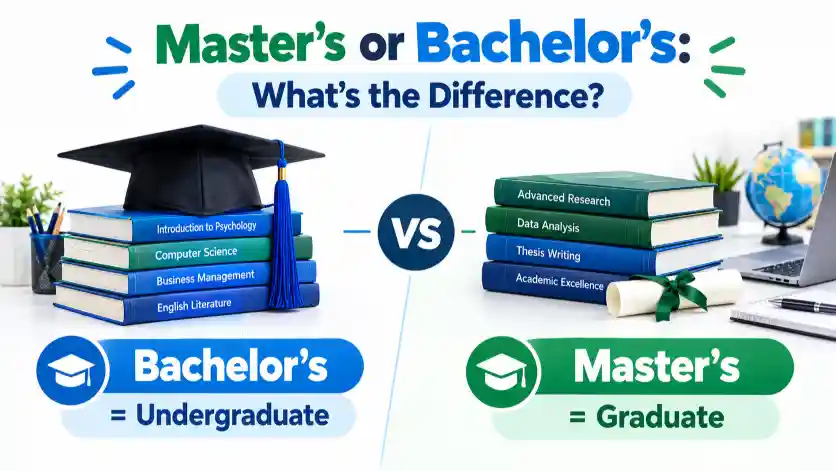
A bachelor’s degree comes before a master’s degree in the traditional higher education pathway.
A bachelor’s is an undergraduate qualification that provides foundational knowledge in a field, while a master’s is a graduate or postgraduate qualification that provides more advanced and specialized study.
People often search “master’s or bachelor’s” when they are comparing degree levels, admission requirements, study duration, career options, or deciding what qualification they need for a particular job.
Understanding the difference can make educational and career planning much easier.
Master’s or Bachelor’s: Quick Answer
A bachelor’s degree is normally the first major university degree a student earns after secondary education.
A master’s degree is a higher level qualification that normally comes after a bachelor’s and focuses on advanced knowledge or specialization.
| Feature | Bachelor’s | Master’s |
| Level | Undergraduate | Graduate/Postgraduate |
| Usually comes | First | After bachelor’s |
| Main focus | Broad foundation | Advanced specialization |
| Typical duration | About 3–4+ years | About 1–2+ years |
| Common degrees | BA, BS, BSc | MA, MS, MSc |
| Admission | Secondary education | Usually bachelor’s degree |
| Coursework | Broad and structured | More specialized |
| Research | Usually limited | Often more significant |
What Is a Bachelor’s Degree?
A bachelor’s degree is an undergraduate academic qualification. It is commonly the first university degree students pursue after completing secondary education.
Bachelor’s programs provide a broad foundation in a particular subject while also developing general academic and professional skills. Common examples include:
- Bachelor of Arts (BA)
- Bachelor of Science (BS/BSc)
- Bachelor of Business Administration (BBA)
- Bachelor of Engineering (BE)
The exact structure and duration vary by country and institution. In the United States, a bachelor’s program is commonly around four years of full time study.
Examples of Bachelor’s Subjects
Students can earn bachelor’s degrees in fields such as:
- English
- Business
- Computer Science
- Psychology
- Biology
- Education
- Engineering
- Economics
- History
- Mathematics
A bachelor’s can prepare someone for employment or provide the academic foundation needed for graduate study.
What Is a Master’s Degree?
A master’s degree is a graduate or postgraduate qualification that generally follows a bachelor’s degree.
Master’s programs focus on deeper knowledge and specialization within a particular subject. Depending on the program, students may complete advanced coursework, practical projects, research, or a thesis.
Common master’s degrees include:
- Master of Arts (MA)
- Master of Science (MS/MSc)
- Master of Business Administration (MBA)
- Master of Education (MEd)
- Master of Public Health (MPH)
For example, someone might complete a BA in English and then pursue an MA in English Literature.
Master’s or Bachelor’s: Which Comes First?
In the traditional education pathway, the bachelor’s comes first.
A typical progression looks like this:
High School → Bachelor’s → Master’s → Doctorate
A bachelor’s provides undergraduate education, while a master’s builds on previous higher education with more advanced study.
There are exceptions in some countries and programs, so admission requirements should always be checked with the specific university.
Master’s vs Bachelor’s: Level of Study
One of the clearest differences is the academic level.
A bachelor’s is generally classified as an undergraduate degree.
A master’s is generally classified as a graduate or postgraduate degree.
This means a master’s represents a higher level of academic study than a bachelor’s.
However, a higher academic level does not automatically mean that a master’s is necessary for every career. Requirements depend on the profession, employer, country, and specific position.
Master’s vs Bachelor’s: Duration
The length of a degree varies considerably depending on the country, university, subject, and study format.
A bachelor’s program is commonly around three to four years of full time study in many education systems, although some programs take longer.
Master’s programs are generally shorter, often around one to two years, although some can take longer.
Part time and online study can also change the total completion time.
Master’s or Bachelor’s: Admission Requirements
Bachelor’s and master’s programs generally have different entry requirements.
Bachelor’s Admission
Universities commonly ask for:
- High school completion
- Academic transcripts
- Application forms
- Proof of language proficiency where applicable
- Entrance tests for some programs
- Other documents required by the institution
Master’s Admission
Master’s programs generally require:
- A completed bachelor’s degree
- Undergraduate transcripts
- Application materials
- Statement of purpose or personal statement for some programs
- Recommendation letters for some programs
- Additional prerequisites depending on the subject
Requirements vary by institution and country.
Difference in Coursework
Bachelor’s programs generally introduce students to a broad range of subjects within their discipline.
For example, a bachelor’s student studying business might take courses in:
- Accounting
- Marketing
- Finance
- Economics
- Management
- Business law
A master’s student may focus much more deeply on a specific area such as:
- Financial management
- Marketing analytics
- Data science
- International business
- Organizational leadership
Graduate study tends to emphasize deeper analysis, specialized knowledge, research, and practical application.
Master’s or Bachelor’s for Career Opportunities
A bachelor’s degree can provide access to many professional and entry level positions.
A master’s may be useful when a career requires advanced specialization or when a person wants to develop expertise in a particular field.
For example:
Bachelor’s in Computer Science → software development roles
Master’s in Computer Science → advanced specialization or research oriented opportunities
The actual requirements depend on the employer and profession. Some jobs require only a bachelor’s, while others require or prefer postgraduate education.
Master’s or Bachelor’s for Further Education
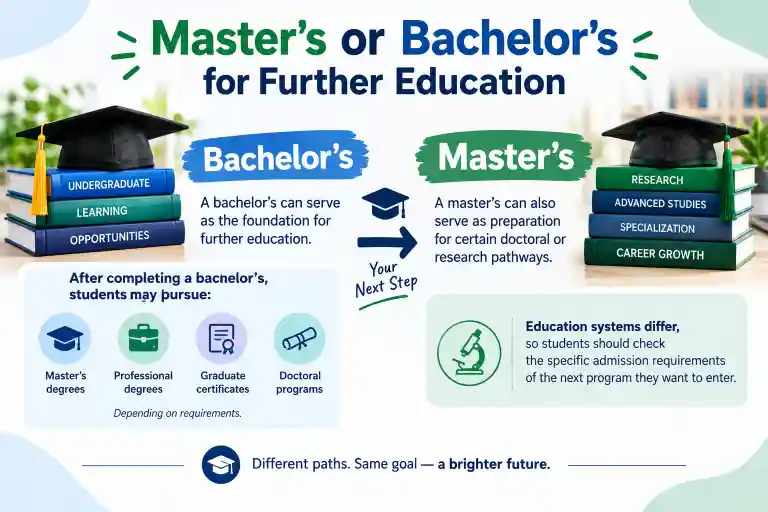
A bachelor’s can serve as the foundation for further education.
After completing a bachelor’s, students may pursue:
- Master’s degrees
- Professional degrees
- Graduate certificates
- Doctoral programs, depending on requirements
A master’s can also serve as preparation for certain doctoral or research pathways.
Education systems differ, so students should check the specific admission requirements of the next program they want to enter.
Cost and Time Commitment
A bachelor’s normally involves more total years of study, while a master’s is usually shorter but more specialized.
The total cost depends on factors such as:
- University
- Country
- Tuition fees
- Program length
- Living expenses
- Online or in person study
- Scholarships
- Financial aid
Therefore, there is no universal answer about which degree costs more.
Common Mistakes With Master’s or Bachelor’s
1. Thinking a Master’s Comes First
In the traditional pathway, a bachelor’s normally comes before a master’s.
Correct:
Bachelor’s → Master’s
2. Using “Bachelor” and “Master” as the Same Level
They represent different academic levels.
Bachelor’s = undergraduate
Master’s = graduate/postgraduate
3. Assuming Every Master’s Takes Two Years
Some master’s programs take one year, while others take two years or longer depending on the institution and subject.
4. Assuming a Master’s Is Required for Every Career
Many careers can be entered with a bachelor’s degree. Other professions or specialized roles may require graduate education.
5. Confusing Degree Names With Academic Levels
BA, BS, MA, and MS are examples of degree types. The exact naming system varies among countries and institutions.
Bachelor’s or Master’s: Example Pathways
Example 1: English
Bachelor’s: BA in English
Master’s: MA in English
Example 2: Computer Science
Bachelor’s: BS in Computer Science
Master’s: MS in Computer Science
Example 3: Business
Bachelor’s: BBA
Master’s: MBA
Example 4: Education
Bachelor’s: Bachelor of Education
Master’s: Master of Education
These pathways show how a master’s can build on knowledge gained during undergraduate study.
Master’s or Bachelor’s: Quick Comparison
| Question | Bachelor’s | Master’s |
| Is it undergraduate? | Yes | No |
| Is it graduate level? | No | Yes |
| Usually requires a bachelor’s first? | No | Yes |
| Provides foundational knowledge? | Yes | Builds on it |
| Provides specialization? | Some | Usually more |
| Can lead to employment? | Yes | Yes |
| Can lead to further study? | Yes | Yes |
| Usually shorter? | No | Yes |
Master’s or Bachelor’s in Pakistan
In Pakistan, degree structures can differ depending on the institution and the specific program. The Higher Education Commission (HEC) recognizes different degree pathways and provides equivalence guidance for qualifications.
For example, HEC states that a four year Bachelor’s (Hons) degree after 12 years of schooling is generally recognized as equivalent to the old MA/MSc involving 16 years of schooling in the relevant field, subject to HEC’s equivalence rules and individual determination where applicable.
This is important because the terminology “bachelor’s” and “master’s” can refer to different structures across education systems.
If you are applying for a job, university program, or equivalence in Pakistan, always check the specific HEC and institution requirements.
Which One Should You Choose?
The answer depends on where you are in your education and what you want to do next.
A bachelor’s degree is generally the starting point if you are beginning university level education after secondary school.
A master’s degree is generally relevant if you already have a bachelor’s and want to pursue advanced or specialized study.
Instead of asking which degree is universally better, consider:
- What qualification does your target career require?
- Do you already have a bachelor’s degree?
- Do you need specialized knowledge?
- How much time can you dedicate to further study?
- What are the total costs?
- Does your chosen university offer the appropriate program?
Key Takeaways
- A bachelor’s degree is generally an undergraduate qualification.
- A master’s degree is generally a graduate or postgraduate qualification.
- A bachelor’s normally comes before a master’s.
- Bachelor’s programs generally provide foundational knowledge.
- Master’s programs generally provide deeper specialization.
- Bachelor’s programs often take longer overall.
- Master’s programs are usually shorter but more advanced.
- Career and admission requirements vary by field and institution.
- In Pakistan, HEC rules are important when determining degree recognition and equivalence.
FAQs About Master’s or Bachelor’s
Is a master’s higher than a bachelor’s?
Yes. In the standard academic hierarchy, a master’s is a graduate level qualification and is higher than a bachelor’s, which is an undergraduate qualification.
Do you need a bachelor’s before a master’s?
Usually, yes. Most master’s programs require applicants to have completed a bachelor’s degree or an equivalent qualification. Specific requirements vary by institution and country.
Is a bachelor’s degree undergraduate or graduate?
A bachelor’s degree is generally an undergraduate degree. It is commonly the first major university qualification students complete after secondary education.
Is a master’s degree undergraduate or graduate?
A master’s degree is generally a graduate or postgraduate degree. It normally builds on knowledge gained during a bachelor’s program.
Which takes longer, a bachelor’s or master’s?
A bachelor’s generally takes longer in total. Bachelor’s programs often take around three to four years or more, while many master’s programs take around one to two years, depending on the country and program.
Can you get a job with a bachelor’s degree?
Yes. Many careers accept or require a bachelor’s degree as an entry qualification. The exact requirement depends on the profession and employer.
Is a master’s degree necessary after a bachelor’s?
Not always. Some people enter employment after completing a bachelor’s, while others pursue a master’s for specialization, career requirements, research, or further academic study.
Can a master’s be in a different subject from your bachelor’s?
Sometimes. Universities may allow students to enter a different discipline, but prerequisites or relevant coursework may be required.
Is BA a bachelor’s degree?
Yes. BA usually stands for Bachelor of Arts, which is a type of bachelor’s degree.
Is MA a master’s degree?
Yes. MA usually stands for Master of Arts, which is a type of master’s degree.
Conclusion
Bachelor’s and master’s degrees represent different stages of higher education. A bachelor’s is generally an undergraduate degree that provides foundational knowledge and skills, while a master’s is a graduate level qualification that allows students to explore a subject in greater depth.
For someone beginning university education, the bachelor’s is normally the starting point. After completing it, a student can decide if additional education is useful for their career or academic goals. A master’s can provide advanced specialization, but it is not automatically required for every profession.
The best choice depends on the field of study, career requirements, educational system, time, cost, and personal goals. Checking the requirements of the specific university or profession is the most reliable way to determine which qualification you need.
Read more:
- Consol or Console: A Quick Fix for 2026 Writers
- Instalments or Installments: American vs British Spelling in 2026
- MP3 or WAV: Which Audio Format Should You Use?






3 thoughts on “Master’s or Bachelor’s: The Decision That Shapes Your Career”