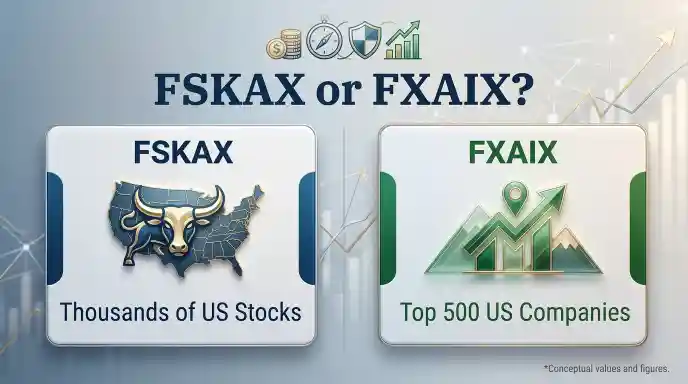
FSKAX or FXAIX comes down to total U.S. market exposure versus concentration in just the 500 largest American companies both are low-cost Fidelity index mutual funds with nearly identical 0.02% expense ratios.
FSKAX tracks the Dow Jones U.S. Total Stock Market Index, holding around 4,000 companies across small, mid, and large caps, while FXAIX tracks the S&P 500, focusing purely on the 500 largest U.S. companies.
Historically, FXAIX has posted slightly higher returns since large tech stocks have driven most recent market growth, though FSKAX offers broader diversification that can outperform when smaller companies rally.
In this guide, you’ll compare fees, holdings, performance, and volatility to help decide which Fidelity index fund fits your investment strategy in 2026.
FSKAX or FXAIX : Quick Answer
| Feature | FSKAX | FXAIX |
| Full name | Fidelity Total Market Index Fund | Fidelity 500 Index Fund |
| Main index | Dow Jones U.S. Total Stock Market Index | S&P 500 Index |
| Approx. holdings | 3,757 | 508 |
| Expense ratio | 0.015% | 0.015% |
| Fund inception | 1997 | 1988 |
| Focus | Broad U.S. stock market | Large U.S. companies |
| Small-cap exposure | Yes | Very limited |
| Minimum investment | $0 | $0 |
Current portfolio and fee figures are based on Fidelity data available in 2026.
What Is FSKAX?
FSKAX is the Fidelity Total Market Index Fund.
Its goal is to provide investment results that correspond to the performance of a broad range of U.S. stocks. It normally invests at least 80% of its assets in stocks included in the Dow Jones U.S. Total Stock Market Index.
As of July 31, 2026, FSKAX had approximately 3,757 holdings. Its largest holdings included NVIDIA, Apple, Microsoft, Amazon, and Alphabet.
Because it covers a much broader portion of the U.S. stock market, FSKAX includes exposure beyond the biggest companies.
What Is FXAIX?
FXAIX is the Fidelity 500 Index Fund.
It seeks to track the performance of the S&P 500 Index, which represents large publicly traded U.S. companies. Fidelity states that the fund normally invests at least 80% of its assets in common stocks included in the S&P 500.
As of July 31, 2026, FXAIX had 508 holdings. Its largest holdings included NVIDIA, Apple, Microsoft, Amazon, and Alphabet.
FSKAX vs FXAIX: Main Difference
The biggest difference is market coverage.
FSKAX
FSKAX attempts to represent a broad section of the U.S. stock market.
That means it includes:
- Large-cap companies
- Mid-cap companies
- Small-cap companies
- Thousands of individual stocks
FXAIX
FXAIX concentrates on the companies represented in the S&P 500.
This means its portfolio is much more focused on large U.S. businesses.
In simple terms:
FSKAX = broader U.S. stock market
FXAIX = S&P 500 large-cap stocks
Holdings: FSKAX vs FXAIX
The difference in the number of holdings is substantial.
As of July 31, 2026:
- FSKAX: 3,757 holdings
- FXAIX: 508 holdings
Despite this difference, the funds have many of the same major companies.
For example, both funds held major companies such as:
- NVIDIA
- Apple
- Microsoft
- Amazon
- Alphabet
- Broadcom
- Meta Platforms
- JPMorgan Chase
The percentage allocated to each company differs because the funds follow different indexes.
Expense Ratio
One of the interesting things about FSKAX vs FXAIX is that their expense ratios are currently the same.
| Fund | Expense Ratio |
| FSKAX | 0.015% |
| FXAIX | 0.015% |
Fidelity lists the expense ratio for both funds at 0.015% as of April 29, 2026.
At that fee level, the difference in expenses between the two funds is essentially negligible for most investors.
Performance Comparison
Performance can change from year to year because the two funds track different indexes.
Fidelity’s data as of August 31, 2026 showed:
| Period | FSKAX | FXAIX |
| 1 year | 20.15% | 20.36% |
| 3 years | 20.67% | 21.03% |
| 5 years | 11.72% | 12.78% |
| 10 years | 14.80% | 15.36% |
These are historical annualized returns and should not be treated as predictions of future performance.
The difference illustrates an important point: past performance does not establish which fund will perform better in the future.
Diversification
FSKAX provides broader diversification across the U.S. equity market because it holds thousands of stocks.
FXAIX also provides substantial diversification because the S&P 500 contains hundreds of companies across major sectors.
However, their diversification is structured differently:
FSKAX: Broad U.S. market exposure
FXAIX: Large-cap U.S. market exposure
Neither fund provides broad international stock-market exposure.
FSKAX or FXAIX for Long Term Investing?
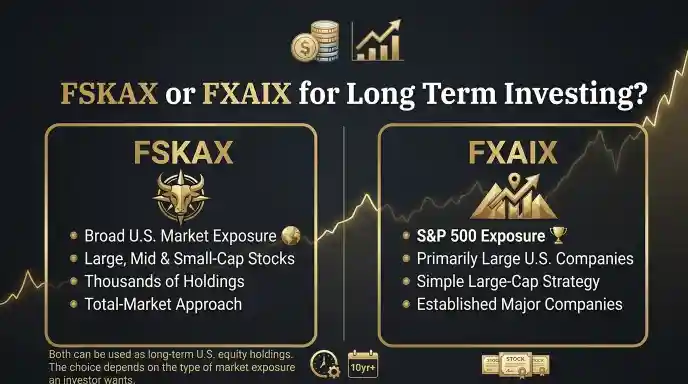
Both funds can be used as long-term U.S. equity holdings.
The choice depends largely on the type of market exposure an investor wants.
FSKAX may fit an investor who wants:
- Broad U.S. market exposure
- Large-, mid-, and small-cap stocks
- Thousands of holdings
- A total-market approach
FXAIX may fit an investor who wants:
- S&P 500 exposure
- Primarily large U.S. companies
- A straightforward large-cap index strategy
- Exposure to established major companies
These are descriptions of the funds’ structures rather than predictions about which investment will produce better future results.
FSKAX or FXAIX: Common Mistakes
Mistake 1: Thinking They Are Completely Different
They are different funds, but they overlap considerably.
Many of the largest U.S. companies appear in both portfolios.
Mistake 2: Choosing Based Only on the Number of Holdings
More holdings do not automatically mean higher returns.
FSKAX has thousands of holdings, while FXAIX has hundreds, but both have substantial exposure to the largest U.S. companies.
Mistake 3: Assuming Past Performance Will Continue
Historical returns can help describe how funds have performed, but they cannot guarantee future results.
Mistake 4: Ignoring Your Overall Portfolio
Choosing between FSKAX and FXAIX is only one part of portfolio construction.
Your other investments, time horizon, risk tolerance, and desired international exposure can also matter.
Mistake 5: Assuming FXAIX Is a Technology Fund
FXAIX is not specifically a technology fund. It tracks the S&P 500 and therefore holds companies across multiple sectors. Fidelity reported information technology as its largest sector at 36.57% as of July 31, 2026.
FSKAX or FXAIX in a Retirement Account
Both funds can be used in retirement-investing contexts, depending on the available investment choices in an individual’s account.
For someone building a long-term portfolio, the key question is not simply which ticker has performed better recently. It is whether the fund’s index exposure fits the investor’s overall strategy.
A retirement portfolio might also include other asset classes or international investments depending on the investor’s objectives.
FSKAX vs FXAIX: Comparison Table
| Category | FSKAX | FXAIX |
| Fund type | Index mutual fund | Index mutual fund |
| Index | Dow Jones U.S. Total Stock Market | S&P 500 |
| Holdings | 3,757 | 508 |
| Market coverage | Broad U.S. market | Large-cap U.S. stocks |
| Small-cap exposure | Yes | Minimal |
| Expense ratio | 0.015% | 0.015% |
| Minimum investment | $0 | $0 |
| Inception | 1997 | 1988 |
| International exposure | Very limited | Very limited |
| Major-company overlap | High | High |
Holdings and fund statistics can change over time, so the figures above should be viewed as a 2026 snapshot.
Google Trends & Modern Usage
Searches for “FSKAX or FXAIX” often come from investors comparing Fidelity’s broad-market fund with its S&P 500 index fund.
Related searches include:
- FSKAX vs FXAIX
- FSKAX or FXAIX for retirement
- FSKAX vs FXAIX performance
- FSKAX vs S&P 500
- FXAIX vs total market
- FSKAX expense ratio
- FXAIX expense ratio
- FSKAX holdings
- FXAIX holdings
The comparison remains relevant because both funds provide low-cost access to large portions of the U.S. stock market.
FAQs About FSKAX or FXAIX
Is FSKAX the same as FXAIX?
No. FSKAX tracks the Dow Jones U.S. Total Stock Market Index, while FXAIX tracks the S&P 500 Index.
Which fund has more holdings?
FSKAX has substantially more holdings. Fidelity reported about 3,757 holdings for FSKAX and 508 for FXAIX as of July 31, 2026.
Do FSKAX and FXAIX have the same expense ratio?
Yes. Fidelity currently lists a 0.015% expense ratio for both funds.
Does FSKAX include small-cap stocks?
Yes. Because FSKAX tracks a broad U.S. total-market index, it includes companies beyond the large-cap stocks represented by the S&P 500.
Does FXAIX track the S&P 500?
Yes. FXAIX is designed to provide investment results corresponding to the S&P 500 Index.
Do FSKAX and FXAIX overlap?
Yes. Both funds hold many of the same large U.S. companies, although their weighting and overall market coverage differ.
Can FSKAX and FXAIX both be held?
Yes, an investor can hold both, but because they have significant overlap, doing so does not simply create two completely separate U.S. stock exposures.
Conclusion
FSKAX and FXAIX are both low-cost Fidelity index funds, but they follow different indexes. FSKAX provides broader exposure to the U.S. stock market with thousands of holdings, while FXAIX focuses on the large-cap companies represented by the S&P 500.
Their expense ratios are currently identical at 0.015%, and both funds have substantial exposure to major U.S. companies.
The main distinction is therefore breadth of market exposure, rather than cost. Understanding that difference can help investors compare the funds based on their own portfolio goals, desired diversification, and investment strategy.
Read More:
- Lowe’s Bend OR: Store, Hours, Address, Services & More
- Pimple or Boil: How to Tell the Difference in 2026
- Master’s or Bachelor’s: The Decision That Shapes Your Career








1 thought on “FSKAX or FXAIX: Settling the Bogleheads Debate for 2026”