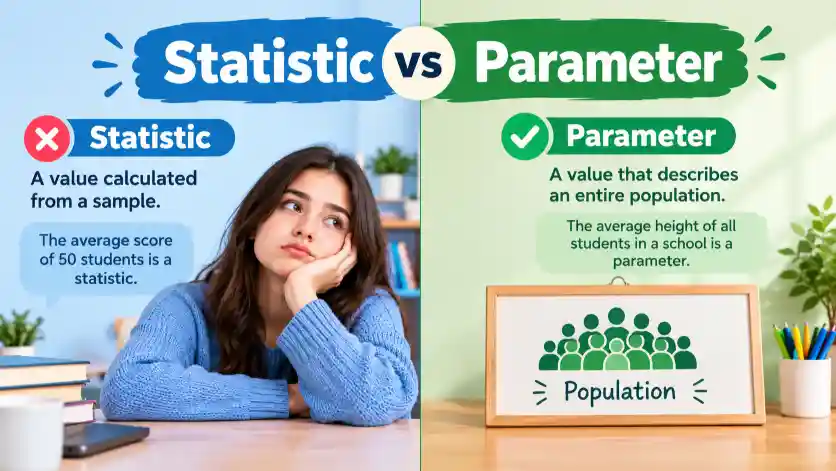
Many students lose marks because of one small mix-up: statistic vs parameter. Here is the quick answer. A statistic describes a sample, which is a small group you study. A parameter describes a population, which is the whole group you want to learn about.
People search for this topic before exams, homework, and research projects. The confusion is normal. Both words sound technical. Both deal with numbers. Many textbooks use them in the same chapter.
This guide clears the confusion step by step. You will learn the simple definitions, easy examples, and a memory trick. You will also see how writers use these words in school, business, and daily life. By the end, you will pick the right word every time. We keep every explanation short and simple, so even new English learners can follow along with ease. No hard math is needed to understand this guide.
Let us start with the short answer.
Statistic vs Parameter in 60 Seconds
A statistic is a number that describes a sample, like the average height of 100 students you measured. A parameter is a number that describes a whole population, like the average height of all students in a country. Use statistic for a small group you study. Use parameter for the full group. The sample gives a statistic. The population gives a parameter.
Statistic vs Parameter: Quick Answer
The rule is simple. A statistic comes from a sample. A parameter comes from a population.
A Simple Example
Think of a school. You ask 50 students about their favorite subject. The result is a statistic. It describes only those 50 students.
Now think of every student in the school. If you ask all of them, the result is a parameter. It describes the full group.
Quick points to remember:
- Sample leads to statistic. A sample is part of the group.
- Population leads to parameter. A population is the whole group.
- Researchers use statistics to guess parameters. They study a few to learn about the many.
How to Tell the Difference in 2 Easy Steps
Use this simple test in exams and homework. It works every time.
Step 1: Ask, “Did They Count Everyone?”
If the answer is yes, you have a parameter. When researchers count every single member of a group, it is called a census. A census always gives a parameter.
Examples: the votes of all 11 players on a cricket team, the marks of every student in one small school, the salaries of all 8 workers in a shop. These groups are small enough to count fully.
If the answer is no, you probably have a statistic. Most studies count only part of a group.
Step 2: Think About Time and Cost
Ask yourself: could anyone really survey every member? Think about the time and money it would take.
Example: a report says 62 percent of a country’s voters support a new law. No team can knock on every door in a country. They asked a sample. So the number is a statistic.
The simple rule: if counting everyone sounds impossible or far too costly, the number in front of you is almost always a statistic.
What Do Statistic and Parameter Mean?
What Does Statistic Mean?
The simple statistic definition is this: a statistic is a number that describes a sample. A sample is a small part of a larger group.
Examples: the average score of 30 students in one class, the share of 200 voters who support a plan, the most common answer in a survey of 100 buyers.
Writers also use statistic for any single number from data. News reports do this often. In this guide, we use the strict research meaning: a number from a sample.
What Does Parameter Mean?
The simple parameter definition is this: a parameter is a number that describes a population. A population is the full group you care about.
Examples: the average income of all workers in a city, the share of all voters in a country who support a plan, the true pass rate of every student who ever took a test.
In math, parameter has a second use. It can mean a fixed value that shapes a rule or model. In daily research talk, it almost always means a population number.
The Origin of Statistic and Parameter
Statistic comes from the Italian word statista, which meant a statesman. German thinkers built Statistik, the science of state numbers. Early statistics were counts about nations: people, crops, and taxes. Over time, the word moved into math and research.
Parameter comes from Greek. Para means beside. Metron means measure. In math, a parameter sits beside the main values and sets the shape of a system. Later, research borrowed the word for any true value of a whole population.
This history explains the split. Statistics grew from counting parts of a state. Parameters grew from fixed values that define a whole.
Greek Letters vs Roman Letters: The Notation Trick
Math books use a secret code. Greek letters mark parameters. Roman letters mark statistics. Once you see it, exam questions get much easier.
How to Read the Symbols
| What It Means | Parameter (Population) | Statistic (Sample) |
| Average | μ, called “mu” | x̄, called “x-bar” |
| Spread | σ, called “sigma” | s |
Example: You see μ in a question. That is a parameter. It talks about the full population. You see x̄ in a question. That is a statistic. It talks about a sample.
Books also use p for a population share and p̂ for a sample share. Do not fear the symbols. Just check the letter family. Greek means the whole group. Roman means part of the group.
British English vs American English
Good news. The spelling is the same in both. There is no US or UK difference for these words.
| British English | American English | Example |
| statistic | statistic | The sample statistic was 72 percent. |
| parameter | parameter | The population parameter is unknown. |
| statistics (plural) | statistics (plural) | Both statistics point the same way. |
| parameters (plural) | parameters (plural) | The model has three parameters. |
APA, MLA, and Chicago all use the same forms. Journals in London and New York spell them the same way. The difference is meaning, not spelling.
Which Word Should You Use?
- United States: Use statistic for sample numbers and parameter for population numbers. Teachers expect this split.
- United Kingdom: Same rule. No spelling change.
- Canada: Same rule. English text always uses parameter.
- Australia: Same rule. Universities follow the same definitions.
- International writing: Keep the split. Readers across countries learn the same terms.
- Academic writing: Define both words on first use. Write “the sample statistic” or “the population parameter” to stay clear.
- Business writing: Most readers know statistic. Few know parameter. Add a short note like “the parameter, or the true full-group value” when you use it.
Common Mistakes
The Wrong Way
Incorrect Example: “The parameter of our survey of 200 users is 60 percent.”
The Right Way
Correct Example: “The statistic from our survey of 200 users is 60 percent.”
Why it is wrong: A survey of 200 users is a sample, not the whole user base. Sample numbers are statistics. The parameter would describe every user, which you did not measure.
Memory tip: S goes with S. Sample gives a Statistic. P goes with P. Population gives a Parameter.
Test Yourself: 3 Quick Questions
Try these. The answers sit right below.
Question 1
A teacher records the marks of all 25 students in her class. Statistic or parameter?
Question 2
A news channel polls 1,000 viewers about a match. Statistic or parameter?
Question 3
A company checks the attendance of all 40 staff members. Statistic or parameter?
Answers
- Parameter. The teacher counted every student. That is a census.
- Statistic. 1,000 viewers are only a sample of all viewers.
- Parameter. All 40 staff members were checked. Nothing was left out.
Everyday Examples
Emails
Example: “The attached report shows one key statistic: 78 percent of sampled clients replied within a day.”
Business Writing
Example: “Our best guess at the true parameter is a 5 percent churn rate across all accounts.”
News Headlines
Example: “New poll statistic: two in three voters in the sample back the plan.” (A poll uses a sample.)
Blogs
Example: “Do not mix the two. Your survey gives a statistic. The full market holds the parameter.”
Social Media
Example: “Fun fact: every poll number you see is a statistic, not a parameter.”
Academic Writing
Example: “We used the sample statistic to estimate the unknown population parameter.”
Daily Conversation
Example: “In our class of 40, the average was 82. That is a statistic for our class, but only a guess about the whole school.”
Google Trends and Modern Usage
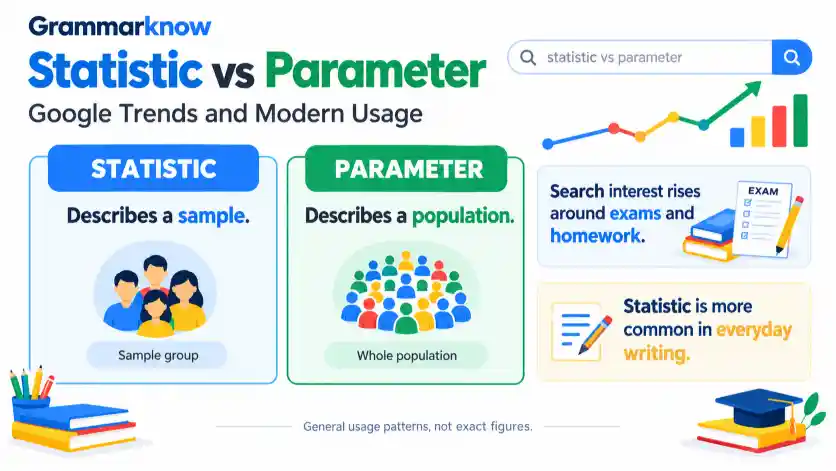
The following is based on general usage patterns, not exact figures.
Search interest follows the school calendar. Students look it up most during exam terms and homework deadlines. Teachers assign it in intro stats courses, so queries rise when classes cover sampling.
In daily use, statistic is far more common than parameter. News, blogs, and ads use statistic for almost any number. Parameter stays inside classrooms, research papers, and tech teams.
The common confusion has two roots. First, both words describe numbers about groups. Second, many writers say statistic when they mean any number at all. This guide fixes that by tying each word to one group size: sample or population.
Quick Comparison Table
| Term | Meaning | Correct? | Region | Example |
| statistic | Number that describes a sample | Yes, for samples | Worldwide | The sample statistic is 64 percent. |
| parameter | Number that describes a population | Yes, for populations | Worldwide | The population parameter is unknown. |
| statistic | Number that describes a population | No, use parameter | Worldwide | Say parameter, not statistic, for the full group. |
| parameter | Number that describes a sample | No, use statistic | Worldwide | Say statistic, not parameter, for a sample. |
Key Takeaways
- A statistic describes a sample. A sample is a small group you study.
- A parameter describes a population. A population is the full group.
- Researchers use statistics to estimate parameters.
- A parameter is fixed. A statistic can change with every new sample.
- Spelling is the same in US and UK English.
- Memory trick: Sample = Statistic, Population = Parameter.
- In business writing, explain parameter on first use.
- Never call a survey result a parameter. It is a statistic.
FAQs
What is the main difference between a statistic and a parameter?
A statistic describes a sample, which is part of a group. A parameter describes a population, which is the whole group. If you measure 100 people out of 10,000, your number is a statistic. The true number for all 10,000 is the parameter. Researchers use the first to estimate the second.
Is the sample mean a statistic or a parameter?
It is a statistic. The mean of a sample describes only the people or items you measured. For example, the average height of 50 players is a sample statistic. It may be close to the true population value, but it is still a guess based on part of the group.
Is the population mean a statistic or a parameter?
It is a parameter. The mean of a full population describes the whole group, not a part of it. If you truly measured every member, the result is a parameter. In real life, full counts are rare, so most means you see are statistics.
Can a parameter ever be known exactly?
Yes, but rarely. You must measure every member of the population. A small club can do this. A whole country cannot. That is why most parameters stay unknown. Research works by estimating them with sample statistics instead. This gap is the whole reason sampling exists.
Why do researchers use statistics instead of parameters?
Full populations are too big, too costly, or too slow to measure. A sample is faster and cheaper. A good sample gives a statistic that sits close to the true parameter. Smart sampling keeps the guess honest without counting everyone.
What is an example of a statistic and a parameter in real life?
Example: Take a school with 2,000 students. You test 100 of them, and their average score is 75. That 75 is a statistic. The average score of all 2,000 students is the parameter. You know the first. You can only estimate the second.
What is a census in statistics?
A census counts every member of a population. No one is left out. Because the full group is measured, a census gives a parameter, not a statistic. Example: a school lists the age of every single student. That list describes a parameter.
How do I know if a number is a statistic or a parameter in an exam?
Use the two-step test. First, ask if every member was counted. If yes, it is a parameter. If no, move to step two. Ask if counting everyone would take intense time or money. If yes, it is a statistic. Example: “70% of city residents” is a statistic, because no one surveys a whole city.
What do μ and x̄ mean in statistics?
μ, called “mu,” marks a population average. It is a parameter. x̄, called “x-bar,” marks a sample average. It is a statistic. Example: a question with μ asks about the whole group. A question with x̄ asks about the part that was measured.
Do British and American English spell these words differently?
No. The spelling is the same in both. Plurals match too: statistics and parameters. Style guides on both sides of the Atlantic agree. Focus on meaning, not spelling, with this pair. No regional variant exists for either word.
How do you remember the difference between statistic and parameter?
Use the first letters. S stands for sample and statistic. P stands for population and parameter. Say it once: sample-statistic, population-parameter. After a few uses, the link sticks, and you will pick the right word without thinking. It works every time.
Is “statistics” the same as “statistic”?
Not quite. A statistic is one number from a sample. Statistics can mean more than one such number. Statistics is also the name of the whole field of study. Context tells you which sense is in play. In this guide, statistic means the single sample number.
Which word should I use in a research paper?
Use both, but in the right spots. Call sample results statistics. Call full-group truths parameters. Mark them clearly, like x-bar for a sample mean and mu for a population mean. Define each term on first use so every reader follows your logic.
Conclusion
The split is simple once you see it. A statistic describes a sample. A parameter describes a population. Samples are the groups you can reach. Populations are the groups you wish you could reach.
Use this split everywhere. In class, it keeps your answers clean. Research, it keeps your claims honest. In business, it keeps your reports clear. When you write statistic, readers know you measured a part. When you write parameter, readers know you mean the whole.
The memory trick does the heavy lifting. Sample starts with S, and so does statistic. Population starts with P, and so does parameter. Keep that pair in mind, and the confusion ends for good.
Here is the takeaway to keep: the whole statistic vs parameter question ends with one rule. Study a few, describe them with a statistic, and use it to estimate the parameter of the many.
Want more simple English guides like this? Keep reading, keep writing, and share this article with a student who needs it.
Read More:
- Bored or Board: Common Mistakes Explained
- Whip or Wip: The Right Spelling for Everyday Writing
- Fetuses or Feti: Which Plural Is Correct?









2 thoughts on “Statistic vs Parameter: The Mix-Up That Costs You Marks”