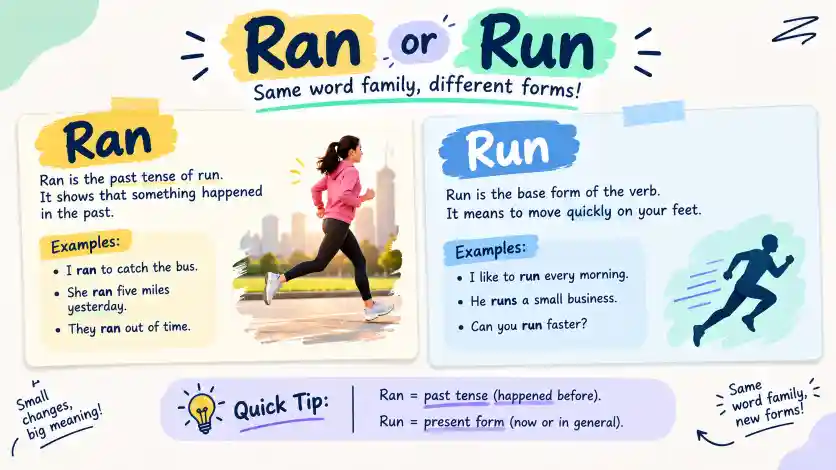
Both ran and run are correct forms of the verb run, but they are used in different parts of a sentence.
Ran is the simple past tense, while run is the past participle and is normally used with helping verbs such as have, has, or had.
For example, you can say, “She ran five miles yesterday.” But you would say, “She has run five miles today.”
Understanding the difference between ran or run is important because these words look similar but follow different grammar patterns.
The correct choice depends mainly on the tense and the structure of the sentence.
Quick Answer
Ran
Ran is the simple past tense of run.
I ran to the store yesterday.
He ran five miles last weekend.
Run
Run is the past participle of run.
It is usually used with have, has, or had.
I have run five miles.
She has run every morning this week.
They had run out of time.
Simple Rule
Use ran for a completed action in the simple past.
Use run with have, has, or had when forming perfect tenses.
What Does Ran Mean?
Definition of Ran
Ran is the simple past form of run.
It describes an action that happened in the past.
Examples:
- She ran home.
- He ran in the park.
- We ran five miles.
- They ran toward the bus.
When to Use Ran
Use ran when the sentence describes a completed past action.
I ran yesterday.
She ran to school this morning.
They ran across the field.
The sentence does not need have, has, or had before ran.
What Does Run Mean?
Definition of Run
Run is the base form of the verb and also its past participle.
Examples of the base form:
I run every morning.
They run a small business.
As a past participle:
I have run every morning this week.
She has run five miles today.
Run With Helping Verbs
Run is commonly used with:
- have
- has
- had
Examples:
I have run three miles.
He has run several races.
We had run out of water.
Ran vs Run: Main Difference
Ran Is Simple Past
Use ran for a completed action in the past.
She ran yesterday.
He ran to the station.
We ran in the race.
Run Is a Past Participle
Use run after have, has, or had.
She has run five miles.
He had run before breakfast.
We have run this route many times.
Comparison
| Word | Form | Example |
| Run | Base form | I run every morning. |
| Ran | Simple past | I ran yesterday. |
| Run | Past participle | I have run today. |
| Running | -ing form | I am running now. |
Ran or Run in Different Tenses
Present Simple
Use run for regular or current actions.
I run every morning.
They run five miles every Sunday.
Simple Past
Use ran.
I ran yesterday.
She ran in the race last week.
Present Perfect
Use run with have or has.
I have run five miles.
She has run three races this year.
Past Perfect
Use run with had.
He had run five miles before lunch.
They had run out of food.
Common Mistakes With Ran and Run
Mistake 1: Using Run for a Simple Past Action
Incorrect:
Yesterday, I run five miles.
Correct:
Yesterday, I ran five miles.
Mistake 2: Using Ran After Have
Incorrect:
I have ran five miles.
Correct:
I have run five miles.
Mistake 3: Using Ran After Has
Incorrect:
She has ran home.
Correct:
She has run home.
Mistake 4: Using Ran After Had
Incorrect:
They had ran out of time.
Correct:
They had run out of time.
Mistake 5: Confusing Run With Running
Incorrect:
I am run to school.
Correct:
I am running to school.
Everyday Examples of Ran
Running Home
She ran home after school.
Running in a Park
He ran in the park yesterday.
Catching a Bus
I ran to catch the bus.
Sports
The player ran across the field.
Exercise
We ran three miles yesterday.
Everyday Examples of Run
Present Action or Habit
I run every morning.
Present Perfect
I have run five miles today.
Past Perfect
She had run before the rain started.
Business
They run a family business.
Machine
The engine has run smoothly all day.
Ran or Run With Time Expressions
Ran With Finished Past Time
It is commonly used with finished time expressions.
Examples:
- yesterday
- last night
- last week
- two days ago
- last year
I ran yesterday.
She ran last week.
They ran two days ago.
Run With Perfect Tenses
Run is used when the sentence has have, has, or had.
I have run today.
She has run this route before.
They had run out of water.
Ran or Run in American and British English
American English
American English uses ran as the simple past form and run as the past participle.
I ran yesterday.
I have run today.
British English
British English follows the same basic pattern.
I ran yesterday.
I have run today.
There is no major difference between American and British English in the basic use of these forms.
Ran or Run: Comparison Table
| Feature | Ran | Run |
| Base form | No | Yes |
| Simple past | Yes | No |
| Past participle | No | Yes |
| Used after have | No | Yes |
| Used after has | No | Yes |
| Used after had | No | Yes |
| Example | I ran yesterday. | I have run today. |
How to Remember Ran and Run
Simple Past = Ran
When you are simply talking about something that happened in the past, use ran.
I ran yesterday.
Have, Has, or Had = Run
When have, has, or had comes before the verb, use run.
I have run today.
She has run before.
They had run away.
Easy Pattern
Run → Ran → Run
This is the basic pattern to remember:
Present: run
Past: ran
Past participle: run
Ran or Run in Formal Writing
Both words are standard English and can be used in formal writing.
The important point is using the correct form for the sentence.
The athlete ran five miles yesterday.
The athlete has run five miles every day this week.
Changing ran to run, or run to ran, can make the sentence grammatically incorrect.
Frequently Asked Questions
Is ran the past tense of run?
Yes. Ran is the simple past tense of run.
Is run the past tense of run?
Run can be the base form and past participle, but ran is the simple past form.
Should I say “I ran” or “I run” yesterday?
Say “I ran yesterday.” The word yesterday refers to a completed past action.
Should I say “I have ran” or “I have run”?
Say “I have run.” The past participle run follows have.
Is “She has ran” correct?
No. The standard form is “She has run.”
Is “I had ran” correct?
No. Say “I had run.”
What are the three main forms of run?
The three main forms are:
run ran run
Conclusion
Ran and run are both correct, but they have different grammatical roles. Ran is the simple past form of run, while run is the base form and past participle.
Use ran when describing a completed action in the past:
She ran home yesterday.
Use run after have, has, or had:
She has run home.
The easiest way to remember the difference is run ran run. Once you know which tense the sentence requires, choosing between ran or run becomes much easier.
Read More:
- Pant or Pants: British and American English Explained
- Lighted or Lit: Simple Grammar Rules Explained
- Flown or Flew: Confused About These Two Words?









3 thoughts on “Ran or Run: When Should You Use Each Word?”