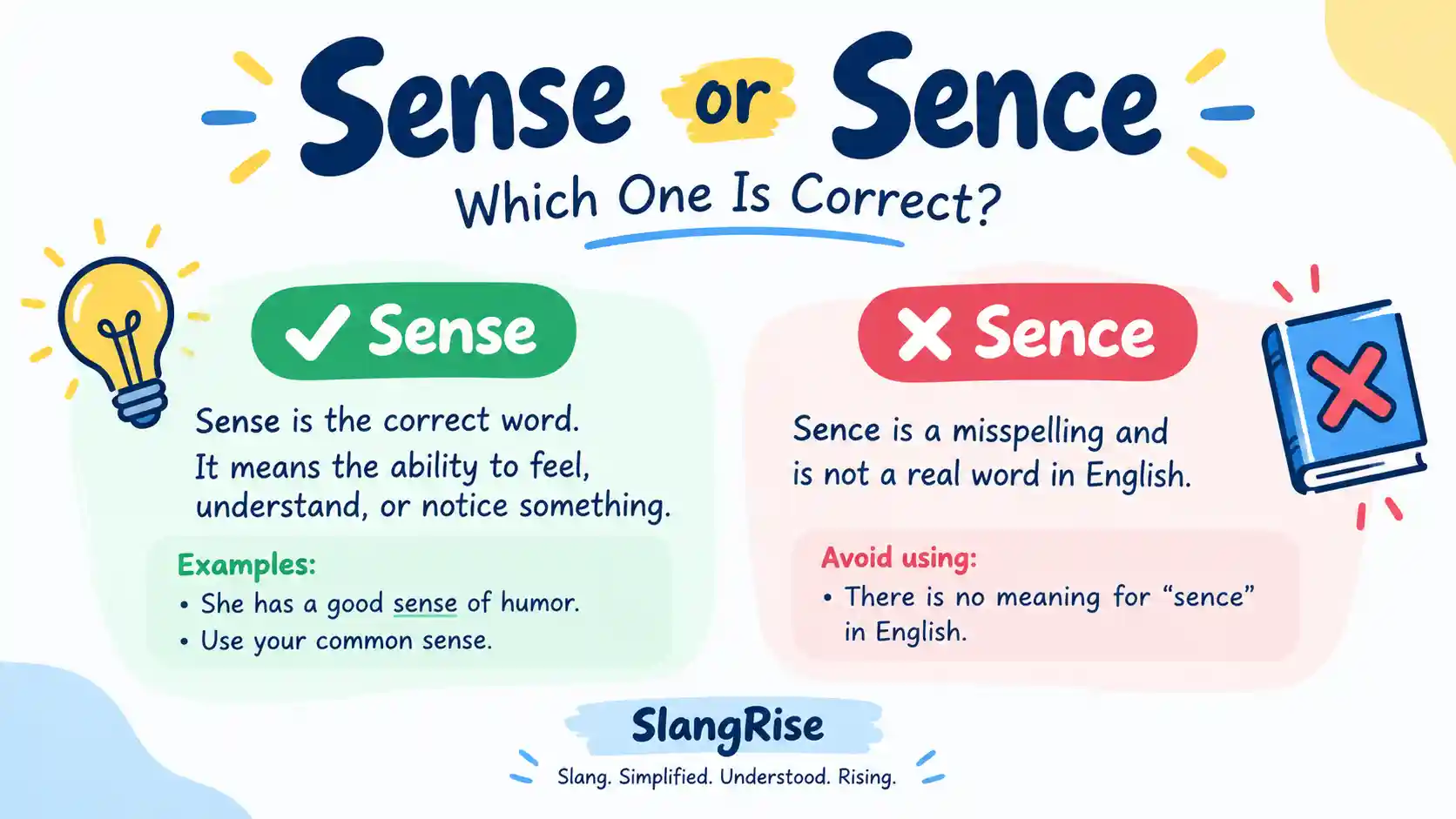
Sense is the correct spelling. Sence is a misspelling in standard English. The word sense refers to a feeling, understanding, judgment, or one of the abilities used to detect things, such as sight, hearing, smell, taste, and touch.
Examples:
- That makes perfect sense.
- She has a good sense of humor.
- Your spelling of sence is incorrect; use sense instead.
Quick Answer
- Sense: Correct spelling; means understanding, awareness, or a physical ability.
- Sence: Incorrect spelling in standard English.
Example: It makes sense to check your work before submitting it.
What Does Sense Mean?
Sense is a noun and a verb. It can describe understanding, good judgment, physical perception, or the ability to notice something.
Sense as a Noun
As a noun, sense has several meanings.
- Understanding: I understand the sense of the sentence.
- Good judgment: Use your common sense.
- Physical ability: The five senses help us experience the world.
- Meaning: The word has a different sense in this context.
- Awareness: I had a sense that something was wrong.
Sense as a Verb
As a verb, sense means to notice, feel, or become aware of something.
Examples:
- She could sense that he was upset.
- Dogs can sense changes in their surroundings.
- I sensed a little tension in the room.
What Does Sence Mean?
Sence is not the standard spelling of the word sense. People may write it by mistake because the two forms sound the same in ordinary speech.
If you want to express understanding, awareness, judgment, or perception, use sense.
Incorrect: That does not make sence.
Correct: That does not make sense.
Incorrect: He has a good sence of humor.
Correct: He has a good sense of humor.
Sense vs Sence: Key Differences
| Feature | Sense | Sence |
| Spelling status | Correct | Misspelling |
| Standard English | Yes | No |
| Meaning | Understanding, awareness, perception | No standard meaning in this usage |
| Part of speech | Noun and verb | Not a standard spelling of this word |
| Example | That makes sense. | That makes sence. |
The key point is simple: sense is the spelling you should use in standard English writing.
Why Do People Confuse Sense and Sence?
People often confuse these spellings because they sound alike. The difference is in the letters, not the usual pronunciation.
Similar Pronunciation
In standard English, sense and the misspelling sence are generally intended to sound the same. Hearing the word alone may not help you identify the correct spelling.
Common Typing Errors
Writers sometimes type sence because they remember the sound but not the correct letter sequence.
Limited Spelling Practice
Repeated exposure to the correct spelling helps learners recognize that sense uses s at the beginning and se before the final nse sequence.
Common Mistakes With Sense and Sence
Mistake 1: Using Sence in Everyday Writing
Incorrect: This explanation makes sence.
Correct: This explanation makes sense.
Mistake 2: Using Sence in Schoolwork
Incorrect: The poem has a deeper sence.
Correct: The poem has a deeper sense.
Mistake 3: Misspelling Common Expressions
Incorrect: Use your common sence.
Correct: Use your common sense.
Mistake 4: Ignoring Spell-Check Warnings
If your writing app marks sence as an error, check the context. For the ordinary word meaning understanding or perception, the correct spelling is sense.
Everyday Examples of Sense
Here are examples showing how to use sense correctly.
- Common sense: Use common sense when making decisions.
- Sense of humor: My brother has a great sense of humor.
- Make sense: Your explanation makes sense.
- Sense of direction: She has an excellent sense of direction.
- Sense of smell: A dog’s sense of smell is very strong.
- Sense of responsibility: He has a strong sense of responsibility.
- Sense something: I could sense that she was nervous.
- In this sense: In this sense, both answers are correct.
These expressions are common in everyday speech, academic writing, and professional communication.
British and American English
Both British and American English use sense with the same spelling and meaning. There is no regional spelling difference between the two varieties.
| Usage | American English | British English |
| Correct spelling | Sense | Sense |
| Incorrect spelling | Sence | Sence |
| Example | It makes sense. | It makes sense. |
| Common expression | Common sense | Common sense |
If you are writing for a British, American, or international audience, use sense.
Easy Trick to Remember the Correct Spelling
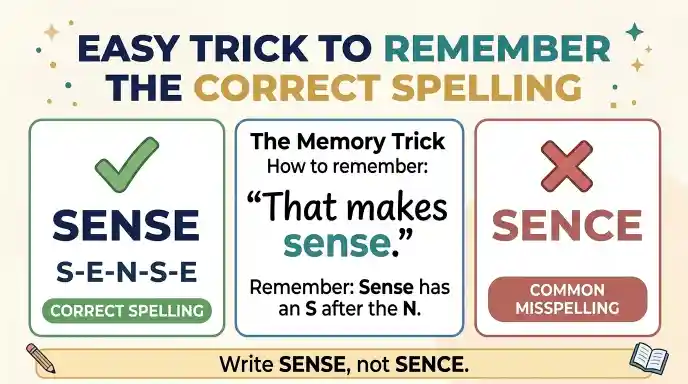
Remember this simple rule:
Sense has an “s” after the “n”: s-e-n-s-e.
You can also memorize a familiar phrase:
“That makes sense.”
Because this expression is widely used, remembering it can help you avoid the misspelling sence.
Before submitting an assignment, email, or article, check that you have written sense, not sence.
Frequently Asked Questions (FAQs)
1. Is sense or sence correct?
Sense is correct. Sence is a misspelling in standard English when intended to mean understanding or perception.
2. Is sence a real English word?
Sence is not the standard spelling of the common English word sense. It may appear as a typo or in names, but it should not replace sense in ordinary writing.
3. What does sense mean?
Sense can mean understanding, good judgment, meaning, awareness, or a physical ability such as sight or hearing.
4. Why do people spell sense as sence?
People often make this mistake because both forms are intended to sound alike, making the spelling easy to confuse.
5. What is an example of sense in a sentence?
“Your explanation makes sense” is a common example.
6. Is common sence correct?
No. The correct expression is common sense, meaning practical judgment.
7. Is sense a noun or a verb?
Sense can be both. As a noun, it can mean understanding or perception. As a verb, it means to notice or become aware of something.
8. Is sense spelled differently in British and American English?
No. Both varieties use the spelling sense.
9. How can I remember the spelling of sense?
Remember the phrase “That makes sense” and the spelling s-e-n-s-e.
10. Can I use sence in formal writing?
No. Use sense in formal writing, school assignments, emails, and professional documents.
Conclusion
Sense is the correct spelling, while sence is a common spelling mistake. The word sense can refer to understanding, judgment, meaning, awareness, or physical perception.
It is used in expressions such as “common sense,” “sense of humor,” and “that makes sense.” Remember the spelling s-e-n-s-e to avoid this mistake in everyday and formal writing.
Read More:
- Siting or Sitting? The Correct Spelling May Surprise You
- Grateful or Thankful? Are These Words Really the Same?
- Statistic vs Parameter: The Mix-Up That Costs You Marks





2 thoughts on “Sense or Sence: The Spelling Mistake You Need to Avoid”