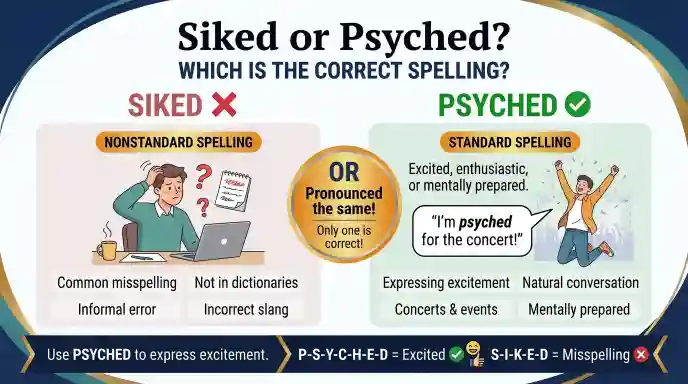
Psyched is the correct standard spelling when you mean excited, enthusiastic, or mentally prepared for something. Siked is an informal spelling sometimes used online to represent slang pronunciation, but it is not the standard spelling for this meaning.
People often confuse these words because they may sound similar in casual speech. For example, someone might write “I’m siked for the concert” when they mean “I’m psyched for the concert.” The second sentence uses the standard spelling.
The word psyched is commonly used when someone feels excited about an upcoming event, looks forward to an activity, or prepares mentally for a challenge. You might feel psyched before a football match, a holiday, a job interview, or a special celebration.
Understanding the difference between siked or psyched helps you write more clearly in text messages, social media posts, school assignments, and everyday conversations. In this guide, you will learn their meanings, origins, spelling differences, common mistakes, and examples of how to use psyched correctly.
Siked or Psyched : Quick Answer
- Psyched: The standard spelling meaning excited, enthusiastic, or mentally prepared.
- Siked: An informal nonstandard spelling sometimes used to represent the same slang pronunciation.
- Example: “I’m psyched about my upcoming vacation.”
- Best choice: Use psyched in standard writing, including articles, emails, and schoolwork.
Easy rule: When you mean excited or eager about something, write psyched.
Definition and Meaning of Psyched
Psyched is an informal adjective that describes feeling excited, enthusiastic, motivated, or mentally prepared for something. It can also be used as the past tense of psych in expressions such as “psych someone up.”
1. Psyched as Excited or Enthusiastic
People often use psyched when they are looking forward to an event or experience.
Examples:
- “I’m psyched about the concert tonight.”
- “She is psyched for her first day at college.”
- “We’re psyched to visit the mountains this weekend.”
- “He was psyched when he received the good news.”
In these sentences, psyched expresses excitement and positive anticipation.
2. Psyched as Mentally Prepared
The word can also describe someone who feels ready to face a challenge.
Examples:
- “The team is psyched for the final match.”
- “She felt psyched before her job interview.”
- “He listened to music to get psyched for the competition.”
- “The athletes were psyched and ready to perform.”
Here, the word suggests confidence, motivation, or mental readiness.
3. Psyched in Everyday Slang
In casual English, psyched is often used to show strong enthusiasm.
Examples:
- “I’m psyched to see you tomorrow!”
- “Are you psyched for the trip?”
- “They’re psyched about the new game.”
The word is informal, so it fits friendly conversations and social media posts particularly well.
What Does Siked Mean?
Siked is a nonstandard spelling sometimes used in informal messages or online conversations to represent the sound of psyched.
For example:
Incorrect in standard writing: “I’m siked for the party.”
Correct: “I’m psyched for the party.”
People may use siked because the spelling of psyched does not clearly show how it sounds. However, siked is not the accepted standard spelling when expressing excitement or enthusiasm.
If you want your writing to be understood clearly and look polished, choose psyched.
Origin of the Word Psyched
The word psyched developed from the informal verb psych, which is related to psychology and the mind. In slang, to psych someone up means to make someone feel excited, motivated, or mentally ready.
Over time, psyched became a common way to describe a person’s emotional or mental state.
For example:
- “The coach psyched up the players before the game.”
- “The players were psyched for the final.”
The spelling reflects its connection to psych, which explains why it begins with psy rather than simply s.
Psyched in British and American English
The standard spelling psyched is used in both British and American English.
| Feature | British English | American English |
| Standard spelling | Psyched | Psyched |
| Meaning | Excited or mentally prepared | Excited or mentally prepared |
| Informal use | Common | Common |
| Is siked standard? | No | No |
There is no major spelling difference between British and American English for this word. Both use psyched when describing excitement or mental readiness.
Which Spelling Should You Use?
Use psyched when you want to express excitement, enthusiasm, or mental preparation.
Use Psyched in Everyday Conversations
Examples:
- “I’m psyched about the weekend.”
- “She’s psyched to start her new job.”
- “We’re psyched for the school trip.”
Use Psyched in Social Media Posts
Examples:
- “So psyched for tonight’s concert!”
- “I’m psyched to share this news.”
- “Our team is psyched for the championship.”
Use Psyched in Professional or Academic Writing Carefully
Although psyched is a recognized word, it is informal. In formal writing, alternatives such as excited, enthusiastic, or motivated may be more suitable.
Example:
Informal: “I’m psyched about the new project.”
More formal: “I’m excited about the new project.”
Remember: Use psyched for the standard spelling, and choose a more formal synonym when the situation requires a professional tone.
Common Mistakes with Siked and Psyched
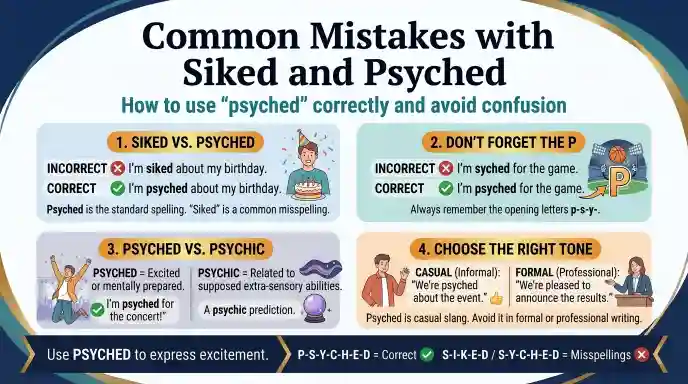
1. Writing Siked Instead of Psyched
Incorrect: “I’m siked about my birthday.”
Correct: “I’m psyched about my birthday.”
Why? Psyched is the standard spelling for expressing excitement.
2. Forgetting the P in Psyched
Incorrect: “I’m syched for the game.”
Correct: “I’m psyched for the game.”
Why? The word begins with psy, just like psychology and psychic.
3. Confusing Psyched with Psychic
The words are related in spelling but have different meanings.
- Psyched: Excited or mentally prepared.
- Psychic: Related to supposed abilities to perceive information beyond ordinary senses.
Example: “I’m psyched for the concert” expresses excitement, while “The character claims to be psychic” refers to a different concept.
4. Using Psyched in Every Formal Situation
Incorrect for a highly formal tone: “We are psyched to announce the results.”
More formal: “We are pleased to announce the results.”
Why? Psyched is informal. It is suitable for casual writing, but more formal wording may work better in official announcements.
Everyday Examples of Psyched
1. In Conversations
- “I’m psyched to see my friends this weekend.”
- “Are you psyched about the concert?”
- “He’s psyched for his first driving lesson.”
2. At School
- “The students were psyched about the science fair.”
- “I’m psyched to start my new course.”
- “She felt psyched before her presentation.”
3. In Sports
- “The players were psyched for the championship.”
- “The coach psyched up the team before the match.”
- “He was psyched after scoring the winning goal.”
4. At Work
- “I’m psyched about joining the new team.”
- “She was psyched to lead the project.”
- “We’re psyched to launch the new product.”
5. On Social Media
- “So psyched for the weekend!”
- “Absolutely psyched about this opportunity.”
- “Can’t wait for the trip. I’m psyched!”
Siked or Psyched: Comparison Table
| Feature | Siked | Psyched |
| Standard spelling | No, for this meaning | Yes |
| Meaning | Informal nonstandard spelling intended to mean excited | Excited, enthusiastic, or mentally prepared |
| Suitable for formal writing | No | Recognized, but informal in tone |
| Common in casual messages | Sometimes | Yes |
| Recommended choice | Avoid in standard writing | Use this spelling |
| Example | “I’m siked for the trip.” | “I’m psyched for the trip.” |
Frequently Asked Questions
1. Is it siked or psyched?
Psyched is the standard spelling when you mean excited, enthusiastic, or mentally prepared. Siked is a nonstandard spelling sometimes seen in casual online writing.
2. What does psyched mean?
Psyched means excited, enthusiastic, motivated, or mentally ready for something.
Example: “She is psyched about her upcoming vacation.”
3. Why is psyched spelled with a P?
The word comes from psych, which is connected to the mind and psychology. That is why the spelling begins with psy.
4. Can I write siked in a text message?
People may use siked informally, but psyched is the standard spelling and the better choice if you want to avoid spelling errors.
5. Is psyched formal or informal?
Psyched is a recognized English word, but it is generally informal. In formal writing, excited, enthusiastic, or motivated may be more appropriate.
6. What is the difference between psyched and psyching someone up?
Psyched describes feeling excited or mentally prepared. Psyching someone up means encouraging or motivating someone to feel ready for an event or challenge.
Example: “The coach psyched up the players before the game.”
7. Is psyched used in British and American English?
Yes. Psyched is used in both British and American English, with the same spelling and a similar meaning.
Conclusion: Siked or Psyched?
The correct standard spelling is psyched, not siked, when you want to express excitement, enthusiasm, or mental readiness. The word is common in everyday conversations, sports, social media posts, and informal writing.
For example, “I’m psyched for the concert” means you are excited about attending it. Similarly, “The team was psyched for the final” means the players felt motivated and ready to compete.
Remember the connection between psyched and psych. Both begin with psy, which helps explain the spelling. Although siked sometimes appears in casual messages, psyched is the best choice for standard English writing.
Read More:
- Gnarly or Narly: The Simple Trick to Remember the Correct Word
- Ither or Either? The Simple Trick to Remember the Spelling
- Comrad or Comrade: Stop Making This Common Spelling Mistake


1 thought on “Siked or Psyched: One Is Standard English, but Which One?”