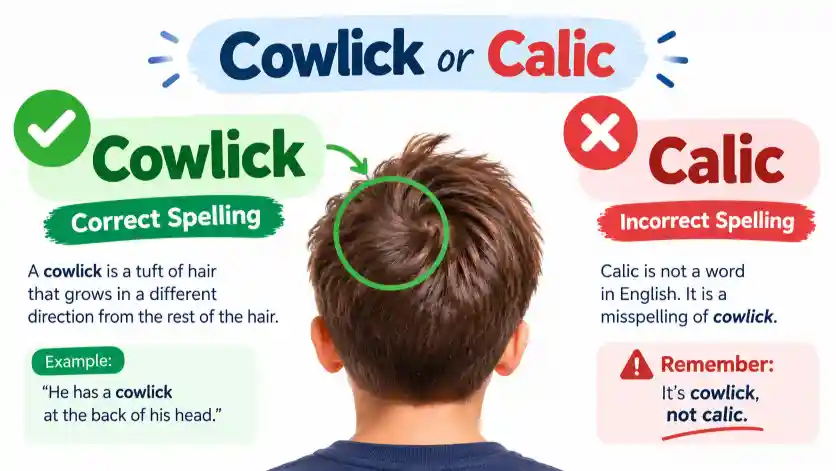
Cowlick is the correct spelling for a section of hair that grows in a different direction from the surrounding hair, causing it to stick up, swirl, or resist styling. Calic is a common misspelling of cowlick when referring to this hair pattern. Many people search for cowlick or calic because the words sound similar, making it difficult to identify the correct spelling.
A cowlick can appear at the crown of the head, near the forehead, along the hairline, or at the back of the neck. It is a natural feature of hair growth and can affect people with short, long, straight, or curly hair.
Understanding the difference between these spellings helps you write accurately when discussing hairstyles, haircuts, grooming, and hair care. In this guide, you will learn the meanings of cowlick and calic, explore their origins, discover common spelling mistakes, and review practical examples.
By the end, you will know which word to use in everyday conversations, beauty-related articles, professional writing, and searches about stubborn sections of hair.
Cowlick or Calic : Quick Answer
Cowlick is the correct English word for a section of hair that naturally grows in a different direction from the surrounding hair.
Calic is not the standard spelling of this hair-related term. People sometimes write it because it sounds similar to cowlick.
Examples:
- Correct: My cowlick makes the hair at the back of my head stick up.
- Incorrect: My calic makes the hair at the back of my head stick up.
Easy rule: If you are talking about a stubborn swirl or patch of hair, always use cowlick.
Definition and Meaning of Cowlick and Calic
What Does Cowlick Mean?
A cowlick is a section of hair that grows in a different direction from the hair around it. This natural growth pattern can create a swirl, raised patch, or stubborn strand that does not lie flat.
Cowlicks commonly appear in several areas:
- At the crown of the head
- Near the front hairline
- Along the forehead
- At the back of the neck
- Around the sides of the head
A cowlick can make certain hairstyles more difficult to maintain, but it is a normal feature of hair growth.
Examples:
- My cowlick makes my fringe stick up every morning.
- The barber adjusted the haircut to work with his cowlick.
- She uses a little styling cream to control the cowlick near her forehead.
What Does Calic Mean?
Calic is a common misspelling of cowlick when someone is referring to a section of hair that grows in an unusual direction.
It is not the standard spelling for this hairstyle-related meaning. People may use it because they hear the word spoken but are unfamiliar with its written form.
Examples:
- Incorrect: My calic makes my hair difficult to style.
- Correct: My cowlick makes my hair difficult to style.
If you are discussing a natural hair swirl, choose cowlick.
Cowlick vs. Calic: Key Differences
| Feature | Cowlick | Calic |
| Spelling | Correct | Common misspelling in this context |
| Standard hair-related meaning | A patch of hair growing in a different direction | No standard meaning for this hair pattern |
| Common use | Haircuts, grooming, hair care | Usually an attempted spelling of cowlick |
| Example | He has a cowlick at the crown. | He has a calic at the crown. |
| Recommended usage | Use this word | Avoid this spelling for the hair-related meaning |
Origin and History of Cowlick and Calic
Where Does the Word Cowlick Come From?
The word cowlick comes from the appearance of hair that looks as if a cow has licked it. When a cow licks its coat, the hair can be left pointing in a different direction. A similar effect occurs when a person’s hair grows in a natural swirl or refuses to lie flat.
The term combines cow and lick, creating a memorable description of this distinctive hair pattern.
Over time, cowlick became an established English word used by barbers, hairstylists, writers, and everyday speakers.
Why Do People Write Calic?
The spelling calic can result from hearing the word rather than seeing it in writing. Since cowlick may sound different across accents and speaking speeds, some people attempt to spell it phonetically.
However, the accepted spelling for this hair feature remains cowlick.
British English vs. American English
The spelling cowlick is standard in both British and American English. There is no major regional spelling difference for this word.
| Context | British English | American English |
| Correct spelling | Cowlick | Cowlick |
| Hair growth pattern | Cowlick | Cowlick |
| Haircut discussion | The barber worked around my cowlick. | The barber worked around my cowlick. |
| Common misspelling | Calic | Calic |
People in different English-speaking regions may pronounce the word differently, but the standard spelling remains the same.
If you are writing for an international audience, use cowlick consistently.
Which Spelling Should You Use: Cowlick or Calic?
The correct choice depends on what you want to communicate. When describing a natural section of hair that grows in a different direction, cowlick is the appropriate word.
When to Use Cowlick
Use cowlick when talking about hair growth, styling difficulties, or haircuts affected by a natural swirl.
Examples:
- My cowlick is more noticeable when my hair is short.
- The hairstylist suggested a layered cut to manage the cowlick.
- His cowlick makes the front of his hair stand up.
- A cowlick can influence how a fringe sits.
The word is suitable for casual conversations, hair care guides, salon discussions, and articles about hairstyles.
When Not to Use Calic
Avoid calic when you mean a cowlick. It is not the standard spelling of the English hair-related term.
Incorrect: The stylist cut around my calic.
Correct: The stylist cut around my cowlick.
If you encounter calic in a message or online discussion, consider the context. The writer may simply have intended to write cowlick.
Common Mistakes With Cowlick and Calic
Although the distinction is straightforward, the similar sound of these forms can lead to spelling mistakes.
1. Writing Calic Instead of Cowlick
Incorrect: I have a calic near my forehead.
Correct: I have a cowlick near my forehead.
Explanation: Cowlick is the accepted spelling for this natural hair pattern.
2. Leaving Out Part of the Spelling
Incorrect: I have a cowlik at the back of my head.
Correct: I have a cowlick at the back of my head.
Explanation: The standard spelling ends with -lick, including the final k.
3. Assuming a Cowlick Is a Haircut
Incorrect: My barber gave me a cowlick yesterday.
Better: My barber gave me a haircut that works with my cowlick.
Explanation: A cowlick is a natural hair-growth pattern, not a haircut itself.
4. Assuming Every Raised Strand Is a Cowlick
Incorrect: Every strand of hair that sticks up is a cowlick.
Better: A cowlick is a natural growth pattern that causes hair to grow in a particular direction.
Explanation: Hair can also stick up because of static, product buildup, sleeping positions, or styling. A cowlick is associated with the direction in which the hair grows.
5. Using the Wrong Word in Hair Care Articles
Incorrect: Five ways to control a calic.
Correct: Five ways to control a cowlick.
Explanation: Use the standard spelling in titles, instructions, product descriptions, and articles about hair care.
Everyday Examples of Cowlick and Calic
These examples show how cowlick appears in common situations.
1. Everyday Conversations
“My cowlick always sticks up after I wake up.”
The speaker describes a natural hair pattern that becomes noticeable after sleeping.
2. Barber Shops
“Could you cut my hair in a way that works with my cowlick?”
The customer asks the barber to account for the direction in which the hair grows.
3. Hair Care Articles
“Using a lightweight styling product may help control a stubborn cowlick.”
Here, cowlick refers to a section of hair that resists styling.
4. Family Conversations
“My son has a small cowlick near the crown of his head.”
The word describes a natural feature of the child’s hair.
5. Hairstyle Tutorials
“This hairstyle works well for people who have a cowlick near the front hairline.”
The sentence explains how a haircut or styling technique can accommodate a particular hair-growth pattern.
6. Professional Writing
“The stylist examined the client’s cowlick before recommending a shorter cut.”
The term is used correctly in a professional hairdressing context.
7. Online Searches
“Why does my cowlick stick up even after I brush my hair?”
The search uses the correct spelling for a common hair-styling concern.
8. Spelling Practice
“Cowlick is the correct spelling; calic is a common misspelling of the term.”
This sentence directly explains the difference between the two forms.
Cowlick or Calic: Usage Trends and Modern Writing
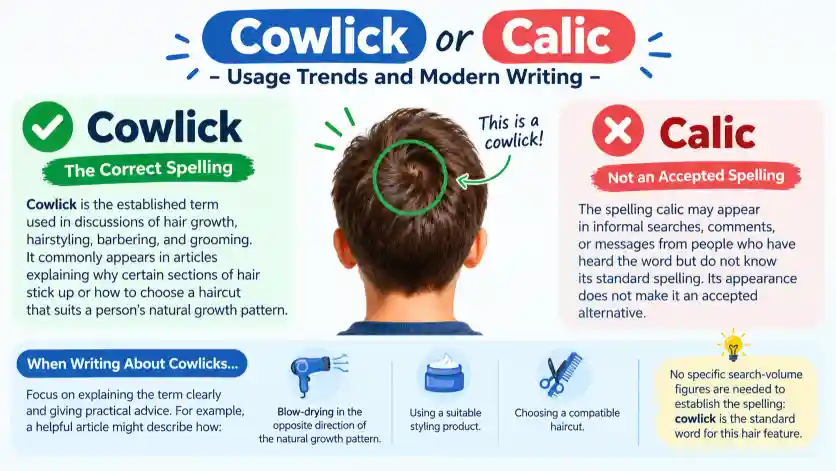
Cowlick is the established term used in discussions of hair growth, hairstyling, barbering, and grooming. It commonly appears in articles explaining why certain sections of hair stick up or how to choose a haircut that suits a person’s natural growth pattern.
The spelling calic may appear in informal searches, comments, or messages from people who have heard the word but do not know its standard spelling. Its appearance does not make it an accepted alternative.
When writing about cowlicks, focus on explaining the term clearly and giving practical advice. For example, a helpful article might describe how blow-drying in the direction opposite to the natural growth pattern, using a suitable styling product, or choosing a compatible haircut can help manage stubborn hair.
No specific search-volume figures are needed to establish the spelling: cowlick is the standard word for this hair feature.
Cowlick vs. Calic: Comparison Table
| Example sentence | Correct choice | Explanation |
| My makes the front of my hair stick up. | Cowlick | Refers to a natural hair pattern |
| The barber worked around my . | Cowlick | Describes the direction of hair growth |
| She has a small at the crown. | Cowlick | Names a section of hair growing differently |
| How can I control my ? | Cowlick | Correct term in a hair care question |
| My becomes more visible with short hair. | Cowlick | Uses the standard spelling |
| The stylist explained how to manage a . | Cowlick | Appropriate for a salon discussion |
In every example above, cowlick is the correct choice when referring to this hair feature.
Easy Trick to Remember Cowlick or Calic
Use this simple memory trick to remember the correct spelling.
Cowlick = Cow + Lick
Imagine a cow licking its coat and leaving the hair pointing in an unusual direction. A cowlick on a person’s head resembles that effect.
Remember these points:
- Cowlick: Correct spelling for a natural hair swirl.
- Calic: Common misspelling when referring to a cowlick.
- Hair growth: A cowlick forms because of the direction in which the hair grows.
- Styling: A suitable haircut or styling technique can help manage a cowlick.
If you are unsure, remember the full spelling: C-O-W-L-I-C-K.
Frequently Asked Questions (FAQs)
1. Is it cowlick or calic?
Cowlick is the correct spelling for a section of hair that grows in a different direction from the surrounding hair. Calic is a common misspelling of the term.
2. What is a cowlick in hair?
A cowlick is a natural hair-growth pattern that causes a section of hair to stick up, swirl, or resist lying flat. It can appear near the crown, forehead, hairline, or back of the neck.
3. Why is it called a cowlick?
The name comes from the appearance of hair that resembles the effect of a cow licking its coat and leaving the hair pointing in a different direction.
4. Is calic a real English word?
Calic is not the standard spelling for a hair-growth pattern. In this context, people generally mean cowlick. A different specialized use or name would need to be assessed separately.
5. Can a cowlick be removed?
A cowlick is caused by the natural direction of hair growth, so brushing alone cannot permanently remove it. A suitable haircut, blow-drying technique, or styling product may make it less noticeable.
6. Are cowlicks common?
Yes. Cowlicks are a normal variation in hair growth and can occur in people with different hair lengths, textures, and styles.
7. Does a cowlick mean your hair is damaged?
No. A cowlick does not automatically indicate damaged hair. It usually reflects the direction in which a section of hair naturally grows.
8. Is cowlick spelled differently in British and American English?
No. Cowlick is the standard spelling in both British and American English.
9. Can a cowlick affect a haircut?
Yes. A cowlick can influence how a fringe, parting, or short hairstyle sits. Barbers and hairstylists may adjust the cut to work with the natural direction of the hair.
10. How do I remember the spelling of cowlick?
Break it into two familiar parts: cow + lick. This helps you remember the complete spelling and avoid writing calic.
Conclusion
The difference between cowlick or calic is simple: cowlick is the correct English word for a section of hair that grows in a different direction, while calic is a common misspelling when used with this meaning.
A cowlick can appear at the crown, forehead, or hairline and may make some hairstyles more difficult to manage. Understanding the word helps you discuss haircuts, grooming, and styling more accurately.
Remember the trick cow + lick = cowlick, and use the standard spelling in your writing, searches, and everyday conversation.
Read More:
- Moron or Moran? Avoid This Common Spelling Mistake
- Organisational or Organizational: Which Spelling Is Correct?
- Forward or Foward? Don’t Let This Spelling Mistake Fool You







1 thought on “Cowlick or Calic: Can You Guess Which One Is Correct?”