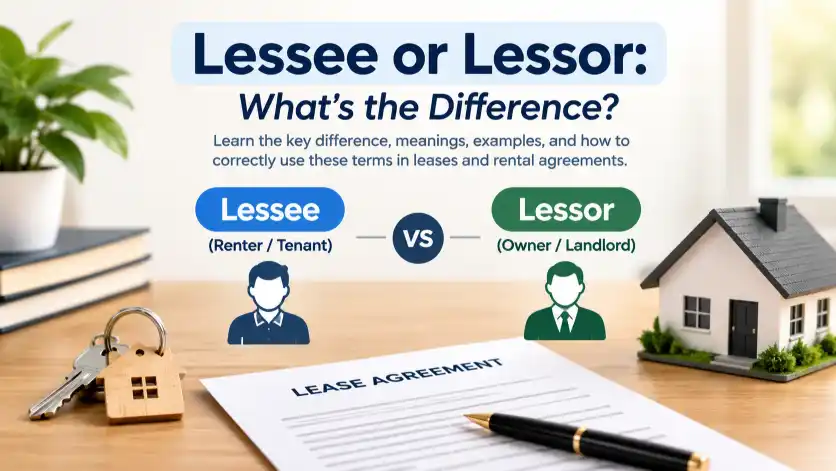
When reading a lease, rental agreement, or property contract, two words often cause confusion: lessee or lessor. They look similar, sound related, and both appear in legal and business writing. So, which one means the tenant, and which one means the owner?
The answer is simple: the lessee is the person or organization that receives the right to use property under a lease, while the lessor is the person or organization that gives that right. For example, if you rent an apartment, you are the lessee, while the property owner is the lessor.
People search for “lessee or lessor” because these terms are easy to mix up when completing forms, reading contracts, or writing about property. The confusion is made worse because the two words differ by only a few letters.
This guide explains lessee vs. lessor, their history, spelling, correct usage, common mistakes, examples, and practical tips. By the end, you should know exactly which word to use.
Lessee or Lessor Quick Answer
The easiest way to remember the difference is:
- Lessee = the person who uses or rents the property
- Lessor = the person who owns or leases out the property
For example:
Sarah rents an apartment from John.
- Sarah is the lessee.
- John is the lessor.
A lessee usually makes payments to use property owned by someone else. A lessor allows another person or organization to use their property under a lease.
Simple comparison
| Term | Meaning | Simple example |
| Lessee | Person who receives the lease | The tenant |
| Lessor | Person who gives the lease | The landlord |
| Lease | Legal agreement between them | Rental contract |
Quick memory tip:
Think of lessee as the person who gets the lease and lessor as the person who offers it.
The Origin of Lessee or Lessor
The words lessee and lessor come from the same legal language tradition. Both developed from Anglo-French terms connected with lease.
Lessee appeared in English in the late 15th century. It came from Anglo-French lesee and Old French lessé, meaning someone to whom a lease was given. The word ultimately traces back to Latin laxare, meaning “to loosen” or “to release.”
Lessor is older. It dates to the late 14th century and came from Anglo-French lessor, meaning someone who grants a lease.
The related word lease also has Anglo-French and Old French roots. Its legal meaning developed around an agreement that gives someone possession or use of property for a set period.
Why do the words look so similar?
Legal English often uses paired terms to show two sides of an action. In this case:
- Lessor → grants the lease
- Lessee → receives the lease
The -or and -ee pattern can also help show the roles involved. This is why the two words became useful in formal contract language.
British English vs American English Spelling
Unlike many English spelling differences, lessee and lessor are not normally spelled differently in British and American English.
The standard spellings are:
- British English: lessee / lessor
- American English: lessee / lessor
The main differences are more likely to appear in pronunciation, legal style, or related vocabulary—not in the spelling of these two words. Cambridge lists both forms with the same spelling in its UK and US entries.
Comparison table
| Meaning | British English | American English |
| Person who receives the lease | lessee | lessee |
| Person who grants the lease | lessor | lessor |
| Rental agreement | lease | lease |
| Person renting property | tenant | tenant |
| Property owner | landlord | landlord |
So, if you are wondering if “lessee” is British and “lessee” is American, there is no spelling change. Lessee is correct in both.
Which Spelling Should You Use?
There is no need to choose a British or American spelling for lessee or lessor. Use the standard spelling in either variety of English.
For a US audience
Use:
- lessee
- lessor
- lease
- landlord
- tenant
These are standard terms in American legal and business writing.
For a UK or Commonwealth audience
Use the same spellings:
- lessee
- lessor
- lease
- landlord
- tenant
However, the exact legal meaning of a lease can depend on local law. If you are preparing an actual legal contract, use the terminology required by the relevant jurisdiction.
For a global audience
If your readers may not know legal terms, consider using a simple explanation:
Lessee (tenant): the person who rents the property.
Lessor (landlord/property owner): the person who provides the property.
This makes the article or document easier to understand.
Common Mistakes with Lessee or Lessor
Because these words are so similar, several mistakes are common.
1. Calling the tenant the lessor
Incorrect:
The lessor pays monthly rent to the owner.
Correct:
The lessee pays monthly rent to the lessor.
The lessee is generally the party using the leased property.
2. Calling the owner the lessee
Incorrect:
The lessee owns the apartment and rents it to another person.
Correct:
The lessor owns the apartment and rents it to another person.
3. Writing “leasee”
Incorrect: leasee
Correct: lessee
Lessee has two s letters followed by ee.
4. Writing “lesser” when you mean “lessor”
Incorrect:
The lesser must maintain the property.
Correct:
The lessor must maintain the property.
Lesser is normally a different word. Lessor is the legal term for the party granting a lease.
5. Assuming lessor means “someone who pays less”
It does not. Lessor is related to lease, not to the ordinary adjective less.
Lessee or Lessor in Everyday Examples
These terms appear most often in legal, property, business, and financial writing.
In an email
Please ask the lessee to sign the lease before Friday.
In a rental agreement
The lessee agrees to pay rent on the first day of each month.
In a property document
The lessor gives the lessee permission to use the property for five years.
In a news article
The company is the lessee of the building under a long-term lease.
In social media
A casual post may say:
“I’m renting this apartment.”
A more formal post might say:
“I am the lessee under the current rental agreement.”
In formal writing
The lessor may terminate the agreement if the lessee fails to make the required payments.
This type of wording is common because contracts need to clearly identify each party.
Lessee or Lessor Google Trends & Usage Data
People often search for “lessee or lessor” when they need to understand a contract or determine which party they are in a lease.
Google Trends can compare search terms by location, time, and region. Its data is presented as relative search interest rather than a simple count of all searches. Google explains that regional values are normalized and shown on an indexed scale.
It is also important not to treat Google Trends as a dictionary or legal database. Search interest can change because of property markets, business activity, legal questions, and educational searches.
What the search context tells us
| Search variation | Likely search intent |
| lessee or lessor | Understand the difference |
| lessee vs lessor | Compare the two terms |
| lessee meaning | Find the definition |
| lessor meaning | Find the definition |
| who is the lessee | Identify the tenant |
| who is the lessor | Identify the landlord/owner |
| lessee and lessor agreement | Understand a lease contract |
Google Trends allows users to compare terms and explore interest by country and region.
Lessee vs. Lessor: Quick Variation Table
| Variation | Correct? | Meaning |
| lessee | ✅ | Person receiving the lease |
| lessor | ✅ | Person granting the lease |
| lessee vs lessor | ✅ | Comparison phrase |
| lessee or lessor | ✅ | Question about the correct role |
| leasee | ❌ | Common misspelling |
| lesser | ❌ | Usually a different word |
| lessor vs lessee | ✅ | Reverse comparison |
FAQs About Lessee or Lessor
1. Is the lessee the tenant?
Yes. In general, the lessee is the person or organization that has the right to use property under a lease.
2. Is the lessor the landlord?
Usually, yes. The lessor is the person or organization that grants another party the right to use property under a lease.
3. Is “lessee or lessor” correct?
Yes. The phrase is useful when you need to identify which party is the tenant or which party is providing the leased property.
4. Is it “leasee” or “lessee”?
Lessee is correct. Leasee is a common misspelling.
5. Is “lessor” British or American?
Lessor is standard in both British and American English.
6. Is the spelling “lessee” different in British English?
No. Lessee is the standard spelling in both British and American English.
7. How can I remember the difference?
Remember:
Lessee = gets the lease.
Lessor = gives the lease.
For example, the tenant is the lessee, and the landlord is the lessor.
Conclusion
Understanding lessee or lessor is simple once you know which side of the lease each word describes. The lessee is the person or organization that receives the right to use property under a lease. The lessor is the person or organization that grants that right.
Both words have long histories in English legal language. They developed from Anglo-French terms connected with lease, which helps explain why they look and sound so similar.
There is also no British-versus-American spelling problem here. Lessee and lessor are standard spellings in both forms of English. The main challenge is remembering their roles.
For everyday writing, tenant and landlord may be easier for readers. For contracts, legal documents, and professional property writing, lessee and lessor are useful and precise terms.
The simplest rule is: the lessee uses the property; the lessor provides it.
Related Articles:




3 thoughts on “Lessee or Lessor: What’s the Difference? (2026 Guide)”