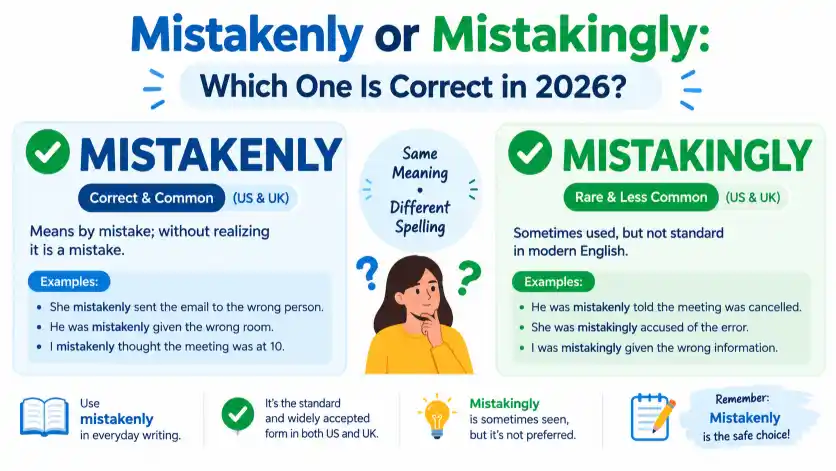
Mistakenly is the standard and widely accepted form, while mistakingly is generally avoided in modern standard English.
If you are unsure whether to write mistakenly or mistakingly, choose mistakenly. It is the normal adverb formed from mistaken, and dictionaries such as Cambridge and Oxford list it as a standard English word.
People often search for these two forms because mistakingly looks like it could naturally come from the verb mistake or the present participle mistaking. However, English does not always form adverbs in the way learners might expect. In this case, mistakenly is the established choice.
For example:
I mistakenly sent the email to the wrong person.
Here, mistakenly means by mistake, accidentally, or incorrectly.
This guide explains the difference between mistakenly and mistakingly, their meanings, word formation, common mistakes, everyday examples, usage, and the best choice for formal and professional writing.
Mistakenly or Mistakingly: Quick Answer
Mistakenly is the correct standard choice in modern English.
Mistakingly is not the normal standard form and should generally be avoided, especially in formal, academic, professional, and edited writing.
| Word | Standard modern usage | Meaning |
| mistakenly | ✅ Standard | By mistake; incorrectly |
| mistakingly | ⚠️ Generally avoided | Intended to express the same idea |
Examples
✅ I mistakenly deleted the file.
❌ I mistakingly deleted the file.
✅ She mistakenly believed that the meeting was tomorrow.
❌ She mistakingly believed that the meeting was tomorrow.
Cambridge defines mistakenly as meaning “wrongly or by mistake,” while Oxford defines it as doing something in a way that is wrong because of an incorrect opinion or judgment.
Definition and Meaning of Mistakenly or Mistakingly
What Does Mistakenly Mean?
Mistakenly is an adverb. It describes an action or belief that happens because someone is wrong, confused, or has made a mistake.
It can mean:
- by mistake
- accidentally
- incorrectly
- based on a wrong belief
- because of an error
For example:
I mistakenly took the wrong bus.
The person did not intend to take the wrong bus.
Another example:
He mistakenly believed that the store was closed.
Here, the person’s belief was incorrect. Oxford specifically describes mistakenly as acting based on a wrong opinion or judgment.
What About Mistakingly?
Mistakingly may seem logical because the verb is mistake and the related form mistaking exists.
However, mistakingly is not the usual standard adverb used in modern English.
For clear and professional writing, use:
mistakenly
instead.
The Origin of Mistakenly or Mistakingly
The word mistakenly comes from the adjective mistaken plus the adverb-forming suffix -ly.
The basic structure is:
mistaken + -ly → mistakenly
The verb mistake has a long history in English. It comes from the idea of taking or understanding something wrongly.
The form mistaken developed as the past participle of mistake:
- mistake
- mistook
- mistaken
From mistaken, English forms the adverb:
- mistaken → mistakenly
This explains why mistakenly is the established form rather than mistakingly.
The related adjective mistaken means being wrong about something or having an incorrect belief.
Word Family
| Word | Part of speech | Example |
| mistake | noun/verb | I made a mistake. |
| mistaken | adjective/past participle | I was mistaken. |
| mistook | past tense | I mistook him for his brother. |
| mistakenly | adverb | I mistakenly called the wrong number. |
| mistaking | present participle | She is mistaking kindness for weakness. |
British English vs American English Spelling
Unlike pairs such as colour/color or neighbourhood/neighborhood, there is no standard British-versus-American spelling difference between mistakenly and mistakingly.
The preferred standard form is:
mistakenly
This applies to both British and American English.
| English variety | Preferred form | Example |
| British English | mistakenly | She mistakenly opened the letter. |
| American English | mistakenly | She mistakenly opened the letter. |
| Canadian English | mistakenly | He mistakenly entered the wrong address. |
| Australian English | mistakenly | They mistakenly sent the package elsewhere. |
| International English | mistakenly | The information was mistakenly published. |
Key Point
There is no need to choose mistakingly for American English or mistakenly for British English.
Mistakenly is the standard choice in both.
Which Spelling Should You Use?
The answer is simple:
For Formal Writing
Use mistakenly.
The information was mistakenly included in the report.
For Academic Writing
Use mistakenly.
The researcher mistakenly interpreted the results.
For Business Emails
Use mistakenly.
I mistakenly attached the wrong document.
For Everyday English
Use mistakenly.
I mistakenly thought you were at home.
For Websites and Content
Use mistakenly as your main form.
If your article targets the keyword “mistakenly or mistakingly,” you can discuss both forms naturally. However, the body of the article should use mistakenly when you mean “by mistake” or “incorrectly.”
Common Mistakes with Mistakenly or Mistakingly
1. Using Mistakingly Instead of Mistakenly
This is the most common mistake.
❌ I mistakingly sent the message.
✅ I mistakenly sent the message.
2. Assuming Every Verb Takes “-ing + -ly”
Learners may think:
mistake → mistaking → mistakingly
This looks logical, but English word formation does not always work this way.
The established adverb is:
mistaken → mistakenly
3. Confusing Mistakenly With Mistaking
Mistaking is a real word, but it has a different grammatical role.
Example:
She is mistaking his silence for anger.
Here, mistaking is part of the verb phrase.
But:
She mistakenly thought he was angry.
Here, mistakenly is an adverb.
4. Confusing Mistakenly With Accidentally
These words can sometimes have similar meanings, but they are not always identical.
Mistakenly focuses on an error or incorrect belief.
I mistakenly entered the wrong number.
Accidentally focuses more directly on something happening unintentionally.
I accidentally deleted the photo.
Mistakenly or Mistakingly in Everyday Examples
In Emails
I mistakenly sent you the previous version of the document.
The invoice was mistakenly sent to the wrong department.
In News Writing
The report was mistakenly published before the official announcement.
In Social Media
I mistakenly posted this on the wrong account!
In Formal Writing
The figures were mistakenly entered into the final report.
In Academic Writing
The results were mistakenly interpreted as evidence of a direct relationship.
In Everyday Conversation
I mistakenly thought you were coming today.
She mistakenly took my phone.
Mistakenly or Mistakingly – Google Trends & Usage Data
Searches for “mistakenly or mistakingly” usually come from people who are unsure which adverb is standard.
The important usage pattern is clear: mistakenly is the established dictionary form. Cambridge and Oxford both list mistakenly as an adverb, with definitions related to being wrong, making an error, or acting from an incorrect belief.
The question is especially useful for learners because mistakingly looks like a possible formation from mistaking. However, dictionary evidence supports mistakenly as the standard word.
For SEO content, it is useful to address the alternative spelling because users may search for it. But the recommended wording should remain mistakenly.
Mistakenly vs Mistakingly: Comparison Table
| Feature | Mistakenly | Mistakingly |
| Standard modern English | ✅ Yes | ⚠️ Generally avoided |
| Dictionary-listed standard adverb | ✅ Yes | Not the normal choice |
| Meaning “by mistake” | ✅ Yes | Not recommended |
| Meaning “incorrectly” | ✅ Yes | Not recommended |
| British English | ✅ Preferred | Avoid |
| American English | ✅ Preferred | Avoid |
| Formal writing | ✅ Recommended | Avoid |
| Academic writing | ✅ Recommended | Avoid |
| Professional emails | ✅ Recommended | Avoid |
| SEO content | ✅ Use | Mention only when discussing the confusion |
FAQs About Mistakenly or Mistakingly
1. Is mistakenly or mistakingly correct?
Mistakenly is the standard modern English form. Mistakingly is generally avoided in standard formal English.
2. Is mistakenly a proper word?
Yes. Mistakenly is a standard English adverb. Cambridge defines it as meaning “wrongly or by mistake.”
3. Can I say “I mistakingly did it”?
It is better to say:
I mistakenly did it.
Or:
I did it by mistake.
4. Why is mistakenly correct?
Mistakenly is formed from mistaken + -ly. It is the established adverb related to the adjective mistaken.
5. Is mistakingly a spelling mistake?
In most standard modern English contexts, mistakingly should be treated as a form to avoid. Use mistakenly instead.
6. What is the difference between mistakenly and accidentally?
Mistakenly usually emphasizes an error or incorrect belief, while accidentally emphasizes that something happened unintentionally.
I mistakenly chose the wrong option.
I accidentally broke the glass.
7. What is another word for mistakenly?
Depending on the sentence, alternatives include:
- wrongly
- incorrectly
- accidentally
- inadvertently
- by mistake
For example:
She mistakenly entered the wrong address.
can become:
She entered the wrong address by mistake.
Conclusion: Mistakenly or Mistakingly?
When choosing between mistakenly and mistakingly, the safest and standard choice is mistakenly. It is the established adverb used to mean by mistake, wrongly, or incorrectly. Cambridge and Oxford both recognize mistakenly as a standard English adverb.
The confusion happens because mistakingly may look like a natural form of the verb mistake. However, English does not always create adverbs directly from an -ing form. In this case, the accepted pattern is mistaken → mistakenly.
Use mistakenly in everyday conversations, emails, academic writing, professional documents, websites, and formal content. You can also replace it with phrases such as by mistake, wrongly, or incorrectly, depending on the sentence.
The easiest rule to remember is:
Use “mistakenly” when you mean “by mistake” or “incorrectly.”
That simple rule will help you avoid the common mistakenly vs. mistakingly error.
Read More:
- Misspell or Mispell : Only One Spelling Is Correct
- Inquiring or Enquiring: American vs British English, Explained
- Neighbourhood or Neighborhood: One Letter, Two Countries Divided






1 thought on “Mistakenly or Mistakingly: Which One Is Correct in 2026?”