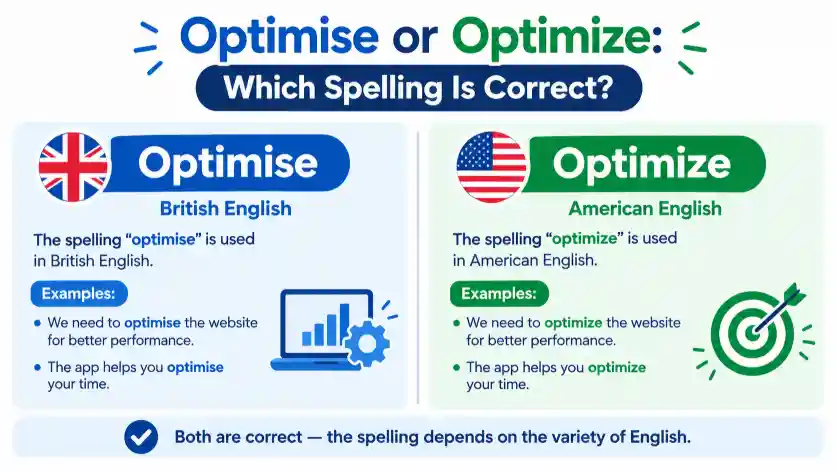
Optimise and optimize are both correct spellings of the same word, meaning to make something as effective or efficient as possible the difference comes down to regional spelling convention.
“Optimize” (with a “z”) is the standard American English spelling, following the U.S. preference for ” ize” endings in verbs like “organize” and “realize.”
“Optimise” (with an “s”) is the standard British English spelling, commonly used across the UK, Australia, and other Commonwealth countries that favor ” ise” endings.
Neither spelling is technically wrong the correct choice simply depends on which English variant you’re writing in and your intended audience.
In this guide, you’ll learn the regional difference between optimise and optimize, why the spelling split exists, and which version fits your writing in 2026.
Optimise or Optimize: Quick Answer
Which spelling is correct?
✅ Optimize Standard American English
✅ Optimise Common British English spelling
Both mean to make something as good, effective, or efficient as possible.
Examples
American English:
We need to optimize the website.
British English:
We need to optimise the website.
The meaning does not change. Only the spelling convention is different.
What Does Optimize or Optimise Mean?
Optimize or optimise means to improve something so that it works as effectively, efficiently, or successfully as possible.
Cambridge defines the word as making something “as good as possible.”
It is commonly used when talking about:
- Websites
- Software
- Business processes
- Performance
- Resources
- Systems
- Search engines
- Technology
- Manufacturing
- Time management
- Marketing
Examples
We need to optimize our website for mobile users.
The company is trying to optimise its production process.
This software helps optimize computer performance.
The team wants to optimise its resources.
The Origin of Optimize
The word optimize comes from optimum, which is related to the Latin word optimus, meaning “best.”
Oxford dates the word to the early 19th century and gives its origin as Latin optimus plus the suffix ize.
The basic idea is therefore connected to making something optimal, or as good as it can be.
Over time, the word became widely used in fields such as business, engineering, mathematics, computing, and technology.
Today, both optimize and optimise are commonly used depending on the English variety.
Optimise vs Optimize: British and American English
This is primarily a spelling difference.
| English Variety | Preferred/Common Spelling | Example |
| American English | optimize | Optimize the website. |
| British English | optimise | Optimise the website. |
| Australian English | optimise | Optimise the process. |
| New Zealand English | optimise | Optimise the system. |
| International English | Either, depending on style | Keep usage consistent. |
Cambridge specifically identifies optimise as the usual UK form of optimize.
However, there is an important detail: Oxford’s spelling system uses ize forms for words in this group, including optimize. Oxford nevertheless identifies optimise as a British English form.
So you may encounter optimize in British publications that follow Oxford’s spelling conventions.
Why Are There Two Spellings?
The difference comes from two spelling conventions:
- ize
- ise
American English generally uses ize for this group of words.
British English often uses ise, although ize is also accepted and used by some British publishers and dictionaries.
For example:
| American English | British English |
| optimize | optimise |
| organize | organise |
| maximize | maximise |
| recognize | recognise |
| realize | realise |
The pronunciation and meaning remain essentially the same.
Optimize or Optimise in Formal Writing
Both forms are appropriate in formal writing as long as they match the variety of English you are using.
American English
The company plans to optimize its delivery system.
British English
The company plans to optimise its delivery system.
The important point is consistency.
If your article uses British spelling, don’t switch randomly between optimise, organize, maximize, and similar forms.
Likewise, if your content uses American English, maintain the ize pattern.
Optimize or Optimise for SEO?
For content, the best choice depends on your target audience.
Targeting U.S. readers
Use:
optimize
Examples:
- Optimize your website
- Optimize page speed
- Optimize content
- Optimize images
Targeting UK readers
Use:
optimise
Examples:
- Optimise your website
- Search engine optimisation
- Optimise page speed
- Optimise content
- Optimise images
If your website targets an international audience, you can choose one spelling system and use it consistently.
The two spellings have the same meaning, so the important thing is to avoid unnecessary spelling inconsistency.
Optimize or Optimise in Computing
The word is especially common in technology and computing.
Oxford gives a computing specific meaning: changing data, software, or other elements to make them work more efficiently or become more suitable for a particular purpose.
Examples
Developers optimize software for mobile devices.
Engineers optimise the system to reduce processing time.
The website has been optimized for faster loading.
The application is optimised for smaller screens.
In technology writing, you will frequently see both forms depending on the publication’s regional style.
Optimize vs Optimise: Related Words
The same spelling pattern appears in the related forms.
| American English | British English |
| optimize | optimise |
| optimized | optimised |
| optimizing | optimising |
| optimization | optimisation |
| optimizer | optimiser |
Cambridge lists optimization with optimisation as the usual UK form.
American English
We optimized the website.
The optimization improved performance.
British English
We optimised the website.
The optimisation improved performance.
Common Mistakes With Optimise or Optimize
1. Thinking One Spelling Is Wrong
The biggest mistake is assuming that either optimise or optimize is universally incorrect.
Both spellings are established English forms.
The appropriate choice depends largely on the English variety and style guide you are following.
2. Assuming Optimise Is Always British
Optimise is commonly used in British English, but British publishers do not all follow the same spelling conventions.
Oxford, for example, uses ize spellings for this group while also recognizing optimise as a British form.
3. Assuming Optimize Is Only American
Optimize is strongly associated with American English, but it is also used in British English, particularly under Oxford style spelling conventions.
4. Mixing the Two Forms
Avoid writing:
We need to optimize the website and optimise its images.
If you are following one spelling system, keep the same convention throughout your content.
Better:
We need to optimize the website and optimize its images.
Or:
We need to optimise the website and optimise its images.
Everyday Examples of Optimize
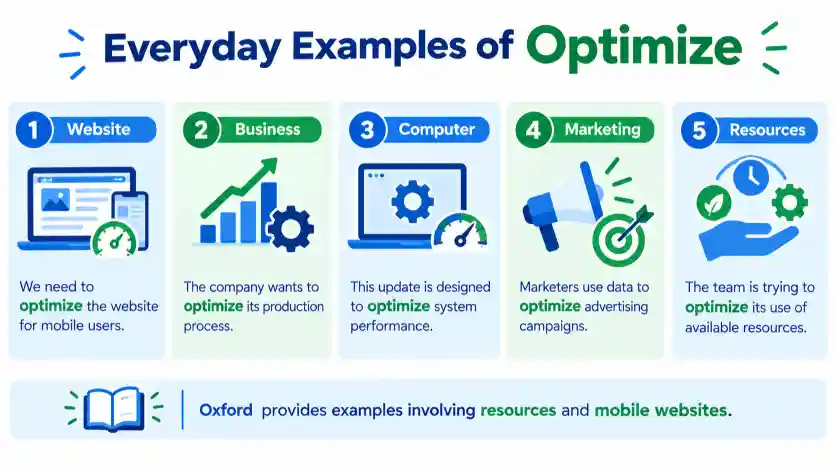
Example 1: Website
We need to optimize the website for mobile users.
Example 2: Business
The company wants to optimize its production process.
Example 3: Computer
This update is designed to optimize system performance.
Example 4: Marketing
Marketers use data to optimize advertising campaigns.
Example 5: Resources
The team is trying to optimize its use of available resources.
Oxford provides examples involving resources and mobile websites.
Everyday Examples of Optimise
Example 1
We need to optimise the website for mobile devices.
Example 2
The company is working to optimise its production process.
Example 3
The new software helps optimise system performance.
Example 4
They are trying to optimise their use of resources.
The meaning in every example is the same as optimize.
Which Spelling Should You Use?
The easiest rule is:
Use optimize for American English.
Use optimise for standard British style writing when your chosen style uses ise.
For an international website, either can work. The most important thing is to establish a consistent editorial style.
For a U.S. focused website
Use:
optimize
optimized
optimizing
optimization
For a British style website
Use:
optimise
optimised
optimising
optimisation
Google Trends & Modern Usage for Optimise or Optimize
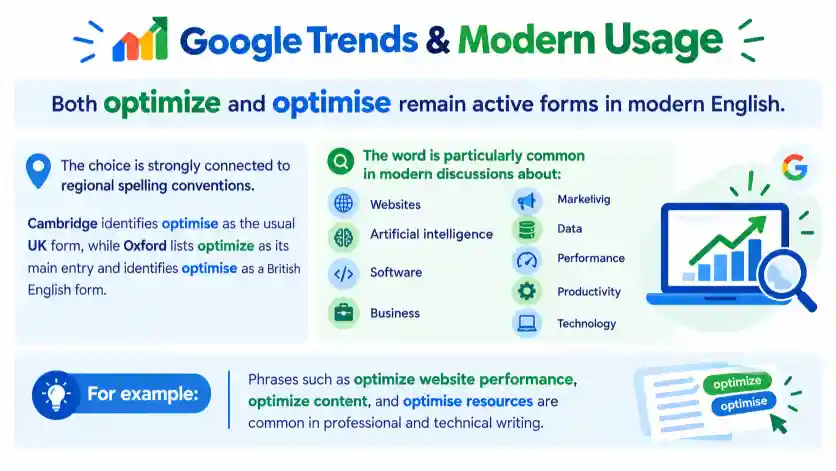
Both optimize and optimise remain active forms in modern English.
The choice is strongly connected to regional spelling conventions. Cambridge identifies optimise as the usual UK form, while Oxford lists optimize as its main entry and identifies optimise as a British English form.
The word is particularly common in modern discussions about:
- Websites
- Artificial intelligence
- Software
- Business
- Marketing
- Data
- Performance
- Productivity
- Technology
For example, phrases such as optimize website performance, optimize content, and optimise resources are common in professional and technical writing.
Quick Comparison Table
| Feature | Optimize | Optimise |
| Meaning | Same | Same |
| Part of speech | Verb | Verb |
| American English | ✅ Common | Less common |
| British English | ✅ Used | ✅ Common |
| Pronunciation | Same | Same |
| Formal writing | ✅ | ✅ |
| SEO writing | ✅ | ✅ |
| Past tense | optimized | optimised |
| ing form | optimizing | optimising |
| Noun | optimization | optimisation |
Key Takeaways
- Optimize and optimise are both correct.
- They have the same meaning.
- Optimize is the standard American English form.
- Optimise is commonly used in British English.
- Oxford uses ize as its preferred spelling convention for this group.
- Cambridge identifies optimise as the usual UK form.
- The same difference appears in optimization/optimisation.
- Choose one spelling style and remain consistent.
- For U.S. focused content, optimize is generally the natural choice.
- For British style content, optimise is commonly preferred.
FAQs About Optimise or Optimize
Is optimize or optimise correct?
Both are correct. Optimize is commonly used in American English, while optimise is the usual British form according to Cambridge. Oxford also recognizes optimise as a British form while using optimize as its main entry.
Is optimise British or American?
Optimise is commonly associated with British English and other varieties that follow the British ise spelling pattern. American English generally uses optimize.
Is optimize American English?
Yes. Optimize is the standard spelling used in American English. It is also used in some British English styles, including Oxford’s spelling convention.
Do optimize and optimise mean the same thing?
Yes. Both words mean to make something as good, effective, or efficient as possible. There is no difference in their basic meaning.
Is optimization or optimisation correct?
Both are correct. Optimization is the American form, while optimisation is commonly used in British English. Cambridge identifies optimisation as the usual UK form.
Can I use optimize in British English?
Yes. British English can use optimize, particularly in styles that follow Oxford’s ize spelling convention.
Is optimise more correct than optimize?
No. Neither spelling is universally more correct. The appropriate choice depends on the English variety and style you are following.
What is the past tense of optimise?
The British style past tense is optimised. The American form is optimized.
What is the noun form of optimize?
The noun is optimization in American English and optimisation in British style spelling. Both refer to the process of making something as effective or efficient as possible.
Conclusion
When choosing between optimise or optimize, remember that both spellings are correct. The main difference is spelling convention rather than meaning.
Optimize is the standard American English form, while optimise is commonly used in British English. Cambridge specifically identifies optimise as the usual UK form, while Oxford lists optimize as its main entry and also recognizes optimise as a British form.
For American readers, use optimize. For British style writing that follows the ise convention, use optimise. Most importantly, don’t mix the two forms unnecessarily within the same piece of content.
The simple rule:
🇺🇸 American English → Optimize
🇬🇧 British English → Optimise
Both mean to make something as good or effective as possible.
Read More:
- Ceramist or Ceramicist: Both Are Correct in 2026
- Advertize or Advertise: The Spelling Mistake to Avoid in 2026
- Inquiring or Enquiring: American vs British English, Explained