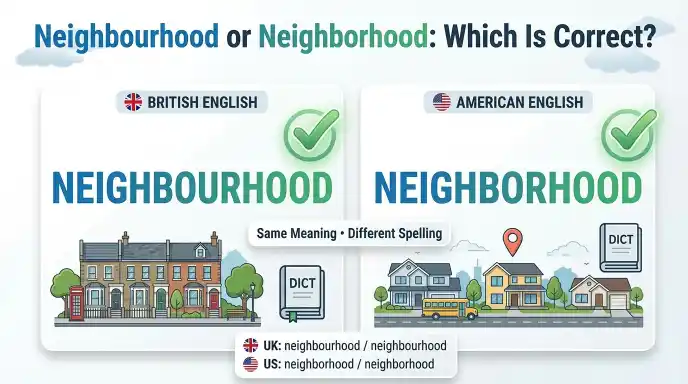
Neighbourhood and neighborhood are both correct spellings of the same word, referring to a local area or community where people live the only difference is regional spelling convention.
“Neighbourhood” (with the extra “u”) is used in British English, along with other Commonwealth countries like Canada, Australia, and the UK.
“Neighborhood” (without the “u”) is the standard American English spelling, following the U.S. pattern of dropping the “u” from words like “colour,” “favour,” and “honour.”
Neither spelling is technically wrong the correct choice simply depends on which English variant you’re writing in and your intended audience.
In this guide, you’ll learn the regional difference between neighbourhood and neighborhood, why the spelling split exists, and which version fits your writing in 2026.
Neighbourhood or Neighborhood : Quick Answer
Neighbourhood is the British English spelling.
Neighborhood is the American English spelling.
Both mean an area where people live, usually around the same streets or community.
Examples:
- British English: I live in a quiet neighbourhood.
- American English: I live in a quiet neighborhood.
| British English | American English |
| neighbourhood | neighborhood |
| neighbour | neighbor |
| neighbouring | neighboring |
The main spelling difference is the letter “u.”
Definition and Meaning of Neighbourhood or Neighborhood
A neighbourhood/neighborhood is a local area where people live. It can include homes, streets, shops, schools, parks, and other nearby places.
Simple Meaning
Neighbourhood or neighborhood means a particular area or community where people live.
For example:
We moved to a friendly neighbourhood.
This means the area where the speaker lives is friendly.
Context and Usage
The word can describe both a physical area and the people who live there.
Physical area:
There is a new park in our neighbourhood.
Local community:
Everyone in the neighbourhood knows each other.
The word can also describe an approximate number or amount.
The temperature is in the neighbourhood of 30°C.
Here, neighbourhood means around or approximately.
The Origin of Neighbourhood or Neighborhood
The word comes from neighbour plus the suffix “-hood.”
The word neighbour comes from Old English nēahgebūr, referring to a person who lives nearby. The suffix “-hood” refers to a state, condition, or group.
Over time, neighbourhood developed to describe the area or community around where people live.
The spelling difference developed as English evolved differently in Britain and the United States.
American English often removed the “u” from words such as:
- colour → color
- favour → favor
- neighbour → neighbor
- neighbourhood → neighborhood
British English generally kept the traditional “u” spelling.
So, neighbourhood and neighborhood are not different words. They are regional spelling forms of the same word.
British English vs American English Spelling
The biggest difference is the use of “u.”
British English
British English uses:
neighbourhood
American English
American English uses:
neighborhood
Both forms are grammatically correct.
| Feature | British English | American English |
| Main spelling | neighbourhood | neighborhood |
| Related word | neighbour | neighbor |
| Verb | neighbour | neighbor |
| Adjective | neighbouring | neighboring |
| Meaning | Same | Same |
| Pronunciation | Generally the same | Generally the same |
Examples
UK:
She lives in a beautiful neighbourhood.
US:
She lives in a beautiful neighborhood.
UK:
The neighbouring town is only five miles away.
US:
The neighboring town is only five miles away.
The meaning does not change.
Neighbourhood or Neighborhood: Which Spelling Should You Use?
Your audience should determine which spelling you use.
If You Write for the United States
Use:
neighborhood
Example:
Our neighborhood has a new library.
This is the standard American spelling.
If You Write for the United Kingdom
Use:
neighbourhood
Example:
Our neighbourhood has a new library.
This is the standard British spelling.
If You Write for Commonwealth Readers
Neighbourhood is commonly preferred in British-style English used in places such as the UK, Australia, and New Zealand.
If You Write for a Global Audience
Either form can be understood, but consistency is important.
If your website mainly targets American readers, use neighborhood throughout your content. If it targets British English users, use neighbourhood.
Common Mistakes with Neighbourhood or Neighborhood
1. Mixing Both Spellings
A common mistake is using both forms in the same article without a reason.
Inconsistent:
Our neighborhood is a friendly neighbourhood.
Better:
Our neighborhood is a friendly neighborhood.
Or, in British English:
Our neighbourhood is a friendly neighbourhood.
Choose one spelling style and keep it consistent.
2. Thinking One Spelling Is Incorrect
Neither spelling is wrong.
❌ “Neighborhood is always incorrect.”
❌ “Neighbourhood is always incorrect.”
✅ Both are correct regional spellings.
3. Using British Spelling for a US Audience
If your website targets American readers, neighborhood is normally the expected spelling.
4. Using American Spelling for a British Audience
For British English content, neighbourhood is generally preferred.
5. Confusing Neighbour With Neighbourhood
Neighbour means a person who lives nearby.
Neighbourhood means the local area or community.
Example:
My neighbour has a dog.
My neighbourhood has several parks.
Neighbourhood or Neighborhood in Everyday Examples
The word appears often in everyday conversations and different types of writing.
In Emails
British English:
We are planning a neighbourhood meeting next week.
American English:
We are planning a neighborhood meeting next week.
In News
British English:
Police increased patrols in the neighbourhood.
American English:
Police increased patrols in the neighborhood.
On Social Media
I love my neighbourhood! ❤️
Or:
I love my neighborhood! ❤️
Both are correct depending on the English variety.
In Formal Writing
British English:
The project will improve transport links across the local neighbourhood.
American English:
The project will improve transport links across the local neighborhood.
In Everyday Speech
What is your neighbourhood like?
What is your neighborhood like?
The pronunciation and meaning remain essentially the same.
Google Trends & Usage Data
Search interest for neighbourhood and neighborhood generally follows regional English usage.
- Neighborhood is strongly associated with the United States.
- Neighbourhood is strongly associated with British English and other regions that follow British spelling conventions.
- In international English, both spellings may appear.
- Online content can contain both forms because websites often serve readers from different countries.
Google Trends data should be interpreted by country and time period, because search behavior changes. A search for “neighborhood” in the United States does not mean that “neighbourhood” is incorrect. It reflects the spelling convention used by that audience.
For SEO, the most useful approach is to match the spelling to your target audience rather than forcing both versions into every sentence.
Neighbourhood vs Neighborhood: Comparison Table
| Point | Neighbourhood | Neighborhood |
| English variety | British English | American English |
| Meaning | Local area/community | Local area/community |
| Pronunciation | Same | Same |
| Extra “u” | Yes | No |
| Common in the US | Less common | Standard |
| Common in the UK | Standard | Less common |
| Correct spelling | Yes | Yes |
| Example | quiet neighbourhood | quiet neighborhood |
FAQs About Neighbourhood or Neighborhood
1. Is neighbourhood or neighborhood correct?
Both are correct. Neighbourhood is the British English spelling, while neighborhood is the American English spelling.
2. Is neighbourhood British or American?
Neighbourhood is mainly the British English spelling.
3. Is neighborhood American English?
Yes. Neighborhood is the standard American English spelling.
4. What is the difference between neighbourhood and neighborhood?
There is no difference in meaning. The main difference is spelling: British English uses neighbourhood, while American English uses neighborhood.
5. Does Australia use neighbourhood or neighborhood?
Australian English generally follows British spelling and uses neighbourhood.
6. Can I use neighbourhood in an American English article?
Readers will understand it, but neighborhood is the standard spelling for American English. If your content targets US readers, consistency with American spelling is usually preferable.
7. How do you remember the difference?
Think of the related words:
British: neighbour → neighbourhood
American: neighbor → neighborhood
The American forms remove the “u.”
Conclusion: Neighbourhood or Neighborhood?
Neighbourhood and neighborhood are two regional spellings of the same English word. Both describe a local area or community where people live, and both have the same basic meaning and pronunciation.
The key difference is regional spelling. Neighbourhood is the standard British English form, while neighborhood is the standard American English form. British-style spelling is also commonly used in countries such as Australia and New Zealand.
When choosing between them, think about your readers first. Use neighborhood when writing primarily for an American audience and neighbourhood when following British English. If you are writing for a global audience, either form can work, but avoid switching between them without a clear reason.
The most important rule is simple: choose the spelling that matches your English style and use it consistently throughout your writing.
Read More:
- Misspell or Mispell : Only One Spelling Is Correct
- Inquiring or Enquiring: American vs British English, Explained
- Mistakenly or Mistakingly: Which One Is Correct in 2026?








2 thoughts on “Neighbourhood or Neighborhood: One Letter, Two Countries Divided”