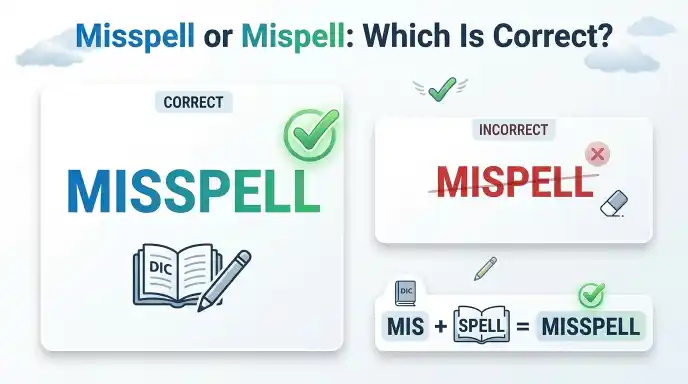
Misspell is the correct spelling, while “mispell” is simply a common misspelling of the word itself missing its second “s.”
The word “misspell” combines the prefix “mis-” (meaning wrongly or incorrectly) with “spell,” and both S’s are required: one from “mis-” and one from “spell” itself.
This mix-up happens often because English speakers naturally simplify double letters when typing quickly, especially in casual texts or social media posts.
Autocorrect tools and spell-checkers will typically flag “mispell” as an error, gently nudging writers back toward the correct double-S spelling every time.
In this guide, you’ll learn why “misspell” carries two S’s, common reasons people drop one, and simple tricks to remember the correct spelling going forward into 2026.
Misspell or Mispell: Which Is Correct?
Misspell is the correct standard spelling. Mispell is incorrect in standard modern English.
The spelling misspell combines mis-, meaning something done wrongly or incorrectly, with spell. The two parts keep their s letters, giving us mis + spell = misspell.
Quick rule: Remember mis + spell = misspell.
Misspell or Mispell: Quick Answer
The correct spelling is misspell, with two s’s.
- ✅ misspell: correct
- ❌ mispell: incorrect
- ✅ I often misspell difficult words.
- ❌ I often mispell difficult words.
The verb misspell means to spell a word incorrectly. Cambridge and Oxford both list misspell as the standard verb.
The same spelling is used in both British and American English. However, the past forms can differ:
- American English: misspelled
- British English: misspelled or misspelt
What Does Misspell Mean?
Misspell is a verb that means to spell a word incorrectly.
For example:
I always misspell her last name.
This means the person does not write the letters of the name in the correct order.
Another example:
Be careful not to misspell the company’s name.
Here, misspell means to write the company’s name incorrectly.
Common forms of misspell
| Form | Example |
| misspell | I sometimes misspell names. |
| misspells | He often misspells long words. |
| misspelled | She misspelled my name. |
| misspelt | She misspelt my name. |
| misspelling | There is a misspelling in the sentence. |
Oxford lists misspell, misspells, misspelled, misspelt, and misspelling as forms of the word.
The Origin of Misspell
The word misspell is formed from two parts:
mis- + spell = misspell
The prefix mis- is used in English to indicate something wrong, mistaken, or incorrectly done. The verb spell refers to forming a word correctly with letters.
Etymological sources date misspell to the 1650s, with the meaning “spell incorrectly.” The related noun misspelling appeared later, in the 1690s.
The important point for modern writers is that the spelling reflects the two parts of the word:
mis + spell → misspell
That structure also explains why mispell is easy to write by mistake. Writers sometimes drop one of the repeated letters, but standard spelling keeps both s’s.
British English vs American English
There is no British-American spelling difference between misspell and mispell. The correct verb is misspell in both varieties.
The main difference appears in the past tense and past participle. British English commonly allows misspelt, while misspelled is also used. American English generally uses misspelled. Cambridge and Oxford both recognize these forms.
| British English | American English | Example |
| misspell | misspell | Don’t misspell the name. |
| misspells | misspells | He misspells the word. |
| misspelled | misspelled | She misspelled it. |
| misspelt | misspelled | She misspelt it. |
| misspelling | misspelling | I found a misspelling. |
What about Canada and Australia?
Canadian and Australian English can use forms found in both British and American English. In formal writing, follow the spelling conventions required by your school, employer, publication, or style guide.
The key distinction remains simple:
misspell = correct
mispell = incorrect
Which Version Should You Use?
For the basic verb, use misspell regardless of where you write.
United States
Use:
I accidentally misspelled the word.
American English generally uses misspelled for the past tense.
United Kingdom
You can write:
I misspelled the word.
or:
I misspelt the word.
Both forms are recognized.
Canada
Use misspell for the base verb. For past-tense spelling, follow the conventions expected by your institution or publication.
Australia
Use misspell as the base form. Both misspelled and misspelt may be encountered, depending on the preferred English variety.
International writing
For international readers, misspell is the safest standard form because it is understood across English varieties.
Academic writing
Use the form required by your institution or style guide. More importantly, proofread carefully because spelling errors can distract readers from your argument.
Business writing
Use misspell and proofread names, company names, product names, and technical terms carefully.
Common Mistakes with Misspell or Mispell
Mistake 1: Writing “mispell”
❌ I always mispell this word.
✅ I always misspell this word.
Why?
The word is formed from mis- + spell, so both parts contribute an s.
Memory tip:
Think:
MIS + SPELL = MISSPELL
Mistake 2: Using “mispelled”
❌ The name was mispelled.
✅ The name was misspelled.
The extra s is still needed in the past-tense form.
Mistake 3: Writing “mispelling”
❌ There is a mispelling in the paragraph.
✅ There is a misspelling in the paragraph.
The noun also keeps the double s.
Mistake 4: Confusing “misspell” with “misspelt”
❌ Assuming misspelt is simply a spelling mistake.
✅ Misspelt is a legitimate British English past form of misspell. Misspelled is also correct.
Everyday Examples of Misspell
In emails
Please check the customer’s name. I don’t want to misspell it.
Sorry, I misspelled your name in my previous email.
In business writing
Make sure you do not misspell the company name.
The report contains one misspelling.
In news headlines
Officials Correct Name After It Was Misspelled in the Report
In blogs
Writers often misspell words when typing too quickly.
On social media
I can’t believe I misspelled my own username!
In academic writing
Students should proofread their essays for misspellings before submitting them.
In daily conversation
How do you spell that? I don’t want to misspell it.
These examples show that misspell is useful whenever someone spells a word incorrectly.
Google Trends & Modern Usage
People search for “misspell or mispell” because the two spellings look almost identical. The repeated s is easy to overlook, particularly when the word is typed quickly.
Modern dictionaries continue to list misspell as the standard English verb. Cambridge defines it as failing to spell a word correctly, while Oxford also lists misspell and its forms.
Merriam-Webster also specifically identifies mispell as an incorrect spelling and explains that misspell retains both s’s.
Search interest in this type of query does not mean that mispell has become an accepted alternative. People often search incorrect spellings precisely because they are unsure which form is standard.
Exact Google Trends numbers should be checked directly for a chosen country and time range rather than assumed from general search behavior. The important usage fact is clear: misspell is the standard spelling.
Quick Comparison Table
| Version | Meaning | Correct? | Region | Example |
| misspell | Spell incorrectly | ✅ Yes | All major English varieties | Don’t misspell my name. |
| mispell | Intended to mean “spell incorrectly” | ❌ No | Not standard | Avoid this spelling. |
| misspelled | Past form of misspell | ✅ Yes | Especially common in US English | I misspelled it. |
| misspelt | Past form of misspell | ✅ Yes | Common in UK English | I misspelt it. |
| misspelling | An incorrect spelling | ✅ Yes | International | There is a misspelling. |
Key Takeaways
- Misspell is the correct spelling.
- Mispell is a common spelling error.
- Remember mis + spell = misspell.
- The base verb is spelled misspell in British and American English.
- Misspelled is a standard past form.
- Misspelt is also standard, especially in British English.
- Misspelling is the correct noun.
- If you are unsure, remember the two parts: mis + spell.
FAQs
Is misspell or mispell correct?
Misspell is correct. Mispell is not the standard spelling. The word is formed from mis- and spell, producing misspell. For example: “I often misspell difficult words.” The same base spelling is used in British and American English.
Why does misspell have two s’s?
Misspell has two s’s because it combines mis- with spell. The first s comes from mis- and the second s comes from spell. So the easiest way to remember the spelling is mis + spell = misspell.
Is mispell a word?
Mispell is not the standard spelling of the English verb. When you mean “to spell a word incorrectly,” use misspell. Merriam-Webster specifically lists mispell among incorrect spellings and explains why misspell keeps both s’s.
Is misspelled or misspelt correct?
Both misspelled and misspelt are correct forms of misspell. Misspelled is especially common in American English, while misspelt is commonly associated with British English. Oxford lists both forms.
What is the noun form of misspell?
The noun is misspelling. It means an incorrect spelling of a word. For example: “There is a misspelling in this sentence.” The word keeps the double s found in misspell.
How do you spell misspell correctly?
Spell it M-I-S-S-P-E-L-L. A useful memory trick is to separate it into two parts: MIS + SPELL. This makes it easier to remember why there are two s’s.
Is misspell the same in British and American English?
Yes. The base verb is misspell in both British and American English. The main difference is in the past form: British English commonly uses misspelt, while American English generally uses misspelled.
What is the past tense of misspell?
The past tense can be misspelled or misspelt. For example: “I misspelled the word.” In British English, “I misspelt the word” is also common. Both forms are recognized by major English dictionaries.
What is the difference between misspell and misspelling?
Misspell is a verb, while misspelling is a noun. You misspell a word when you write it incorrectly. A misspelling is the incorrect spelling itself. For example: “I misspelled the word” and “I found a misspelling.”
How can I remember the spelling of misspell?
Use the simple formula MIS + SPELL = MISSPELL. The word spell already begins with s, and mis- ends with s, so the two s’s stay together. This is one of the easiest ways to avoid writing mispell.
Conclusion
When choosing between misspell or mispell, always use misspell. It is the standard spelling of the English verb meaning “to spell a word incorrectly.”
Mispell is a common error caused by dropping one of the two s’s.
The spelling becomes easier when you break the word into its parts: mis + spell = misspell. This rule also helps with related forms such as misspelled and misspelling.
In British English, misspelt is another accepted past form, while American English generally favors misspelled.
For schoolwork, professional emails, websites, academic writing, and everyday communication, misspell is the form to use.
If you see mispell, treat it as a spelling mistake rather than an alternative spelling.
Memorable takeaway: If you can remember “mis + spell,” you can remember to spell it “misspell.”
Read More:
- Inquiring or Enquiring: American vs British English, Explained
- Neighbourhood or Neighborhood: One Letter, Two Countries Divided
- Mistakenly or Mistakingly: Which One Is Correct in 2026?




3 thoughts on “Misspell or Mispell : Only One Spelling Is Correct”