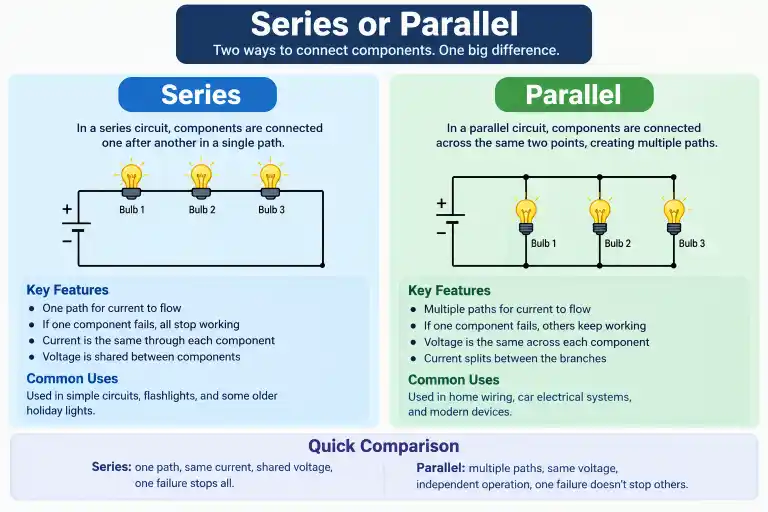
If you are asking “series or parallel?” in electrical circuits, the answer depends on how the components are connected: series has one path for current, while parallel has multiple paths.
People often search series or parallel when learning basic electricity, checking a circuit diagram, choosing a wiring method, or trying to understand why one component affects another.
The two terms can seem confusing because both describe ways of connecting electrical components.
The easiest rule is simple: series means one path, while parallel means more than one path. In a series circuit, the same current flows through each component.
In a parallel circuit, each branch has the same voltage, while current divides between the branches.
This guide explains the meaning of series and parallel, their history, key differences, common mistakes, everyday examples, and when each connection is useful.
Series or Parallel – Quick Answer
Series: Components are connected one after another in a single path.
Parallel: Components are connected in separate branches, creating multiple paths.
| Feature | Series | Parallel |
| Current path | One | Multiple |
| Current | Same through components | Divides between branches |
| Voltage | Divided | Same across branches |
| Failure | Can stop the whole circuit | Usually affects only one branch |
| Common example | String lights | Home electrical wiring |
A quick way to remember it is:
Series = single path. Parallel = separate paths.
Definition and Meaning of Series or Parallel
What Does Series Mean?
In an electrical circuit, series means that components are connected end to end. Current has only one continuous path to follow.
For example, if three bulbs are connected in one continuous loop, they are in series.
A series circuit has these main features:
- One path for current
- The same current through each component
- Voltage divided among components
- Total resistance increases when resistors are added
For resistors, the total resistance is:
Rₜ = R₁ + R₂ + R₃
What Does Parallel Mean?
Parallel means that components are connected across the same two points, creating separate branches for current.
For example, household lights are commonly connected in parallel. Each light can work independently.
A parallel circuit has these main features:
- More than one path for current
- Voltage is the same across each branch
- Current divides between branches
- One failed branch does not normally stop the other branches
For resistors, total resistance is calculated using:
1/Rₜ = 1/R₁ + 1/R₂ + 1/R₃
These basic rules are central to circuit analysis.
The Origin of Series or Parallel
The words series and parallel have different origins.
The word series entered English in the early 1600s. It comes from Latin series, meaning a row, chain, sequence, or succession. It is related to the Latin verb serere, meaning “to join” or “to link.”
The word parallel entered English in the 1500s. It came through French parallèle and Latin parallelus, from Greek parallēlos. The Greek idea means “beside one another.”
These meanings fit electrical circuits well:
- Series suggests things linked one after another.
- Parallel suggests separate things running beside each other.
Unlike spelling pairs such as color and colour, series and parallel are not alternative spellings of the same word. They are two different words with different meanings.
British English vs American English Spelling
There is no major British vs American spelling difference for series or parallel.
Both British and American English use:
- series
- parallel
- series circuit
- parallel circuit
- series connection
- parallel connection
| Term | British English | American English |
| Series | series | series |
| Parallel | parallel | parallel |
| Series circuit | series circuit | series circuit |
| Parallel circuit | parallel circuit | parallel circuit |
| Series connection | series connection | series connection |
| Parallel connection | parallel connection | parallel connection |
So, if you are writing for the US, UK, Canada, Australia, or an international audience, you normally do not need to change the spelling.
The difference is about electrical arrangement, not regional spelling.
Which Spelling Should You Use?
You can use series and parallel in every major form of English.
US audience, use:
- series circuit
- parallel circuit
- series connection
- parallel connection
For a UK or Commonwealth audience, the same terms are correct.
For a global website, use series circuit and parallel circuit because these are clear and widely understood technical terms.
The bigger issue is not spelling. It is choosing the correct word for the circuit.
If there is one path, think series.
If the path branches, think parallel.
Common Mistakes with Series or Parallel
Mistake 1: Thinking parallel means “next to each other”
A diagram can look parallel without actually showing a parallel electrical connection.
Correct approach: Look at the connection points and current paths, not just the visual shape.
Mistake 2: Assuming all circuits are series or parallel
Many real circuits contain both series and parallel sections. These are called series-parallel circuits.
Mistake 3: Thinking current is the same in parallel
In a parallel circuit, current can divide between branches.
Remember:
Series = same current.
Parallel = same voltage.
Mistake 4: Thinking voltage is always divided
Voltage is divided across components in series, but components connected in parallel have the same voltage across them.
Mistake 5: Assuming parallel is always better
Neither connection is always better.
The right choice depends on the purpose of the circuit.
Series or Parallel in Everyday Examples
1. Household Wiring
Most household loads are connected in parallel so that appliances can operate independently. Turning off one light does not normally turn off every other light.
2. String Lights
Traditional strings of lights can use series connections. Because the components share one path, a break can interrupt the entire string.
3. Batteries in Series
Connecting batteries in series can increase the total voltage.
For example, two 1.5-volt cells connected in series can provide 3 volts under the appropriate conditions.
4. Batteries in Parallel
Connecting suitable batteries in parallel can increase available current capacity while keeping the voltage at the same nominal level. The exact design depends on battery type and safety requirements.
5. Electronics
Electronic circuits often contain both series and parallel sections. Engineers analyze each section based on how its components are connected.
6. Emails and Formal Writing
The terms are also common in technical writing:
Email:
“Please check if the two resistors are connected in series or parallel.”
News:
“The engineers tested the batteries in parallel.”
Social media:
“Can someone explain the difference between series and parallel circuits?”
Formal writing:
“The resistors were connected in series to increase the total resistance.”
Series or Parallel : Google Trends & Usage Data
Search interest for “series or parallel” is closely tied to education and electrical topics. People often use the phrase while studying circuits, solving homework problems, reading electronics guides, or troubleshooting electrical systems.
The search phrase is also commonly expanded into queries such as:
- series or parallel circuit
- series vs parallel
- series and parallel circuits
- batteries in series or parallel
- resistors in series or parallel
- lights in series or parallel
Current educational and engineering resources continue to treat series and parallel circuits as two basic circuit arrangements.
Search behavior also varies by context. Students often search for the basic difference, while electronics users may search for formulas, resistance, voltage, current, or practical wiring choices.
Because search interest changes over time, Google Trends should be used as a live tool rather than as a fixed popularity number.
Series vs Parallel: Comparison Table
| Feature | Series | Parallel |
| Number of paths | One | Two or more |
| Current | Same | Divides |
| Voltage | Divided | Same across branches |
| Resistance | Increases | Decreases |
| Component failure | Can affect the whole circuit | Usually affects one branch |
| Wiring | End to end | Across common points |
| Example | String of lights | Home wiring |
| Best remembered as | One path | Multiple paths |
For resistors, adding more resistance in series increases total resistance. Adding another resistor in parallel lowers the equivalent resistance.
FAQs About Series or Parallel
1. What is the main difference between series and parallel?
The main difference is the number of current paths. A series circuit has one path, while a parallel circuit has multiple branches. Series circuits have the same current through each component, while parallel branches have the same voltage.
2. Which is better, series or parallel?
Neither is always better. Series is useful when components need to share the same current or when voltage division is needed. Parallel is useful when separate components need the same supply voltage and independent operation.
3. Are house lights connected in series or parallel?
Household lights are generally connected in parallel. This allows different lights and appliances to operate independently. A problem with one branch does not normally stop every other branch.
4. What happens if one bulb fails in a series circuit?
If one bulb creates an open circuit, the single current path is broken. As a result, the other bulbs in that series path may also stop working.
5. What happens if one bulb fails in a parallel circuit?
If one branch opens, current can usually continue through the other branches. This allows the remaining bulbs or loads to keep operating.
6. Is voltage the same in series or parallel?
Voltage is generally not the same across each resistor in a series circuit. In a parallel circuit, each connected branch has the same voltage across it.
7. Can a circuit have both series and parallel connections?
Yes. Many practical circuits contain both types. These are called series-parallel circuits and are common in electronics.
Conclusion
Understanding series or parallel becomes much easier when you focus on the path of current. A series circuit has one continuous path, so the same current flows through each component. A parallel circuit has multiple branches, so current can divide while the voltage remains the same across the branches.
The two terms are not British and American spelling variations. Both series and parallel are standard in British and American English. They describe two different ways of connecting electrical components.
For a quick memory trick, remember “series = single path” and “parallel = multiple paths.” Series connections can be useful for increasing resistance or voltage in suitable circuits, while parallel connections are useful when independent operation and a common voltage are needed.
Many real circuits use a combination of both. Once you learn to identify the paths, it becomes much easier to understand circuit diagrams, calculate values, and choose the right connection for a specific task.
Read More:
- Flown or Flew: Confused About These Two Words?
- Seat or Sit: Which One Should You Use in 2026?
- Could or Would: What’s the Difference?






1 thought on “Series or Parallel: A Simple Breakdown for 2026”