
If you are confused about “flown or flew,” remember this simple rule: flew is the simple past tense of “fly,” while flown is the past participle used with helping verbs such as have, has, and had.
Many English learners mix up these two forms because both refer to flying in the past. However, they have different grammatical jobs.
For example, we say “She flew to London yesterday,” but “She has flown to London before.”
Understanding the difference between flew and flown is especially useful when writing about travel, airplanes, birds, vacations, and other situations involving flight.
It also helps you avoid common mistakes such as “I have flew” or “I flown yesterday.”
In this guide, you will learn when to use flew, when to use flown, how they work in different tenses, common mistakes, everyday examples, and an easy way to remember the difference.
Flown or Flew : Quick Answer
The easiest way to remember the difference is:
| Word | Grammar | Example |
| Flew | Simple past | I flew to Dubai yesterday. |
| Flown | Past participle | I have flown to Dubai before. |
Use flew for a completed action in the past.
Examples:
- We flew to New York last week.
- She flew home yesterday.
- The bird flew away.
- They flew across the country.
Use flown with a helping verb.
Usually, flown follows have, has, or had.
Examples:
- I have flown on this airline before.
- She has flown to Paris twice.
- They had flown home before the storm began.
According to standard English conjugation, fly → flew → flown.
Definition and Meaning of Flown or Flew
What Does “Fly” Mean?
Fly means to move through the air, usually with wings, or to travel by aircraft.
For example:
Birds fly south in winter.
We fly to Canada every summer.
The verb fly is irregular, so it does not form its past tense by simply adding -ed.
Its main forms are:
| Verb Form | Word | Example |
| Base form | fly | I fly often. |
| Simple past | flew | I flew yesterday. |
| Past participle | flown | I have flown before. |
| Present participle | flying | I am flying today. |
| Third-person singular | flies | She flies every month. |
The standard forms are consistently listed as fly, flew, flown, flying, flies.
When to Use Flew
Flew is the simple past form of fly.
Use it when an action happened and finished in the past.
Examples
- I flew to London last Friday.
- She flew home yesterday.
- We flew over the mountains.
- The plane flew through the clouds.
- He flew a kite in the park.
- The bird flew out of the window.
Notice that flew can stand alone as the main verb:
She flew to Paris yesterday.
You do not need have, has, or had before it.
When to Use Flown
Flown is the past participle of fly.
It normally appears with a helping verb, especially have, has, or had.
Present Perfect
Use have/has + flown.
- I have flown to Spain.
- She has flown to New York.
- We have flown with this airline before.
Past Perfect
Use had + flown.
- I had flown home before the storm started.
- They had flown to London before we arrived.
- She had already flown away when I called.
The key rule is:
have/has/had + flown
Not:
❌ I have flew.
✅ I have flown.
Flown or Flew: Grammar Comparison
| Feature | Flew | Flown |
| Verb | Fly | Fly |
| Form | Simple past | Past participle |
| V2 | Yes | No |
| V3 | No | Yes |
| Usually needs helping verb? | No | Yes |
| Example | She flew yesterday. | She has flown before. |
A quick memory trick is:
Flew stands alone. Flown needs a helping verb.
This is not an absolute description of every possible construction because participles can occur in passive and other structures, but it is an excellent rule for everyday usage.
The Origin of Flown or Flew
The verb fly has a very old Germanic history. It comes from Old English fleogan, meaning to fly or move through the air. The modern forms flew and flown developed from older irregular verb patterns rather than from the regular -ed ending.
This explains why English does not use “flyed” as the normal past form.
Instead, the verb changed its form:
fly → flew → flown
This type of change is common among older English irregular verbs.
For example:
- know → knew → known
- grow → grew → grown
- blow → blew → blown
- fly → flew → flown
Learning these patterns can make irregular verbs easier to remember.
British English vs American English Spelling
There is no British vs. American spelling difference between flew and flown.
Both British and American English use:
- fly
- flew
- flown
- flying
- flies
| British English | American English |
| fly | fly |
| flew | flew |
| flown | flown |
| flying | flying |
| flies | flies |
So whether you are writing for readers in the United Kingdom, United States, Canada, Australia, or elsewhere, the forms flew and flown remain the same.
The difference is grammatical, not regional.
Which Version Should You Use?
Use flew when you are talking about a completed past action.
I flew to Rome last year.
Use flown when it follows a suitable helping verb.
I have flown to Rome several times.
Compare:
❌ I have flew to Rome.
✅ I have flown to Rome.
She flown to London yesterday.
He flew to London yesterday.
❌ They had flew home.
✅ They had flown home.
A simple question can help:
Did the action happen at a specific past time?
If yes, flew is often correct.
Is there have, has, or had before the verb?
If yes, use flown.
Common Mistakes with Flown or Flew
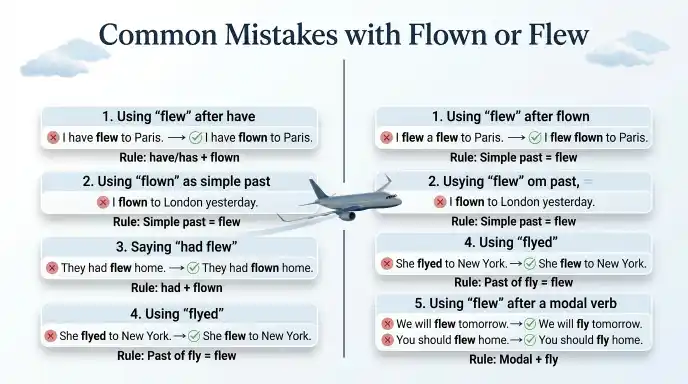
1. Using “flew” after have
❌ I have flew to Paris.
✅ I have flown to Paris.
After have/has, use the past participle flown.
2. Using “flown” as simple past
❌ I flown to London yesterday.
✅ I flew to London yesterday.
Because there is no helping verb, the simple past flew is required.
3. Saying “had flew”
❌ They had flew home.
✅ They had flown home.
The structure is:
had + past participle = had flown
4. Using “flyed”
❌ She flyed to New York.
✅ She flew to New York.
Fly is an irregular verb, so flyed is not the standard past form.
5. Using “flew” after a modal verb
After words such as will, can, should, must, and might, use the base form fly.
❌ We will flew tomorrow.
✅ We will fly tomorrow.
❌ You should flew home.
✅ You should fly home.
The rule is:
Modal + fly
Flown or Flew in Everyday Examples
Here are some natural examples to make the difference clear.
Flew
- We flew to Turkey last summer.
- She flew home on Monday.
- The plane flew over the city.
- The bird flew away.
- I flew for the first time when I was 18.
- They flew to California yesterday.
Flown
- I have flown on this airline before.
- She has flown to many countries.
- We have flown this route several times.
- He had flown home before the airport closed.
- They have flown together many times.
- The birds had flown south before winter arrived.
Flew vs Flown in Different Tenses
Understanding the complete tense pattern can make this much easier.
Present Simple
I fly to work every week.
Past Simple
I flew to work yesterday.
Present Perfect
I have flown to work many times.
Past Perfect
I had flown there before.
Future Simple
I will fly tomorrow.
Present Continuous
I am flying tomorrow morning.
This shows why flew and flown cannot simply be swapped.
Quick Comparison Table
| Sentence | Correct? | Why? |
| I flew yesterday. | ✅ | Simple past |
| I have flown before. | ✅ | Have + past participle |
| She flew to Paris. | ✅ | Simple past |
| She has flown to Paris. | ✅ | Has + past participle |
| They had flown home. | ✅ | Had + past participle |
| I have flew before. | ❌ | Use flown after have |
| She flown yesterday. | ❌ | Use flew for simple past |
| He flyed home. | ❌ | The correct past form is flew |
“Flew” vs “Flown” With Questions
The same rule applies when asking questions.
Flew
Did you fly to London?
Notice that after did, we actually use the base form fly, not flew.
❌ Did you flew to London?
✅ Did you fly to London?
Flown
Have you flown to London before?
Here, have requires the past participle flown.
This gives us another useful rule:
Did + fly
Have/Has/Had + flown
Is “Flown” Ever Used Without Have, Has, or Had?
Yes. Although have/has/had + flown is the most useful pattern for learners, flown can also appear in passive constructions.
For example:
The supplies were flown to the island.
Here, were + flown creates a passive construction.
So the broader rule is not simply “flown must always follow have.” Instead, flown is a past participle, and past participles can appear in several grammatical structures.
For everyday learning, however, remembering have/has/had + flown is the easiest starting point.
Flown or Flew : Google Trends & Usage Data
Searches for “flown or flew” are mainly driven by people trying to understand the difference between the simple past and past participle forms of fly. Grammar resources consistently identify flew as the past simple form and flown as the past participle.
The search intent behind this keyword is therefore strongly educational. People commonly encounter the two forms in sentences such as:
- “I flew to London.”
- “I have flown to London.”
- “She had flown home.”
The confusion usually comes from not knowing which verb form follows a helping verb.
For SEO content, the strongest approach is to answer the question immediately, then explain flew vs. flown, provide examples, show the verb forms, and address mistakes such as “have flew” and “flied.”
Because Google Trends values can change over time, exact trend numbers should be checked directly for the target country and date range rather than treated as permanent statistics.
Easy Trick to Remember Flown or Flew
Here is the simplest memory trick:
Flew = yesterday
Flown = have/has/had
Think:
I flew yesterday.
I have flown before.
You can also remember the complete pattern:
Fly → Flew → Flown
- Fly = present
- Flew = past
- Flown = past participle
If you remember these three forms, most mistakes become easy to avoid.
FAQs About Flown or Flew
1. Is “flew” the past tense of “fly”?
Yes. Flew is the simple past tense of fly.
Example:
We flew to Paris last week.
2. Is “flown” the past tense of “fly”?
No. Flown is the past participle of fly.
Example:
We have flown to Paris before.
3. Should I say “I flew” or “I flown”?
Say “I flew” when using the simple past.
I flew to London yesterday.
Use “I have flown” when using the present perfect.
I have flown to London before.
4. Is “I have flew” correct?
No.
❌ I have flew to New York.
✅ I have flown to New York.
After have, use the past participle flown.
5. Is “flied” correct?
For the normal verb fly, flied is not the standard past form. The correct forms are flew and flown.
However, flied out is used as specialized baseball terminology, so you may see it in sports contexts.
6. What are the three forms of fly?
The three main forms are:
Fly – Flew – Flown
Example:
fly every month.
I flew last week.
i have flown many times.
7. What is the difference between “flew” and “flown”?
Flew is the simple past, while flown is the past participle.
She flew to Canada yesterday.
She has flown to Canada before.
Key Takeaways
- Fly is an irregular verb.
- Flew is the simple past form.
- Flown is the past participle.
- Use flew for a completed past action.
- Use flown with helping verbs such as have, has, and had.
- Flyed is not the normal past form.
- After did, use fly, not flew.
- After have/has/had, use flown.
- British and American English use the same forms.
Remember:
Fly → Flew → Flown
Once you understand this pattern, choosing between flown or flew becomes much easier.
Conclusion
Choosing between flown or flew is simple once you understand their grammatical roles. Flew is the simple past form of the irregular verb fly, while flown is its past participle. Use flew when describing a completed action in the past, such as “She flew to London yesterday.” Use flown when it works with a helping verb, such as “She has flown to London before.”
The easiest pattern to remember is fly → flew → flown. Also remember that did + fly is correct, while have/has/had + flown is correct. Avoid common mistakes such as “I have flew,” “I flown yesterday,” and “flyed.”
Whether you are writing about airplanes, birds, travel, or everyday experiences, these three forms follow the same basic grammar rules. Once you practice a few examples, the difference between flew and flown becomes much easier to recognize and use correctly.
Read More:
- Seat or Sit: Which One Should You Use in 2026?
- Could or Would: What’s the Difference?
- Manners or Manors: Commonly Confused Words Explained









3 thoughts on “Flown or Flew: Confused About These Two Words?”