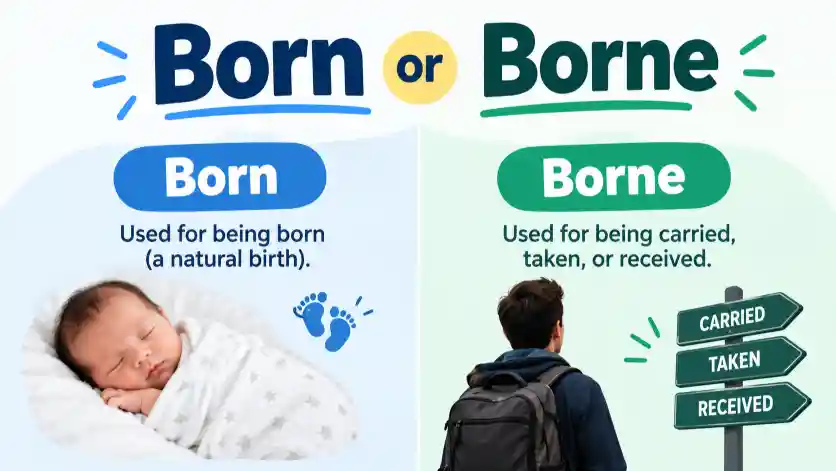
Have you ever wondered if you should write born or borne in a sentence? Both words are correct, but they serve different purposes in English grammar. Born is mainly used when talking about birth, while borne is the past participle of bear and usually refers to carrying, enduring, supporting, or accepting something.
These words often confuse students, writers, English learners, and even experienced speakers because they come from the same verb: bear. Their meanings overlap historically, but their modern uses are different. Choosing the right form makes your writing clearer and helps you avoid common grammar mistakes.
For example, you would say, “She was born in London,” to describe someone’s birth. However, you would write, “The company has borne the cost,” to explain that the company paid or accepted an expense.
In this guide, you will learn the meanings of born and borne, their grammatical roles, British and American usage, common mistakes, and practical examples. You will also discover a simple memory trick to help you choose the correct word whenever you write or speak English.
Born or Borne : Quick Answer
Born is used mainly to describe the beginning of someone’s life or the origin of an idea, movement, or organization. Borne is used when describing something carried, endured, supported, or accepted.
- Born: She was born in 2002.
- Borne: The expenses were borne by the company.
Both words are forms of the verb bear, but they are not interchangeable in most modern sentences.
Easy rule: Use born for birth and borne for carrying or enduring.
Definition and Meaning of Born and Borne
What Does Born Mean?
Born is the past participle of bear when the verb refers to giving birth. It commonly appears in passive constructions with forms of be, such as was born, were born, and is born.
It can also describe the origin or beginning of something, including an idea, tradition, or movement.
Examples:
- My brother was born in July.
- She was born in Canada.
- A new tradition was born from that experience.
- He is a born leader.
In the last example, born describes someone who seems naturally suited to leadership.
What Does Borne Mean?
Borne is the past participle of bear when it means to carry, support, endure, or accept something. It is commonly used in formal, professional, and academic writing.
Examples:
- She has borne many responsibilities.
- The costs were borne by the employer.
- The bridge has borne the weight of heavy vehicles.
- The consequences must be borne by those responsible.
In these sentences, borne expresses carrying a burden, accepting responsibility, or enduring a situation.
Born vs. Borne: Key Differences
| Feature | Born | Borne |
| Main meaning | Given birth; brought into existence | Carried, endured, supported, or accepted |
| Base verb | Bear | Bear |
| Common construction | Was born | Has borne |
| Typical context | Birth, origin, natural qualities | Costs, burdens, responsibility, transmission |
| Example | He was born in April. | He has borne the burden. |
Origin and History of Born and Borne
The words born and borne developed from different historical forms associated with the verb bear. This verb has long carried meanings related to carrying, supporting, producing, and giving birth.
Over time, English developed distinct forms for particular uses. Born became the usual form associated with birth, while borne remained the standard past participle for other meanings of bear.
This distinction explains why English speakers say “She was born in 1998” but “She has borne the responsibility for the project.”
Although the words share a common origin, their modern grammatical functions make them different in everyday writing.
British English vs. American English
The distinction between born and borne is essentially the same in British and American English. Neither spelling is exclusively British or American.
| Usage | British English | American English |
| Describing birth | She was born in London. | She was born in Boston. |
| Describing a burden | He has borne the burden. | He has borne the burden. |
| Describing expenses | The costs were borne by the firm. | The costs were borne by the company. |
| Describing a beginning | A new movement was born. | A new movement was born. |
Both varieties use born for birth and borne for carrying, enduring, or accepting something.
The main differences in these examples involve regional details, such as place names or vocabulary, rather than the words themselves.
Which Word Should You Use: Born or Borne?
Choosing between born and borne becomes easier when you focus on the intended meaning.
When to Use Born
Use born when talking about someone’s birth or the beginning of something.
Examples:
- My cousin was born in December.
- The famous writer was born in Scotland.
- A brilliant idea was born during the discussion.
- She was born with excellent musical ability.
Remember: When the sentence refers to entering life or something coming into existence, born is usually the correct choice.
When to Use Borne
Use borne when the meaning involves carrying, enduring, accepting, or supporting something.
Examples:
- The entire cost was borne by the government.
- He has borne the responsibility for years.
- The pain was difficult to bear, but it was borne with courage.
- The disease is borne by certain insects.
In the last example, borne means that insects carry or transmit the disease.
Remember: If the sentence involves a burden, expense, responsibility, or something being carried, borne is generally the correct form.
Common Mistakes With Born and Borne
Writers sometimes confuse these words because both come from bear. Understanding their separate uses prevents errors.
1. Using Borne to Describe Birth
Incorrect: She was borne in 2005.
Correct: She was born in 2005.
Explanation: Use born when describing the date or place where someone entered the world.
2. Using Born for a Financial Burden
Incorrect: The costs were born by the business.
Correct: The costs were borne by the business.
Explanation: The sentence refers to accepting or covering expenses, so borne is appropriate.
3. Confusing Born With Borne in Formal Writing
Incorrect: The manager has born the responsibility for the project.
Correct: The manager has borne the responsibility for the project.
Explanation: When bear means to carry or accept responsibility, its past participle is borne.
4. Forgetting the Verb Form
Incorrect: She has borne in 1999.
Correct: She was born in 1999.
Explanation: The standard expression for someone’s birth uses a form of be followed by born.
5. Assuming the Words Are Interchangeable
Incorrect: The financial burden was born by the family.
Correct: The financial burden was borne by the family.
Explanation: Although the words are related, the context determines the correct form.
Everyday Examples of Born and Borne
These practical examples show how the two words work in different situations.
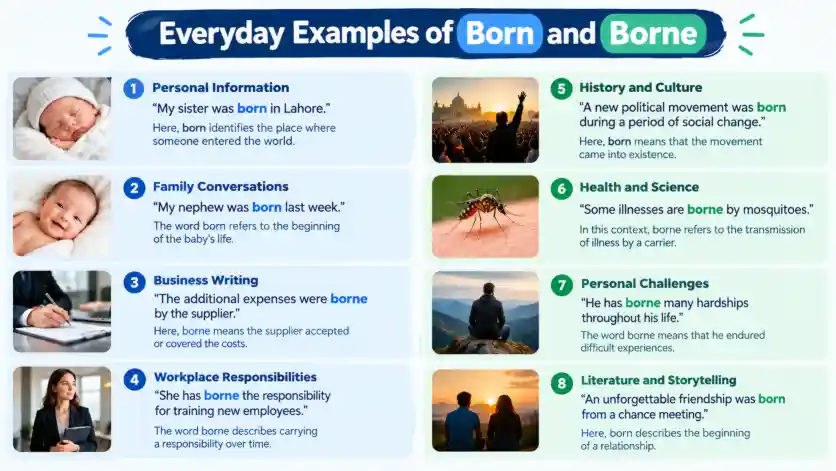
1. Personal Information
“My sister was born in Lahore.”
Here, born identifies the place where someone entered the world.
2. Family Conversations
“My nephew was born last week.”
The word born refers to the beginning of the baby’s life.
3. Business Writing
“The additional expenses were borne by the supplier.”
Here, borne means the supplier accepted or covered the costs.
4. Workplace Responsibilities
“She has borne the responsibility for training new employees.”
The word borne describes carrying a responsibility over time.
5. History and Culture
“A new political movement was born during a period of social change.”
Here, born means that the movement came into existence.
6. Health and Science
“Some illnesses are borne by mosquitoes.”
In this context, borne refers to the transmission of illness by a carrier.
7. Personal Challenges
“He has borne many hardships throughout his life.”
The word borne means that he endured difficult experiences.
8. Literature and Storytelling
“An unforgettable friendship was born from a chance meeting.”
Here, born describes the beginning of a relationship.
Born or Borne: Usage Trends and Modern Writing
Both words remain standard in modern English, but they tend to appear in different contexts.
Born is common in biographies, personal introductions, historical accounts, news stories, and everyday conversations. Expressions such as “born in 2001,” “born in London,” and “born leader” are familiar to most English readers.
Borne appears frequently in formal writing, financial documents, business reports, scientific explanations, and discussions about responsibility. Phrases such as “costs borne by the employer,” “burden borne by families,” and “disease borne by insects” illustrate its typical uses.
Their different meanings explain why one word cannot simply replace the other. For accurate modern usage, focus on the meaning of bear in the sentence rather than choosing based on appearance alone.
A reliable way to check an unfamiliar example is to consult a reputable dictionary and look at the complete sentence in context. Avoid relying on search popularity alone to decide which form is grammatically correct.
Born vs. Borne: Comparison Table
| Sentence | Correct word | Reason |
| She was in 2004. | Born | Describes birth |
| The costs were by the company. | Borne | Describes accepting expenses |
| He has many difficulties. | Borne | Means endured |
| A new idea was from the discussion. | Born | Describes something coming into existence |
| The responsibility was by the team. | Borne | Means carried or accepted |
| My daughter was in winter. | Born | Refers to birth |
| The infection is by mosquitoes. | Borne | Means transmitted or carried |
| A new friendship was that day. | Born | Describes the beginning of a relationship |
Easy Trick to Remember the Difference
Use this simple memory trick:
- Born = Birth. Both words begin with the letter B, and born is the word used for entering the world.
- Borne = Burden. Think of borne as carrying a burden, responsibility, cost, or difficulty.
For example:
- “I was born in 2003.” This describes birth.
- “I have borne many responsibilities.” This describes carrying responsibilities.
Another useful trick is to replace the intended meaning with a simpler phrase. If you mean “came into the world,” use born. If you mean “carried,” “endured,” or “accepted,” use borne.
Frequently Asked Questions (FAQs)
1. Is born or borne correct?
Both are correct words. Born is generally used for birth, while borne is used for carrying, enduring, supporting, or accepting something.
2. What is the difference between born and borne?
Born refers mainly to birth or the beginning of something. Borne refers to carrying a burden, enduring difficulty, accepting responsibility, or transmitting something.
3. Is it born in or borne in?
Use born in when referring to someone’s place or date of birth.
Example: “He was born in Pakistan.”
4. Is it cost born or cost borne?
The correct expression is cost borne when referring to the person or organization responsible for paying or accepting a cost.
Example: “The cost was borne by the employer.”
5. Is borne the past tense of bear?
Borne is the past participle of bear when it means to carry, endure, support, or accept. The simple past tense is bore.
Example: “She bore the responsibility last year” and “She has borne the responsibility for years.”
6. Can borne be used for giving birth?
In modern standard English, born is the usual form for birth in expressions such as “She was born in 2000.” Borne is generally used for other meanings of bear, although the verb bear can refer to giving birth in other grammatical constructions.
7. What is an example of borne in a sentence?
“The financial burden was borne by the family.”
Here, borne means the family accepted or carried the financial burden.
8. What is an example of born in a sentence?
“My brother was born in April.”
Here, born describes the time when the person entered the world.
9. Are born and borne pronounced the same?
Yes. In standard modern English, born and borne are usually pronounced the same way, which contributes to confusion when writing them.
10. How can I remember born and borne easily?
Remember born = birth and borne = burden. This simple association will help you select the right word in most everyday sentences.
Conclusion
The difference between born and borne depends on what you want to express. Use born when describing someone’s birth or the beginning of something. Use borne when referring to carrying, enduring, supporting, or accepting a burden, cost, or responsibility.
For example, “She was born in 2001” is correct, while “The expenses were borne by the company” is also correct. Remember the simple rule born = birth and borne = burden, and you will be able to use both words confidently in everyday conversations, academic work, and professional writing.
Read More:
- Moron or Moran? Avoid This Common Spelling Mistake
- Prove or Proof? One Is an Action, the Other Is Evidence
- Critic or Critique? Are You Using the Wrong Word?









1 thought on “Born or Borne: Stop Making This Common Grammar Mistake”