
Empathy and sympathy are both correct words, but they have different meanings. Empathy means understanding or sharing another person’s feelings, while sympathy means caring about someone else’s suffering and feeling concern for them. People often confuse these words because both relate to emotions, compassion, and how we respond to someone else’s experiences.
For example, if your friend loses a loved one, you might feel sympathy by expressing sadness for their loss. You might show empathy by trying to understand the grief they are experiencing and listening to how they feel.
Knowing the difference between empathy and sympathy can help you communicate more clearly in everyday conversations, friendships, family relationships, education, and professional settings. Although the words are closely connected, they describe different ways of responding to another person’s emotional situation.
In this guide, you will learn the meanings of empathy and sympathy, explore their origins, understand their use in British and American English, and discover common mistakes with practical examples. You will also find an easy memory trick to help you choose the right word confidently.
Empathy or Sympathy : Quick Answer
Empathy means understanding or sharing another person’s feelings, while sympathy means feeling concern, compassion, or sorrow for someone who is experiencing difficulty.
- Empathy: I understand how painful this experience must be for you.
- Sympathy: I am sorry that you are going through such a difficult time.
Both words express emotional awareness, but empathy focuses more on understanding another person’s feelings, while sympathy focuses more on concern for their situation.
Easy rule: Empathy means understanding someone’s feelings; sympathy means caring about their suffering.
Definition and Meaning of Empathy and Sympathy
What Does Empathy Mean?
Empathy is the ability to understand another person’s feelings, emotions, or perspective. It involves trying to see a situation from their point of view and recognizing how they might feel.
You do not need to have experienced exactly the same situation to show empathy. Listening carefully and acknowledging another person’s emotions can be enough.
Examples:
- I felt empathy for my friend when she explained her struggles.
- A good teacher shows empathy toward students who are having difficulties.
- The nurse treated every patient with empathy and patience.
- He listened with empathy instead of judging her decisions.
Empathy is especially valuable in relationships, counseling, healthcare, education, and teamwork because it helps people feel heard and understood.
What Does Sympathy Mean?
Sympathy is a feeling of care, concern, compassion, or sorrow for someone experiencing pain, loss, hardship, or disappointment.
When you express sympathy, you recognize that someone is going through a difficult experience and show that you care about their well-being.
Examples:
- I expressed my sympathy to the family after their loss.
- She felt sympathy for the people affected by the flood.
- His colleagues offered sympathy when his father passed away.
- We have great sympathy for anyone facing financial hardship.
Sympathy often appears in condolence messages, supportive conversations, and situations where someone needs kindness or reassurance.
Empathy vs. Sympathy: Key Differences
| Feature | Empathy | Sympathy |
| Main meaning | Understanding another person’s feelings | Feeling concern for another person’s suffering |
| Emotional focus | Understanding their experience | Caring about their situation |
| Common expression | “I can understand how you feel.” | “I’m sorry you’re going through this.” |
| Typical context | Listening, support, relationships | Condolences, concern, compassion |
| Example | She showed empathy toward her friend. | She expressed sympathy for her friend. |
Origin and History of Empathy and Sympathy
Where Does the Word Empathy Come From?
The word empathy entered English in the early twentieth century. It was developed from the German term Einfühlung, which referred to the process of feeling oneself into another person’s experience, especially in aesthetics and psychology.
Its roots include the Greek word em or en, meaning “in,” and pathos, meaning “feeling” or “emotion.”
Over time, empathy became widely used in psychology, education, healthcare, and everyday discussions about emotional understanding.
Where Does the Word Sympathy Come From?
The word sympathy has older roots in English and comes through Latin and Greek. Its Greek origin, sympatheia, combines elements meaning “with” and “feeling.”
Historically, sympathy referred to sharing feelings or being affected by another person’s experience. In modern English, it often means expressing compassion or sorrow for someone facing hardship.
Although empathy and sympathy share a connection to feelings, their modern meanings emphasize different aspects of emotional response.
British English vs. American English
The words empathy and sympathy have the same spellings and essentially the same meanings in British and American English. There is no major regional spelling difference between the two varieties.
| Context | British English | American English |
| Understanding feelings | She showed empathy toward her colleague. | She showed empathy toward her coworker. |
| Expressing concern | I have great sympathy for him. | I have great sympathy for him. |
| Condolence messages | Please accept my sympathy. | Please accept my sympathy. |
| Emotional support | Empathy can strengthen relationships. | Empathy can strengthen relationships. |
Some vocabulary choices, such as colleague and coworker, may differ in frequency between regions, but the distinction between empathy and sympathy remains the same.
Which Word Should You Use: Empathy or Sympathy?
Choosing the right word depends on the type of emotional response you want to describe.
When to Use Empathy
Use empathy when you mean understanding another person’s feelings or trying to see a situation from their perspective.
Examples:
- The teacher showed empathy toward a student who was struggling.
- She listened with empathy when her friend described her anxiety about an exam.
- Effective managers use empathy to understand their employees’ concerns.
- His empathy helped him respond thoughtfully to the family’s needs.
Empathy is useful when discussing emotional understanding, active listening, supportive relationships, and the ability to recognize another person’s perspective.
When to Use Sympathy
Use sympathy when you mean feeling concern or sorrow for another person’s hardship.
Examples:
- We expressed our sympathy to the family after the accident.
- She felt sympathy for the children who had lost their home.
- My colleagues offered their sympathy after my difficult experience.
- He sent a message of sympathy to his friend.
Sympathy is especially appropriate when offering condolences, acknowledging someone’s suffering, or expressing concern about a difficult situation.
Can You Show Both Empathy and Sympathy?
Yes. The two responses can occur together.
Imagine that a friend loses a job. You might feel sympathy because you are concerned about their financial difficulties. You might also show empathy by listening carefully and trying to understand their disappointment, uncertainty, and fear.
Both responses can help someone feel supported. Neither word is automatically better than the other; the appropriate choice depends on the situation.
Common Mistakes With Empathy and Sympathy
These words are related, but using them precisely makes your communication clearer.
1. Treating Empathy and Sympathy as Identical
Incorrect: Empathy and sympathy always mean exactly the same thing.
Better: Empathy emphasizes understanding another person’s feelings, while sympathy emphasizes concern or compassion for their situation.
Explanation: The words overlap, but they are not perfect synonyms.
2. Using Sympathy When You Mean Understanding
Less precise: I showed sympathy by understanding exactly why she felt disappointed.
More precise: I showed empathy by trying to understand why she felt disappointed.
Explanation: When the focus is understanding another person’s emotional experience, empathy is generally more precise.
3. Using Empathy When You Mean Condolences
Less natural: I sent my empathy to the family after the loss.
More natural: I expressed my sympathy to the family after the loss.
Explanation: In English, express sympathy is a common phrase used in condolence situations. You can also say that you showed empathy toward the grieving family.
4. Assuming Empathy Requires the Same Experience
Incorrect: You cannot show empathy unless you have experienced exactly the same situation.
Correct: You can show empathy by listening and trying to understand another person’s feelings, even if your experiences are different.
Explanation: Empathy involves understanding another person’s perspective, not necessarily having lived through the same events.
5. Thinking Sympathy Is Always Pity
Incorrect: Sympathy always means looking down on someone.
Correct: Sympathy can express genuine concern, compassion, and care.
Explanation: Sympathy may sometimes feel distant or pitying, but it can also be a sincere and respectful emotional response.
Everyday Examples of Empathy and Sympathy
The following examples show how both words are used in common situations.
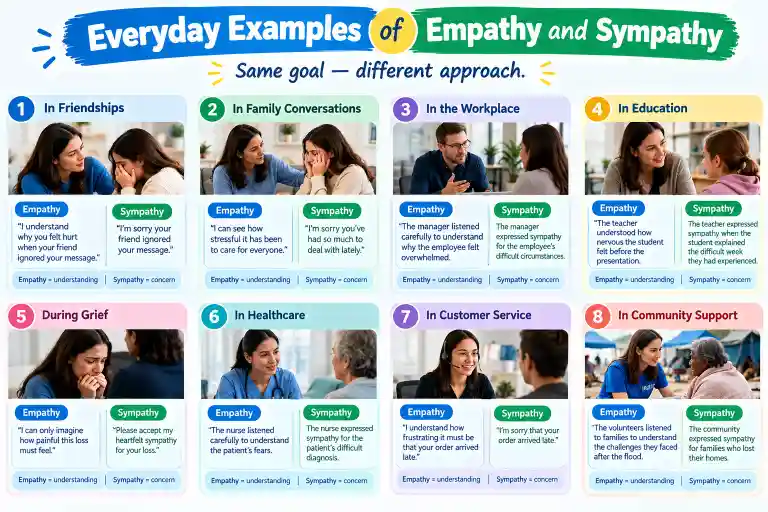
1. In Friendships
Empathy: “I understand why you felt hurt when your friend ignored your message.”
Sympathy: “I’m sorry your friend ignored your message.”
Empathy focuses on understanding the person’s emotional reaction. Sympathy expresses concern about the experience.
2. In Family Conversations
Empathy: “I can see how stressful it has been to care for everyone.”
Sympathy: “I’m sorry you’ve had so much to deal with lately.”
Both statements offer support, but they emphasize different emotional responses.
3. In the Workplace
Empathy: “The manager listened carefully to understand why the employee felt overwhelmed.”
Sympathy: “The manager expressed sympathy for the employee’s difficult circumstances.”
Empathy emphasizes understanding the employee’s perspective, while sympathy expresses concern about the situation.
4. In Education
Empathy: “The teacher understood how nervous the student felt before the presentation.”
Sympathy: “The teacher expressed sympathy when the student explained the difficult week they had experienced.”
Both responses can help create a supportive learning environment.
5. During Grief
Empathy: “I can only imagine how painful this loss must feel.”
Sympathy: “Please accept my heartfelt sympathy for your loss.”
The first statement attempts to acknowledge the person’s emotional experience. The second directly expresses condolences.
6. In Healthcare
Empathy: “The nurse listened carefully to understand the patient’s fears.”
Sympathy: “The nurse expressed sympathy for the patient’s difficult diagnosis.”
Healthcare professionals may use both approaches to support patients respectfully.
7. In Customer Service
Empathy: “I understand how frustrating it must be that your order arrived late.”
Sympathy: “I’m sorry that your order arrived late.”
The empathetic response recognizes the customer’s frustration, while the sympathetic response expresses concern.
8. In Community Support
Empathy: “The volunteers listened to families to understand the challenges they faced after the flood.”
Sympathy: “The community expressed sympathy for families who lost their homes.”
Both responses recognize hardship, but they describe different forms of emotional support.
Empathy or Sympathy: Usage Trends and Modern Writing
These are widely used in modern English, especially in conversations about relationships, emotional intelligence, education, healthcare, and workplace communication.
Empathy often appears in discussions about active listening, leadership, conflict resolution, and understanding different perspectives. For example, an article about effective management may explain how empathy helps leaders recognize employees’ concerns.
Sympathy frequently appears in condolence messages, discussions about hardship, and expressions of compassion. Phrases such as “deepest sympathy,” “express sympathy,” and “sympathy for the victims” are common examples.
Both words are appropriate in formal and informal writing. The best choice depends on the intended meaning, not on which word sounds more emotional or polite.
For clear writing, identify the main idea first:
- If you mean understanding another person’s feelings, choose empathy.
- If you mean feeling concern or sorrow for another person, choose sympathy.
This distinction makes your message more precise and helps readers understand the emotional response you want to describe.
Empathy vs. Sympathy: Comparison Table
| Situation | Best word | Example |
| Understanding a friend’s disappointment | Empathy | She showed empathy when her friend explained the situation. |
| Offering condolences | Sympathy | We expressed our sympathy after the loss. |
| Understanding a patient’s fears | Empathy | The doctor listened with empathy. |
| Feeling concern for people affected by a disaster | Sympathy | The community showed sympathy for the victims. |
| Understanding an employee’s frustration | Empathy | The supervisor responded with empathy. |
| Sending a condolence message | Sympathy | Please accept my deepest sympathy. |
| Trying to understand another perspective | Empathy | Empathy helped them resolve their disagreement. |
| Expressing sorrow for another person’s hardship | Sympathy | He expressed sympathy for the struggling family. |
Easy Trick to Remember Empathy or Sympathy
Use this simple memory trick to remember the difference.
Empathy = Enter their experience.
Think of empathy as trying to understand what another person might be feeling from their point of view.
Sympathy = Support their situation.
Think of sympathy as showing concern, compassion, or sorrow for what someone is experiencing.
For example:
- “I understand why you feel disappointed.” Empathy
- “I’m sorry that this happened to you.” Sympathy
These are helpful guidelines rather than strict rules. A person can express sympathy while also showing empathy, and the same conversation may involve both.
Frequently Asked Questions (FAQs)
1. What is the difference between empathy and sympathy?
Empathy means understanding another person’s feelings or perspective. Sympathy means feeling concern, compassion, or sorrow for someone experiencing difficulty.
2. Is empathy better than sympathy?
Neither is always better. Empathy can help someone feel understood, while sympathy can communicate care and concern. The most helpful response depends on the person’s needs and the situation.
3. Can you have empathy and sympathy at the same time?
Yes. You can understand another person’s emotional experience and also feel concern for their suffering. For example, you may empathize with a grieving friend while expressing sympathy for their loss.
4. What is an example of empathy?
“I understand how disappointing it must feel to work hard and not get the result you hoped for.”
This statement attempts to recognize another person’s emotional experience.
5. What is an example of sympathy?
“I’m sorry you didn’t get the job. I know you were hoping for good news.”
This statement expresses concern for someone who experienced disappointment.
6. Is sympathy the same as pity?
No. Sympathy involves concern or compassion for another person’s hardship. Pity can sometimes suggest looking down on someone, although its meaning depends on the context.
7. What does empathy mean in a relationship?
Empathy in a relationship means trying to understand your partner’s feelings, needs, and perspective. It can support communication, reduce misunderstandings, and help resolve disagreements.
8. Why is empathy important?
Empathy helps people recognize others’ feelings, listen more thoughtfully, and respond with greater understanding. It can improve communication in families, friendships, schools, and workplaces.
9. Can you express sympathy without understanding someone’s feelings?
Yes. You can care about someone and feel sorry for their situation without fully understanding their emotional experience. That is one reason sympathy and empathy are different.
10. How can I remember empathy and sympathy easily?
Remember empathy = understanding feelings and sympathy = expressing concern. This simple distinction will help you choose the appropriate word in most everyday situations.
Conclusion
The difference between empathy and sympathy lies in the kind of emotional response each word describes. Empathy involves understanding another person’s feelings or trying to see a situation from their perspective. Sympathy involves feeling concern, compassion, or sorrow for someone who is experiencing hardship.
For example, listening carefully to understand a friend’s disappointment demonstrates empathy, while expressing sorrow about their difficult experience demonstrates sympathy. Both responses can provide meaningful emotional support.
Remember the simple rule: empathy means understanding; sympathy means caring about someone’s suffering. With this distinction in mind, you can use both words confidently in everyday conversations, academic writing, and professional communication.
Read More:
- Length or Girth: Stop Confusing These Two Measurements
- Born or Borne: Stop Making This Common Grammar Mistake
- Prove or Proof? One Is an Action, the Other Is Evidence








2 thoughts on “Empathy or Sympathy? The Difference Most People Get Wrong”