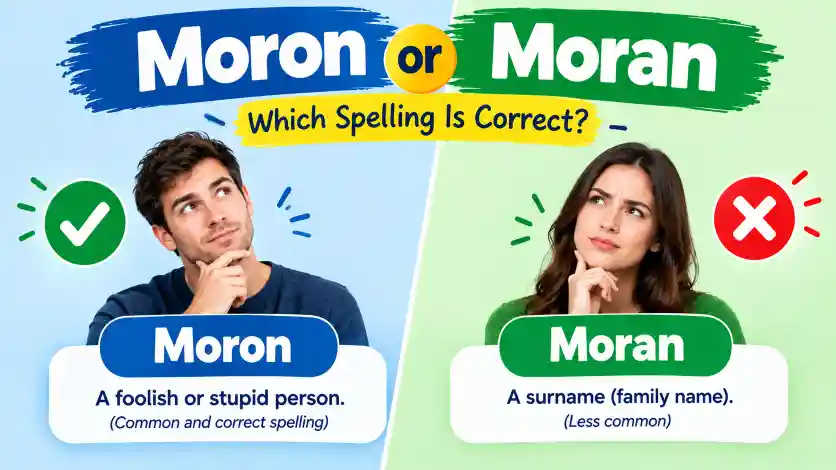
People often search for moron or moran because the two words look and sound similar. However, they have different meanings, and choosing the wrong one can change the meaning of a sentence. Moron is a standard English word used as an insult for someone considered foolish or foolish. Moran is usually a surname or a word used in specific cultural contexts.
The confusion often happens because the words differ by only one letter. If you want to describe someone’s foolish behavior, moron is the spelling you are looking for. If you are referring to a person’s family name, Moran may be correct.
It is also important to understand that moron can sound rude or offensive when directed at another person. In professional or polite conversations, words such as foolish or unwise may be better choices.
In this guide, you will learn the meanings of both words, their origins, how to use them correctly, common mistakes, and examples from everyday writing. You will also discover how capitalization changes the way Moran is understood.
Moron or Moran: Which Word Is Correct?
Both moron and Moran can be correct, but they serve different purposes.
- Moron: An insulting word for a person considered very foolish or foolish.
- Moran: Most commonly a surname, such as the family name Moran. It may also appear in specific cultural or geographic contexts.
Examples:
- Correct: He called the driver a moron.
- Correct: Ms. Moran will attend the meeting.
Use moron when referring to the insult and Moran when referring to a person with that surname. Capitalization is important when writing proper names.
Moron or Moran: Quick Answer
Moron is the correct word when you mean a foolish or foolish person. Moran is generally a proper name, especially a surname. They are not interchangeable.
For example, “That was a moron move” is an informal insult, while “Mr. Moran called this morning” refers to a person. If you are writing about someone’s name, check the correct spelling and capitalization.
What Does Moron Mean?
Moron is a noun used to insult someone by suggesting that the person is foolish, unintelligent, or behaving in a very foolish way.
Definition of Moron
A moron is an informal, offensive term for a person considered foolish or foolish.
Examples:
- He felt like a moron after making the same mistake twice.
- Calling someone a moron will not solve the problem.
- The character in the comedy acts like a moron.
The word is often used in anger, jokes, arguments, or informal conversations. However, it can hurt someone’s feelings, so it should be used carefully.
Is Moron a Rude Word?
Yes. Moron is generally considered an insult when directed at a person.
For example:
- Rude: “You are a moron.”
- More respectful: “That was a careless decision.”
- More constructive: “I think you made a mistake.”
The second and third examples criticize an action instead of attacking a person’s intelligence.
Can Moron Be Used as a Joke?
Friends sometimes use moron jokingly when talking about a silly mistake. However, the tone and relationship matter. A joke that seems harmless to one person may feel insulting to another.
In formal writing, workplace communication, or sensitive conversations, a more neutral word is usually better.
What Does Moran Mean?
Moran is most commonly a surname. It is used as a family name in several English-speaking countries and is associated with Irish surname traditions.
Definition of Moran
Unlike moron, Moran is not the standard English word for a foolish person. It is generally used as a proper noun.
Examples:
- Moran will lead the presentation.
- I spoke with Dr. Moran yesterday.
- The Moran family lives nearby.
Because it is a surname, it is normally capitalized.
Can Moran Have Other Meanings?
Yes. Depending on context, Moran may refer to a place, a named entity, or a term from a particular language or culture. Its meaning depends on the specific context.
In everyday English, however, the most familiar use is as a personal or family name.
The Origin of Moron and Moran
Although moron and Moran look alike, they have different histories and uses.
Origin of Moron
The English word moron entered common use in the early twentieth century. It came from Greek mōron, meaning “foolish,” through a term used in psychological classification.
Historically, the word was used as a technical label for a category of intellectual disability. That classification is now obsolete, and the term is no longer appropriate as a clinical description.
Today, moron is mainly an informal insult. Its historical use is one reason the word can be especially offensive.
Origin of Moran
Moran is commonly found as an Irish surname. Its history is connected to Irish family names and naming traditions.
The exact origin of a particular person’s surname may depend on family history and regional background. It is not the same word as moron, and the spelling should not be changed simply because the two look similar.
British English vs American English
The distinction between moron and Moran is generally the same in British and American English.
| British English | American English | Example |
| Moron | Moron | That was a foolish thing to do. |
| Moran | Moran | Mr. Moran sent an email. |
| Morons | Morons | The movie features two foolish characters. |
| Moron’s | Moron’s | The moron’s behavior caused trouble. |
The word moron has the same spelling in both countries. Moran is also spelled the same way when used as a surname.
The main difference is not regional spelling. It is the meaning and capitalization of the word.
Which Version Should You Use?
Choose the word based on what you want to communicate.
United States
Use moron when referring to the insult and Moran for a surname.
Example: “Mr. Moran said the decision was unwise.”
United Kingdom
The same distinction applies in British English.
Example: “Calling someone a moron is unlikely to help.”
Canada
Both words follow the same general spelling and usage rules.
Example: “Ms. Moran will join the discussion.”
Australia
Use moron for the insult and Moran for a person’s name.
Example: “The character behaves like a moron.”
Academic Writing
Avoid using moron to describe real people in academic work. Use specific, respectful language that explains the behavior or issue being discussed.
Business Writing
Use a person’s correct surname when addressing or referring to them. Avoid insults such as moron in professional communication.
Best advice: Use moron for the insult only when appropriate, and use Moran when referring to a person or name.
Common Mistakes
Mistake 1: Using Moran as an Insult
Incorrect: He is such a moran.
Correct: He is acting like a moron.
Explanation: Moron is the standard spelling of the insult.
Mistake 2: Misspelling Someone’s Name
Incorrect: I spoke to Mr. Moron about the report.
Correct, if his surname is Moran: I spoke to Mr. Moran about the report.
Explanation: Names must be spelled according to the person’s actual name. Do not assume that Moran is a mistake.
Mistake 3: Forgetting Capitalization
Incorrect: I met john moran yesterday.
Correct: I met John Moran yesterday.
Explanation: Personal names begin with capital letters.
Mistake 4: Using Moron in Formal Communication
Less appropriate: The manager made a moron decision.
Better: The manager made an unwise decision.
Explanation: Insults can make professional writing sound hostile. Neutral language communicates criticism more effectively.
Easy Memory Tip
Remember the spelling by associating the o in moron with the word fool. Use Moran with a capital M when it is someone’s surname.
Everyday Examples of Moron and Moran
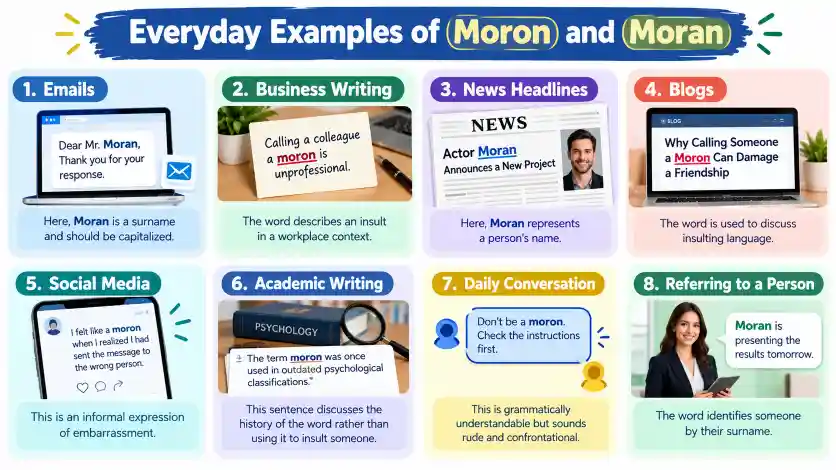
1. Emails
“Dear Mr. Moran, thank you for your response.”
Here, Moran is a surname and should be capitalized.
2. Business Writing
“Calling a colleague a moron is unprofessional.”
The word describes an insult in a workplace context.
3. News Headlines
“Actor Moran Announces a New Project”
Here, Moran represents a person’s name.
4. Blogs
“Why Calling Someone a Moron Can Damage a Friendship”
The word is used to discuss insulting language.
5. Social Media
“I felt like a moron when I realized I had sent the message to the wrong person.”
This is an informal expression of embarrassment.
6. Academic Writing
“The term moron was once used in outdated psychological classifications.”
This sentence discusses the history of the word rather than using it to insult someone.
7. Daily Conversation
“Don’t be a moron. Check the instructions first.”
This is grammatically understandable but sounds rude and confrontational.
8. Referring to a Person
“Moran is presenting the results tomorrow.”
The word identifies someone by their surname.
Google Trends and Modern Usage
People search for moron or Moran because they want to check spelling, understand the difference, or avoid confusing an insult with a person’s name.
The two spellings may appear in similar search results because they differ by just one letter. However, that similarity does not mean they have the same meaning.
Moron remains recognizable as an informal insult, while Moran commonly appears in names and references to specific people.
No verified Google Trends figures are provided here, so exact search volumes or regional rankings should not be assumed.
When choosing between the words, consider the sentence as a whole. A capitalized surname in a person’s name is different from a lowercase insult in a description.
Quick Comparison Table
| Version | Meaning | Correct? | Usage | Example |
| Moron | An insulting term for a foolish person | Yes | Informal language | That was a moron move. |
| Moran | A surname or proper name | Yes | Names and specific references | Mr. Moran is here. |
| Morans | Plural of the surname Moran, when referring to multiple people with that name | Yes | Family names | The Morans attended the event. |
| Moron’s | Possessive form of moron, or a contraction in some contexts | Yes | Depends on sentence | The moron’s actions caused trouble. |
Key Takeaways
- Moron is an informal insult meaning a foolish or foolish person.
- Moran is most commonly a surname.
- Both spellings exist, but they are not interchangeable.
- Capitalize Moran when it is a person’s name.
- Moron can be offensive, especially when directed at someone.
- Use respectful alternatives in academic and professional writing.
- Always check the intended meaning before choosing the spelling.
FAQs About Moron or Moran
1. Is it moron or Moran?
Both words exist, but they have different meanings. Moron is an insult for someone considered foolish or foolish. Moran is commonly a surname. Choose the spelling that matches your intended meaning, and capitalize Moran when using it as a proper name.
2. What does moron mean?
Moron is an informal and often offensive noun for a person considered very foolish or unintelligent. It is commonly used in arguments, jokes, and casual speech. In polite or professional communication, words such as careless or unwise may be more appropriate.
3. Is Moran a real word?
Yes. Moran is commonly used as a surname and can also appear in other proper names or specific cultural contexts. It is not the standard English spelling of the insult moron. When referring to a person with this surname, use the spelling they use.
4. Is moron a bad word?
Moron is generally considered insulting when used to describe a person. Friends may sometimes use it jokingly, but it can still hurt or offend someone. In formal writing and workplace communication, it is usually better to describe the specific mistake or behavior instead.
5. How do you spell moron correctly?
The correct spelling is M-O-R-O-N. It contains the letter o after the initial m and again after the r. If you mean the insult, use moron. If you are writing a person’s surname, check if the correct spelling is Moran.
6. What is the difference between moron and Moran?
The main difference is meaning. Moron is a common noun used as an insult, while Moran is generally a proper name. The spelling changes by one letter, but the context changes completely. Correct spelling helps readers understand if you mean an insult or a person.
7. Is Moran an Irish surname?
Yes. Moran is commonly associated with Irish surname traditions. However, a particular family’s background can vary, and the surname may appear in many countries. If you are researching a specific person’s ancestry, reliable family records are more useful than the surname alone.
8. Can I use moron in professional writing?
It is generally best to avoid calling someone a moron in professional writing because it sounds insulting and unprofessional. Instead, describe the problem clearly. For example, “The decision was poorly considered” communicates criticism without attacking someone’s intelligence.
9. What is a polite alternative to moron?
Depending on the context, you could use foolish, careless, unwise, or mistaken. These words can describe a decision or action without directly insulting a person. For example, “That was an unwise choice” is more respectful than “You are a moron.”
10. Why do people confuse moron and Moran?
People confuse the words because their spellings are almost identical and their pronunciation can sound similar in some accents. However, their meanings differ. Remember that moron contains an o, while Moran contains an a in the second syllable.
Conclusion
When choosing between moron or Moran, remember that both spellings can be correct in different contexts. Moron is an informal, often offensive word for a foolish person. Moran is most commonly a surname or proper name.
The key is to look at the meaning of the sentence. If you are describing foolish behavior, moron is the standard spelling. If you are referring to a person named Moran, preserve the correct spelling and capitalization.
It is also worth remembering that moron can sound harsh. In formal writing, academic work, and business communication, a word such as unwise or careless may communicate your point more clearly and respectfully.
Neither word is simply an alternative spelling of the other. They have distinct uses, and choosing the right one prevents confusion.
Remember: moron is an insult, while Moran is commonly a name. Use the correct spelling, consider your audience, and choose respectful language whenever possible.
Read More:
- Organisational or Organizational: Which Spelling Is Correct?
- Forward or Foward? Don’t Let This Spelling Mistake Fool You
- Simular or Similar? Discover the Correct Word and Its Meaning



3 thoughts on “Moron or Moran? Avoid This Common Spelling Mistake”