
A critic is a person who evaluates or expresses opinions about something, while a critique is a detailed evaluation of a work, idea, or performance. Both words are correct, but they have different meanings and grammatical uses. Understanding the difference helps you choose the right word in essays, reviews, conversations, and professional writing.
People often confuse critic and critique because both words relate to judgment, feedback, and evaluation. However, one usually refers to the person giving an opinion, while the other refers to the evaluation itself. For example, a film critic reviews movies, while a film critique examines a movie’s strengths, weaknesses, and artistic choices.
The distinction becomes easier when you remember that a critic is someone, and a critique is something. Once you understand how each word functions as a noun or verb, you can use both confidently in everyday and academic English.
Critic or Critique: Quick Answer
- Critic: A person who evaluates, reviews, or expresses opinions about something.
- Critique: A detailed analysis or evaluation of something. It can also be used as a verb meaning to evaluate or analyze.
Examples:
- The critic praised the director’s latest film.
- The teacher wrote a critique of the student’s essay.
- The editor will critique my article tomorrow.
Remember: A critic gives an evaluation, while a critique is the evaluation or the act of evaluating.
Definition and Meaning of Critic
A critic is a person who examines, judges, or evaluates something and expresses an opinion about its quality, value, strengths, or weaknesses.
Critics work in many fields, including movies, literature, music, art, politics, and food. Their opinions may help audiences understand a work or decide if it is worth their time or money.
Examples of Critic in Sentences
- The restaurant critic praised the chef’s creative menu.
- A film critic reviewed the new action movie.
- She is a well-known critic of modern architecture.
- The author responded politely to the critic’s comments.
- He became a strong critic of the government’s decision.
In these sentences, critic refers to a person who expresses an evaluation or opinion.
Is Critic Always a Negative Word?
No. A critic does not always express negative opinions. Critics can praise something, identify its weaknesses, or offer a balanced assessment.
For example:
- The critic admired the actor’s performance.
- The critic found several problems with the novel.
Both sentences use critic correctly. The word describes the person’s role, not the positivity or negativity of their opinion.
Definition and Meaning of Critique
A critique is a careful analysis or evaluation of something, often discussing its strengths, weaknesses, effectiveness, or overall quality.
A critique may focus on a book, painting, research paper, speech, business plan, or other work. Unlike a casual opinion, a critique often explains the reasons behind an evaluation.
Critique can also function as a verb. As a verb, it means to examine and evaluate something carefully.
Examples of Critique as a Noun
- The professor asked us to write a critique of the research paper.
- Her critique of the painting explained its use of color.
- The director received a detailed critique of the film.
- His critique highlighted several weaknesses in the proposal.
- The book includes a thoughtful critique of modern society.
Examples of Critique as a Verb
- The editor will critique my first draft.
- Students learned how to critique a piece of literature.
- The manager asked the team to critique the new marketing plan.
- She agreed to critique my presentation before the meeting.
- The professor will critique each student’s research project.
The word critique can describe either the evaluation itself or the action of evaluating something.
Critic vs. Critique: Key Differences
Although both words are associated with evaluation, they serve different purposes in a sentence.
| Feature | Critic | Critique |
| Main meaning | A person who evaluates something | An evaluation or analysis |
| Part of speech | Noun | Noun and verb |
| Refers to | The evaluator | The evaluation or act of evaluating |
| Example | The critic reviewed the play. | The critic wrote a critique of the play. |
| Common settings | Film, art, literature, politics | Education, research, art, writing |
| Related action | Criticizes or evaluates | Critiques or analyzes |
The simplest distinction: A critic is the person, while a critique is the analysis that person may produce.
Why Do People Confuse Critic and Critique?
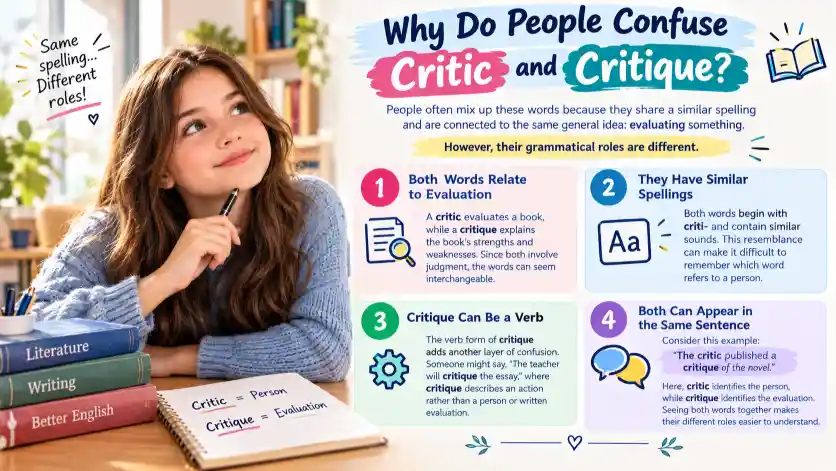
People often mix up these words because they share a similar spelling and are connected to the same general idea: evaluating something.
However, their grammatical roles are different.
1. Both Words Relate to Evaluation
A critic evaluates a book, while a critique explains the book’s strengths and weaknesses. Since both involve judgment, the words can seem interchangeable.
2. They Have Similar Spellings
Both words begin with criti- and contain similar sounds. This resemblance can make it difficult to remember which word refers to a person.
3. Critique Can Be a Verb
The verb form of critique adds another layer of confusion. Someone might say, “The teacher will critique the essay,” where critique describes an action rather than a person or written evaluation.
4. Both Can Appear in the Same Sentence
Consider this example:
“The critic published a critique of the novel.”
Here, critic identifies the person, while critique identifies the evaluation. Seeing both words together makes their different roles easier to understand.
Common Mistakes to Avoid
Using critic and critique incorrectly can make a sentence sound unnatural. Watch out for these common mistakes.
Mistake 1: Using Critique to Refer to a Person
Incorrect: The critique reviewed the movie.
Correct: The critic reviewed the movie.
A critique is an evaluation, not the person who performs it.
Mistake 2: Using Critic to Refer to an Evaluation
Incorrect: The teacher wrote a critic of my essay.
Correct: The teacher wrote a critique of my essay.
Use critique when referring to the written or spoken evaluation.
Mistake 3: Confusing Critique With Criticism
The words critique and criticism are related, but their meanings are not always identical.
- A critique usually involves analysis or evaluation.
- Criticism can refer to disapproval, negative comments, or the broader practice of evaluating something.
For example:
“The editor offered a detailed critique of the article.”
“The writer received criticism for the article’s inaccurate claims.”
Mistake 4: Forgetting That Critique Can Be a Verb
Incorrect: The professor will critic the paper.
Correct: The professor will critique the paper.
Use critique as a verb when describing the action of evaluating or analyzing something.
Everyday Examples of Critic and Critique
These examples show how both words work in common situations.
| Situation | Critic | Critique |
| Movies | The critic gave the movie four stars. | Her critique discussed the movie’s weak ending. |
| Books | The critic praised the author’s writing style. | His critique examined the book’s main argument. |
| Education | The critic evaluated the presentation. | The student submitted a critique of the presentation. |
| Art | The art critic visited the gallery. | The critique explained the painting’s symbolism. |
| Business | The critic questioned the company’s strategy. | The team prepared a critique of the business plan. |
| Writing | The critic reviewed the article. | The editor wrote a critique of the article. |
Short Conversation Examples
Example 1
A: Who reviewed the new film?
B: A famous film critic reviewed it.
Example 2
A: What did your professor ask you to submit?
B: A critique of the research paper.
Example 3
A: Can you examine my presentation before I deliver it?
B: Sure, I can critique it this afternoon.
Critic vs. Critique in Academic and Professional Writing
Both words are useful in formal writing, but the correct choice depends on what you want to describe.
In Academic Writing
Use critic when referring to a person who evaluates an idea, theory, book, or argument.
Example: “The critic challenged the author’s interpretation of the historical evidence.”
Use critique when referring to an analytical assignment or evaluation.
Example: “Students must submit a critique of the assigned research article.”
In Professional Writing
In the workplace, a critique may help identify problems and improve a project before completion.
Example: “The design team conducted a critique of the proposed website layout.”
A critic, by contrast, is a person who evaluates or comments on something.
Example: “The technology critic reviewed the company’s latest product.”
In Creative Fields
Artists, writers, filmmakers, and designers may receive critiques to improve their work. A critic may publish reviews for an audience, such as readers deciding which book to buy or which film to watch.
Tip: Choose critic when the sentence focuses on a person. Choose critique when it focuses on an evaluation or the act of evaluating.
British English vs. American English
The distinction between critic and critique is essentially the same in British and American English. Both varieties use critic for a person and critique for an evaluation or the act of evaluating.
| Usage | British English | American English |
| A person who reviews films | Film critic | Film critic |
| A detailed evaluation | A critique of the book | A critique of the book |
| To evaluate a project | Critique the proposal | Critique the proposal |
| A negative opinion or response | Criticism | Criticism |
Neither variety requires a different spelling for these words. The choice depends on meaning and grammar rather than regional spelling preferences.
Easy Trick to Remember the Difference
Use this simple memory trick:
- Critic = Person
- Critique = Evaluation
Think of a film critic sitting in a cinema and reviewing a movie. The review or detailed analysis they produce can be called a critique.
You can also remember these two example sentences:
- The critic wrote a review.
- The critique explained the reviewer’s findings.
Another useful trick is to ask yourself one question: Am I talking about a person or an evaluation?
If you mean a person, use critic. If you mean an analysis, written assessment, or the action of evaluating something, use critique.
Frequently Asked Questions (FAQs)
1. What is the main difference between critic and critique?
A critic is a person who evaluates something, while a critique is an evaluation or analysis of a work, idea, or performance.
2. Is critic a person or a thing?
Critic is a noun that refers to a person who evaluates or expresses opinions about something.
Example: “The critic praised the performance.”
3. Is critique a noun or a verb?
Critique can be both a noun and a verb. As a noun, it means an evaluation. As a verb, it means to examine and evaluate something carefully.
4. Can I use critique instead of criticism?
Sometimes, but the words have different shades of meaning. A critique generally suggests analysis, while criticism can refer to disapproval or negative comments as well as evaluation.
5. Is a critic always negative?
No. Critics can praise, criticize, or provide balanced assessments. The word itself does not mean that someone always finds fault.
6. What is an example of critic in a sentence?
“The film critic praised the actors and the director’s storytelling.”
Here, critic refers to the person evaluating the film.
7. What is an example of critique in a sentence?
“The professor wrote a detailed critique of the student’s essay.”
Here, critique refers to the evaluation.
8. Is critique the same as review?
The words can overlap, but they are not always identical. A review often informs an audience about a work, while a critique generally emphasizes detailed analysis of its strengths, weaknesses, or ideas.
9. What is the plural of critic and critique?
The plural of critic is critics. The plural of critique is critiques.
Examples:
- Several critics reviewed the play.
- The students submitted three critiques.
10. Which word should I use in an essay?
Use critic when discussing a person who evaluates something. Use critique when referring to an analysis, an evaluation, or the act of evaluating a work.
Conclusion
Critic and critique are both correct words, but they are not interchangeable. A critic is a person who evaluates or reviews something, while a critique is a detailed evaluation or the act of analyzing something.
Use critic when referring to the person giving an opinion. Use critique when discussing the analysis itself or describing the process of evaluating a work.
Remember the simple rule: A critic gives a critique. This distinction will help you use both words correctly in academic assignments, professional communication, reviews, and everyday writing.
Read More:
- Appendix or Appendices? Learn the Correct Form in Seconds
- Grateful or Thankful? Are These Words Really the Same?
- Siting or Sitting? The Correct Spelling May Surprise You








2 thoughts on “Critic or Critique? Are You Using the Wrong Word?”