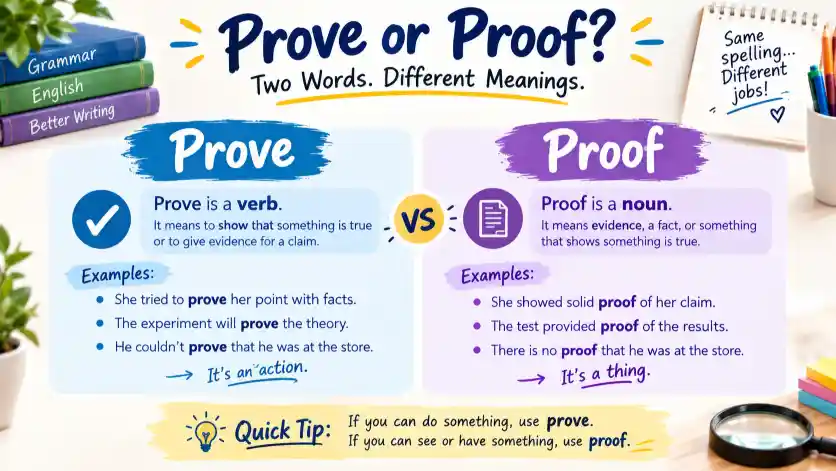
Have you ever wondered if you should write prove or proof? Both words are correct, but they have different meanings and uses. Prove is a verb, while proof is usually a noun. The main difference is simple: you prove something when you show that it is true, and you use proof to refer to evidence that supports a claim.
People often confuse these words because they share the same root and appear in similar sentences. For example, you might say, “I can prove my point,” or “I have proof of my claim.” Both sentences are correct, but the words cannot be swapped.
Knowing the difference helps you write better emails, school assignments, reports, business documents, and everyday messages. It also helps you avoid common grammar mistakes, such as writing “I have prove” when you mean “I have proof.”
In this guide, you will learn the meaning of prove and proof, their origins, the difference between British and American usage, common mistakes, and practical examples. You will also discover an easy trick to remember which word to use.
Prove or Proof? Which Word Is Correct?
Both prove and proof are correct English words, but they serve different grammatical roles. Prove is a verb that means to show that something is true. Proof is usually a noun that means evidence or information that shows something is true.
- Prove: “She will prove her point.”
- Proof: “She has proof of her claim.”
- Proven: “The method has proven effective.”
Choose the word based on what your sentence means and how it is structured.
Prove or Proof: Quick Answer
When should you use prove?
Use prove when you need a verb to describe showing that something is true, correct, or valid.
Examples:
- “I can prove that my answer is correct.”
- “The test results prove the treatment works.”
- “She wants to prove her skills.”
When should you use proof?
Use proof when you mean evidence, support, or confirmation.
Examples:
- “Do you have proof of payment?”
- “The video is proof that he was there.”
- “Please send proof of your identity.”
Easy rule: You prove something, and you provide proof of it.
What Do Prove and Proof Mean?
What does prove mean?
Prove is a verb. It means to show that something is true, correct, or real through facts, evidence, tests, or clear reasoning.
It often describes an action. Someone does something to establish the truth of a claim.
Examples:
- “The student proved the answer with a simple calculation.”
- “The company must prove that the product is safe.”
- “She proved her ability through hard work.”
In each sentence, prove describes an action.
Common forms of the verb include:
| Form | Example |
| Prove | I can prove my point. |
| Proves | This result proves the theory. |
| Proved | He proved his claim yesterday. |
| Proven | The method has proven useful. |
| Proving | She is proving her ability. |
Both proved and proven are used as past participles. Proved is also the simple past form. For example, “She proved her point” and “She has proven her point” are both correct.
What does proof mean?
Proof is usually a noun. It means evidence or information that helps establish the truth of something.
It names the evidence, not the action of showing the truth.
Examples:
- “The receipt is proof of purchase.”
- “The police found proof of the crime.”
- “We need proof before making a decision.”
The word proof also has other meanings. Mathematics, a proof is a logical explanation that shows a statement is true. In printing, a proof is a version of a document checked before the final copy is printed.
In photography and everyday speech, proof can also refer to a test or sample used for checking a result.
Can prove and proof appear in the same sentence?
Yes. This is one of the easiest ways to understand the difference.
For example:
“The witness will prove the claim by presenting proof.”
Here, prove describes the action. Proof refers to the evidence used for that action.
The Origin of Prove and Proof
Where does prove come from?
The word prove comes through Old French from the Latin verb probare, meaning to test, examine, or demonstrate.
Over time, the word developed the sense of showing that something is true or valid. Today, it appears in many settings, including science, law, education, mathematics, and daily conversation.
For example, a scientist may prove a result through careful testing, while a student may prove an answer through logical steps.
Where does proof come from?
Proof is related to prove and also comes through Old French from Latin roots associated with testing and demonstrating.
The noun developed to describe the evidence, test, or result used to establish something. This explains why the two words are closely related but perform different jobs in a sentence.
For example, a person may prove that a bill has been paid by showing a receipt. The receipt serves as proof.
Why are the words spelled differently?
English often uses related words with different endings to show different grammatical roles. In this pair, prove is the verb, while proof is the noun.
The final letters do not follow one universal rule for all English words. It is best to learn the pair together rather than assume that every verb ending in a similar sound will have a noun ending in -oof.
British English vs American English
Are prove and proof different in the UK and US?
The meanings of prove and proof are essentially the same in British English and American English. Neither spelling is limited to one country.
Both forms are standard in the United States, the United Kingdom, Canada, and Australia.
| British English | American English | Example |
| Prove | Prove | “We can prove the claim.” |
| Proof | Proof | “We need proof of payment.” |
| Proved | Proved | “She proved her point.” |
| Proven | Proven | “The method has proven effective.” |
Do style guides prefer one form?
Most writing guides focus on correct grammar and clear meaning rather than choosing between prove and proof based on location.
Some publishers may prefer proved or proven in certain sentence structures, but both forms are accepted in standard English.
For academic, legal, and professional writing, follow the style guide used by your school, employer, journal, or publisher. Above all, use the word that fits the sentence.
Which Version Should You Use?
In the United States
Use prove for the action of showing something to be true and proof for the evidence.
Examples:
- “The lawyer must prove the case.”
- “The customer provided proof of purchase.”
In the United Kingdom
Use the same distinction. Both words are standard British English.
Examples:
- “The results prove the point.”
- “Please provide proof of address.”
In Canada and Australia
The same grammar applies in both countries. There is no need to switch between prove and proof based on local spelling preferences.
Examples:
- “Can you prove your identity?”
- “We need proof of identity.”
In international writing
Choose the word based on its meaning, not the reader’s location. If your audience includes English learners, use short sentences and clear examples to show the difference.
In academic and business writing
Use prove when describing an action or result. Use proof when referring to evidence or a logical demonstration.
For example:
- Academic: “The researcher aims to prove the hypothesis.”
- Business: “Please provide proof of payment.”
- Mathematics: “The student wrote a proof of the theorem.”
One important point: in research, evidence may support a hypothesis without proving it beyond all doubt. Choose your wording carefully to match the strength of the findings.
Common Mistakes With Prove and Proof
Mistake 1: Using prove as a noun
Incorrect: “I have prove of his claim.”
Correct: “I have proof of his claim.”
Why? The sentence needs a noun after “have.” Proof names the evidence.
Mistake 2: Using proof as a verb
Incorrect: “I will proof that the answer is right.”
Correct: “I will prove that the answer is right.”
Why? The sentence describes an action. The correct verb is prove.
Note that proof can be used as a verb in specialized contexts, such as proofreading or testing materials. However, it does not replace prove when you mean to show that a claim is true.
Mistake 3: Confusing proof with proven
Incorrect: “This is a proof method.”
Correct: “This is a proven method.”
Why? If you mean that a method has been shown to work, proven is the appropriate form. The original sentence could have a different meaning in a technical context, but it does not express the intended idea clearly.
Mistake 4: Using prove after a possessive word
Incorrect: “That is my prove.”
Correct: “That is my proof.”
Why? A possessive word such as my usually needs a noun here. Proof names the evidence being discussed.
A simple memory tip
Remember this sentence:
“I prove my point with proof.”
- Prove = the action.
- Proof = the evidence.
Say this sentence aloud a few times. It makes the difference easier to recall when writing.
Everyday Examples of Prove and Proof
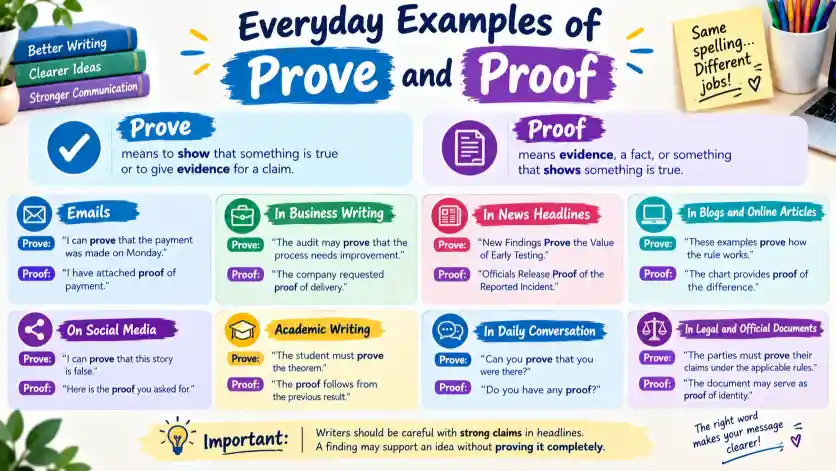
Emails
- Prove: “I can prove that the payment was made on Monday.”
- Proof: “I have attached proof of payment.”
In business writing
- Prove: “The audit may prove that the process needs improvement.”
- Proof: “The company requested proof of delivery.”
In news headlines
- Prove: “New Findings Prove the Value of Early Testing.”
- Proof: “Officials Release Proof of the Reported Incident.”
Writers should be careful with strong claims in headlines. A finding may support an idea without proving it completely.
In blogs and online articles
- Prove: “These examples prove how the rule works.”
- Proof: “The chart provides proof of the difference.”
On social media
- Prove: “I can prove that this story is false.”
- Proof: “Here is the proof you asked for.”
Academic writing
- Prove: “The student must prove the theorem.”
- Proof: “The proof follows from the previous result.”
In daily conversation
- Prove: “Can you prove that you were there?”
- Proof: “Do you have any proof?”
In legal and official documents
- Prove: “The parties must prove their claims under the applicable rules.”
- Proof: “The document may serve as proof of identity.”
Legal requirements vary by situation and location. These examples explain the words, not the legal standard for proving a claim.
Google Trends and Modern Usage
Why do people search for prove or proof?
People often search for prove or proof because the words look and sound similar. They may also appear in the same sentence, which makes it harder to decide which form is correct.
Common searches include:
- Prove vs proof
- Difference between prove and proof
- Is it proof or prove?
- Prove or proof of payment
- Prove or proof in a sentence
- Proved vs proven
These searches usually show a need for a simple grammar explanation and examples.
Which word is more popular?
Both words are common, but they serve different purposes. A raw comparison of search interest would not, by itself, show that one word is more correct than the other.
Google Trends can help compare interest by location and time. However, no verified live Trends figures are included here, so no numerical ranking or percentage is claimed.
The most useful lesson is that search popularity does not determine grammatical correctness. Choose the word that fits the meaning and sentence structure.
Prove or Proof: Quick Comparison Table
What is the difference at a glance?
| Word | Meaning | Correct? | Region | Example |
| Prove | To show something is true | Yes | All major English varieties | “I can prove my point.” |
| Proof | Evidence that supports a claim | Yes | All major English varieties | “I have proof of my claim.” |
| Proved | Past form of prove | Yes | British and American English | “She proved her point.” |
| Proven | Past participle of prove; also an adjective | Yes | British and American English | “It is a proven method.” |
How can you choose the right word?
Ask yourself what you want to express.
- If you mean to show or establish something, use prove.
- If you mean evidence or confirmation, use proof.
- If you describe something established in the past, consider proved or proven, based on the sentence.
For example, “I need to prove my claim” describes an action. “I need proof of my claim” describes what is missing.
Key Takeaways
- Prove is a verb. It describes the act of showing that something is true.
- Proof is usually a noun. It means evidence or confirmation.
- Both words are correct in British and American English.
- Use “prove the claim,” not “proof the claim,” when you mean to establish the truth of an idea.
- Use “proof of payment” when referring to a receipt or other evidence.
- Proved and proven are both accepted forms of the verb prove.
- The easiest memory trick is: “I prove my point with proof.”
- Always check the meaning and grammar of the full sentence before choosing a word.
Frequently Asked Questions
1. Is it prove or proof?
Both words are correct, but they have different grammatical roles. Prove is a verb that means to show something is true. Proof is usually a noun that means evidence supporting a claim. Write “I can prove my point” when describing an action and “I have proof” when referring to evidence.
2. What is the main difference between prove and proof?
The main difference is that prove describes an action, while proof names evidence or a demonstration. For example, a student may prove an answer by showing the steps used to solve a problem. Those steps may form a mathematical proof. The correct choice depends on the meaning and structure of your sentence.
3. Is proof a noun or a verb?
Proof is most often used as a noun, as in “The receipt is proof of purchase.” It also has specialized verb uses, such as proofing a printing document or testing a material. However, if you mean to demonstrate that something is true, use prove, as in “I can prove my claim.”
4. Can I say “I have prove”?
No. In standard English, say “I have proof” if you mean that you possess evidence. You could also say “I have proved it” if you mean that you have already demonstrated something to be true. The correct choice depends on your intended meaning. Remember that proof is a noun and proved is a verb form.
5. Is it proof of payment or prove of payment?
The correct phrase is proof of payment. It refers to evidence that a payment was made, such as a receipt or transaction record. For example, “Please send proof of payment before Friday.” The phrase “prove of payment” is incorrect for this meaning because prove is a verb and cannot replace the noun in this phrase.
6. Is “proven” correct English?
Yes. Proven is a standard form of the verb prove. It is often used in phrases such as “a proven method” or “the approach has proven effective.” Proved is also correct. For example, “She proved her point” and “She has proven her point” are both acceptable, though sentence structure affects which form fits best.
7. Is it “prove me wrong” or “proof me wrong”?
The correct expression is “prove me wrong.” The word prove describes the action of showing that someone’s statement or belief is incorrect. For example, “If you disagree with my answer, prove me wrong with facts.” The phrase “proof me wrong” does not work in standard English when you intend this meaning.
8. What is the plural of proof?
The plural of proof is proofs. For example, “The editor checked three proofs before approving the final document.” The word can refer to several pieces of evidence, mathematical demonstrations, or draft versions prepared for checking. The plural form does not change to prooves, and it remains distinct from the verb prove.
9. Is “proof” the same as “evidence”?
The words are closely related, but they are not always interchangeable. Evidence refers to information or material that supports a claim. Proof often suggests evidence or reasoning that establishes a point. In everyday speech, the terms may overlap, but academic, scientific, and legal contexts can use them with more specific meanings.
10. How can I remember prove vs proof?
Use the short sentence “I prove my point with proof.” The first word describes an action, and the second names the evidence used to support it. You can also check the words around the blank in your sentence. If you need an action, choose prove. If you need a thing or piece of evidence, choose proof.
Conclusion: Prove or Proof?
The difference between prove and proof becomes easy once you understand their roles in a sentence. Prove is a verb that describes showing something to be true, while proof is usually a noun that refers to evidence or a demonstration. Both words are correct in British and American English, so regional spelling is not the issue.
Use prove when describing an action, such as proving a claim, an answer, or a theory. Use proof when referring to evidence, such as proof of payment, proof of identity, or a mathematical proof. Remember that proved and proven are also correct forms of prove, but they fit different sentence structures.
When you are unsure, read your sentence aloud and ask if you mean the action or the evidence. This quick check can prevent common grammar mistakes in schoolwork, emails, reports, and everyday writing.
Read More:
- Critic or Critique? Are You Using the Wrong Word?
- Appendix or Appendices? Learn the Correct Form in Seconds
- Grateful or Thankful? Are These Words Really the Same?






2 thoughts on “Prove or Proof? One Is an Action, the Other Is Evidence”