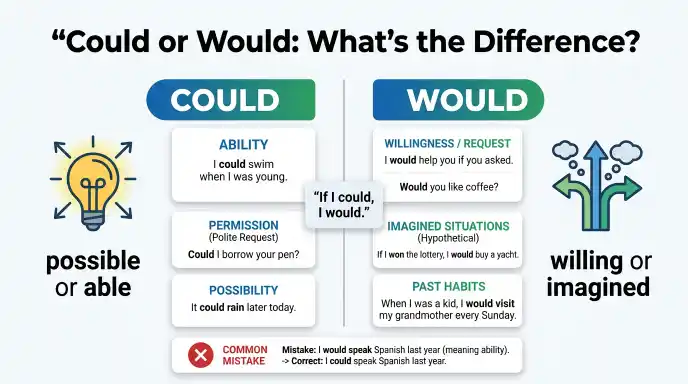
Could is a modal verb used to express past ability, possibility, polite requests, or suggestions, while would is used for willingness, preference, imagined situations, and polite requests or offers.
People often confuse these two words because they can appear in similar sentence patterns, especially in questions and conditional sentences.
For example, “Could you help me?” asks politely about someone’s ability or willingness, while “Would you help me?” focuses more directly on willingness.
This guide explains their differences through simple examples, conditional sentences, common mistakes, everyday conversations, and practical writing tips.
Could or Would: Quick Answer
Could means ability or possibility, while would often expresses willingness, preference, or a hypothetical result.
- Could = ability, possibility, or polite request
Could you help me? - Would = willingness, preference, or imagined situation
Would you help me if I asked?
A simple memory tip is:
Could = possible/able
Would = willing/imagined
What Does Could or Would Mean?
What Does “Could” Mean?
Could is the past form of can, but it has several uses.
It can describe:
Past ability:
When I was young, I could swim very well.
Possibility:
It could rain tonight.
Polite requests:
Could you open the door?
Suggestions:
We could go to the park.
What Does “Would” Mean?
Would is commonly used to talk about hypothetical situations, willingness, preferences, and polite expressions.
Hypothetical result:
I would travel more if I had enough money.
Willingness:
She would help you if she could.
Preference:
I would rather stay home.
Polite request or offer:
Would you like some coffee?
The Origin of Could or Would
Both could and would have Old English roots and developed from earlier forms of English modal verbs.
Could is historically connected to can, which developed meanings related to knowing and being able to do something. Its spelling later developed the l, although the l is not pronounced in modern English.
Would developed from the Old English form related to will. The modern word continues to carry ideas of willingness, intention, and hypothetical situations.
Today, their historical development is less important than their modern grammar:
- could often focuses on ability or possibility.
- would often focuses on willingness, preference, or an imagined result.
British English vs American English
There is no important spelling difference between could and would in British and American English.
| Feature | British English | American English | Example |
| Could | could | could | Could you help me? |
| Would | would | would | Would you like tea? |
| Past ability | could | could | I could swim at five. |
| Conditional | would | would | I would go if I could. |
| Polite question | could | could | Could I ask something? |
Both varieties use these modal verbs in very similar ways.
Which Version Should You Use?
Use “Could” When Talking About Ability
I could run five miles when I was younger.
Here, could describes ability.
Use “Could” for Possibility
We could be late.
This means being late is possible.
Use “Could” for a Polite Request
Could you send me the file?
This is a polite way to ask someone to do something.
Use “Would” for Willingness
He would help if he were here.
The sentence focuses on his willingness.
Use “Would” for Preferences
I would rather stay home.
Use “Would” for Hypothetical Situations
I would buy a new laptop if I had enough money.
The action depends on an imagined condition.
For Academic Writing
Both are useful, but choose the word based on meaning.
The results could indicate a change in behavior.
Here, could expresses possibility.
The results would be different under other conditions.
Here, would describes a hypothetical result.
For Business Writing
Could is often useful for polite requests:
Could you please review the document?
Would is common for offers and preferences:
Would you like us to arrange a meeting?
Common Mistakes
Mistake 1: Using “Would” for Simple Ability
Incorrect:
When I was ten, I would swim very fast. ❌
If you mean general ability, use could:
When I was ten, I could swim very fast. ✅
Memory tip: Ability → could
Mistake 2: Using “Could” for a Hypothetical Result
Incorrect:
If I had more money, I could buy a bigger house.
Actually, this sentence can be correct if you mean buying the house is possible.
But if you are describing the expected result of the condition, would is often better:
If I had more money, I would buy a bigger house.
The difference is subtle:
- could buy = it would be possible.
- would buy = that is what I would choose or expect to do.
Mistake 3: Confusing “Could You” and “Would You”
Both can be polite:
Could you help me?
This asks if the person can or is able to help.
Would you help me?
This focuses more on if the person is willing to help.
In everyday conversation, Could you…? is often the more natural request.
Could vs Would in Conditional Sentences
This is one of the most important differences.
Could
If I had more time, I could learn Spanish.
Meaning: learning Spanish would be possible.
Would
If I had more time, I would learn Spanish.
Meaning: learning Spanish is what I would choose or intend to do.
Both Together
You can use both in the same sentence:
If I had more time, I would learn Spanish, and I could practice every day.
Here:
- would learn = intended hypothetical choice
- could practice = possible ability/opportunity
Everyday Examples
In Emails
Could you please send me the report?
Would you be available for a meeting tomorrow?
In Business Writing
This change could improve productivity.
The company would benefit from lower costs.
In News Headlines
New policy could affect local businesses.
Higher prices would increase pressure on consumers.
In Blogs
You could improve your writing by reading more.
I would recommend checking the sentence twice.
On Social Media
We could try this challenge!
I would never do that!
In Academic Writing
The results could suggest a connection.
A larger sample would provide more reliable evidence.
In Daily Conversation
“Could you pass the salt?”
“Sure.”
“Would you like some tea?”
“Yes, please.”
Google Trends & Modern Usage
People search could or would mainly because both words occur in polite questions, conditional sentences, and hypothetical situations.
The confusion is especially common with sentences such as:
- Could you help me?
- Would you help me?
- I could do it.
- I would do it.
- If I could, I would.
- It could happen.
- It would happen.
There is no major British-American spelling difference to explain the confusion. The key issue is meaning and sentence structure.
Exact search popularity can change depending on the country, date range, and search category, so specific Google Trends numbers should not be claimed without checking current data.
Quick Comparison Table
| Word | Main Meaning | Correct? | Common Use | Example |
| Could | Ability | ✅ | Past ability | I could swim at six. |
| Could | Possibility | ✅ | Possible event | It could rain. |
| Could | Polite request | ✅ | Asking someone | Could you help me? |
| Would | Willingness | ✅ | Conditional willingness | I would help you. |
| Would | Preference | ✅ | Personal choice | I would rather stay home. |
| Would | Hypothetical result | ✅ | Conditional sentence | I would go if I could. |
Could vs Would at a Glance
| Situation | Better Choice | Example |
| Past ability | could | I could read at four. |
| Possibility | could | It could happen. |
| Polite request | could | Could you wait? |
| Willingness | would | Would you help me? |
| Preference | would | I would rather stay. |
| Imagined result | would | I would go if I had time. |
| Possible action in a condition | could | I could go if I had time. |
Key Takeaways
- Could often expresses ability or possibility.
- Would often expresses willingness or preference.
- Could is common in polite requests.
- Would is common in hypothetical situations.
- Could can mean something is possible.
- Would can describe what someone would choose or expect.
- “If I could” often means if it were possible.
- “I would” often means this is what I would choose or do.
- Remember: Could = possible; would = imagined or willing.
FAQs About Could or Would
Is it “could” or “would”?
It depends on what you mean. Use could for ability, possibility, or many polite requests. Use would for willingness, preferences, and hypothetical results. For example, “Could you help me?” is a polite request, while “Would you help me?” asks more directly about willingness.
What is the main difference between could and would?
Could generally focuses on what is possible or what someone is able to do. Would generally focuses on what someone is willing to do, prefers to do, or would do in an imagined situation. For example, “I could go” means going is possible, while “I would go” expresses a hypothetical choice.
Should I say “Could you help me?” or “Would you help me?”
Both are grammatically correct, but they have slightly different meanings. Could you help me? is a common polite request that asks if someone can help. Would you help me? focuses more on if the person is willing to help.
Is “If I could, I would” correct?
Yes. “If I could, I would” is a standard and useful expression. Could means the action is possible or within your ability, while would describes what you would choose or intend to do if it were possible.
Can could and would be used together?
Yes. For example: “If I could afford it, I would buy a new car.” Here, could expresses the possibility or ability to afford the car, while would expresses the hypothetical choice to buy it.
Is “could” the past tense of “can”?
Could is the traditional past form of can, especially when talking about general past ability. For example: “When I was young, I could swim.” However, could also has present and future uses when expressing possibility or making polite requests.
Is “would” the past tense of “will”?
Would is historically the past form associated with will, but modern English uses it in several ways. It commonly appears in reported speech, hypothetical situations, polite requests, preferences, and conditional sentences.
Which is more polite, “could” or “would”?
Both can be polite. Could you…? is especially common for polite requests, while Would you…? can emphasize willingness. For example, “Could you open the window?” is a natural polite request, while “Would you open the window?” asks if the person is willing to do it.
Is “I could” different from “I would”?
Yes. I could usually means something is possible or that you are able to do it. I would usually describes what you choose, intend, or imagine doing under certain conditions. For example, “I could go” means going is possible, while “I would go” often implies a condition or preference.
How can I easily remember could and would?
Use this simple memory rule: Could = possibility or ability. Would = willingness or hypothetical choice. For example, “I could help” means helping is possible, while “I would help” often means you are willing to help, especially under a certain condition.
Conclusion
The difference between could or would becomes much easier when you focus on the meaning of the sentence. Could is commonly used for ability, possibility, suggestions, and polite requests. Would is commonly used for willingness, preferences, hypothetical situations, and conditional results.
Compare these two sentences:
I could go.
Going is possible.
I would go.
Going is what I would choose or intend to do under the right condition.
They can even work together:
If I could, I would.
This means that if something were possible, you would choose to do it.
For everyday English, remember one simple rule: Could is about what is possible; would is about what you would choose, expect, or be willing to do.
When you remember “could = possible” and “would = imagined or willing,” choosing the right word becomes much easier.
Related Articles:
- Manners or Manors: Commonly Confused Words Explained
- Lessee or Lessor: What’s the Difference? (2026 Guide)
- Seat or Sit: Which One Should You Use in 2026?





3 thoughts on “Could or Would: What’s the Difference?”