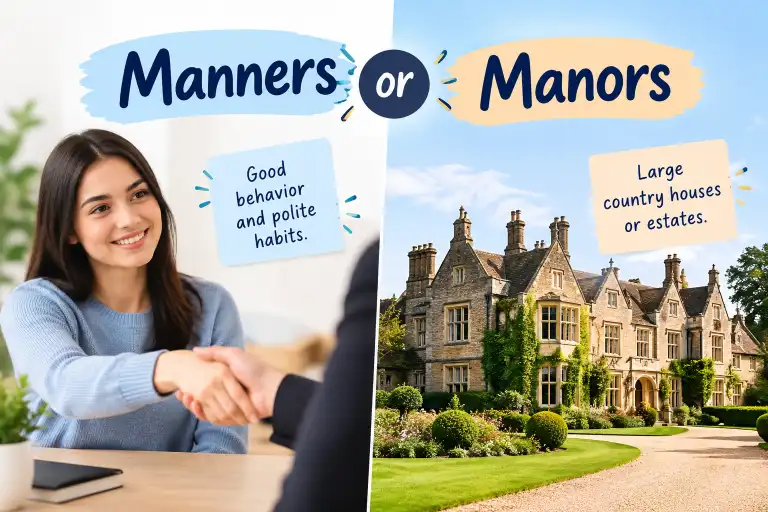
Have you ever typed manners or manors and stopped to wonder which word is correct? The two words sound very similar, but they have completely different meanings.
Manners refers to the way people behave, especially polite or socially acceptable behavior, while manors is the plural of manor, meaning large country houses, estates, or historical landed properties.
This mix-up is common because manners and manors are pronounced almost alike in many varieties of English. The extra n in manners is easy to miss when writing quickly.
In this guide, you will learn the difference between manners and manors, their meanings, origins, correct usage, common mistakes, and easy memory tricks. You will also see examples from everyday speech, emails, business writing, academic writing, and social media.
Manners or Manors: Quick Answer
Manners means polite or socially acceptable ways of behaving. Manors is the plural of manor, a large country house or estate, especially one associated with historical land ownership. For example, “Good manners matter” uses manners, while “The old manors were restored” uses manors.
The correct word depends on what you mean.
- Manners = ways of behaving, especially polite behavior.
- Manors = more than one manor, usually large old houses or estates.
- Manners is related to manner.
- Manors is the plural of manor.
- Neither spelling is a British versus American variation. Both words are standard English in both varieties.
Examples
Manners:
Good manners can make a strong first impression.
Manners:
Children should learn table manners.
Manors:
Several historic manors are open to visitors.
Manors:
The region is known for its old country manors.
A simple way to remember the difference is:
Manners = behavior.
Manors = buildings or estates.
What Does Manners Mean?
Manners is the plural form of manner when the word refers to social behavior or conduct.
It commonly means the ways people behave toward others, especially when that behavior shows politeness, respect, or consideration. Cambridge defines manners as polite ways of treating people and behaving in public.
Common expressions include:
- good manners
- bad manners
- table manners
- social manners
- polite manners
- proper manners
- mind your manners
Examples of manners
Please say “thank you.” It is good manners.
Interrupting someone while they are speaking is often considered bad manners.
The children are learning good table manners.
Manners can also refer more broadly to habitual behavior or social conduct. Merriam-Webster includes meanings connected with conduct, behavior, and social rules.
What Does Manors Mean?
Manors is the plural form of manor.
A manor traditionally refers to a large country house together with its surrounding land or a landed estate. The word is strongly associated with historical European estates and English rural life.
For example:
The countryside contains several impressive manors.
Many old manors have been converted into hotels.
The word manor can also have other specialized uses. In UK slang, for example, manor can refer to an area where someone works or has responsibility.
The Origin of Manners and Manors
Although manners and manors look and sound similar, they come from different word histories.
Origin of Manners
Manners comes from manner. The word manner entered English through Anglo-French and Old French forms related to maniere, meaning a way, fashion, method, custom, or behavior. Its history in English goes back to the Middle English period.
The plural manners developed from the behavioral sense of manner. By the late 14th century, manners could refer specifically to outward behavior, particularly proper or commendable conduct.
Origin of Manors
Manor has a different history. It came through Anglo-French maner and Old French manoir, related to the idea of dwelling or remaining in a place. Its roots ultimately connect with Latin manere, meaning “to stay” or “to remain.”
In English, manor came to refer to a residence and then to a landed estate. The word later became associated with the historical system of estates, lords, and tenants.
Why do they look so similar?
The similarity is mainly a spelling and pronunciation trap. The words developed through different historical paths but ended up with very similar forms.
So, despite their similar appearance:
manners ≠ manors
British English vs American English
There is no spelling difference between British English and American English for these two words.
| Word | British English | American English | Example |
| manners | manners | manners | Good manners are important. |
| manors | manors | manors | The area has several historic manors. |
| manner | manner | manner | He spoke in a calm manner. |
| manor | manor | manor | They visited an old manor. |
The main difference you may notice is pronunciation. Cambridge lists slightly different UK and US pronunciations for manner and manor, but the spelling remains the same.
Style guides and publishing
Writers do not need to choose manners or manors based on whether they are writing for a British or American audience.
Instead, choose the word according to meaning.
If you are talking about behavior, use manners.
If you are talking about estates or large historic houses, use manors.
Which Version Should You Use?
You do not need to choose one spelling for a particular country. Both words are correct internationally.
United States
Use manners for behavior and manors for estates or historic houses.
Good manners are important at work.
The tour includes three historic manors.
United Kingdom
The same distinction applies.
His manners were excellent.
The village is surrounded by old manors.
Canada
Canadian English also uses both words according to their meanings.
Australia
Australian English follows the same basic distinction.
International writing
For ESL learners and international readers, focus on the meaning rather than regional spelling.
Academic writing
Use manners when discussing social behavior, etiquette, or conduct.
Use manors when discussing historical estates, architecture, landholding, or social history.
Business writing
In professional writing, manners is more likely to appear:
Professional manners can affect workplace relationships.
Manors would normally appear only when discussing property, history, tourism, architecture, or similar topics.
Common Mistakes
The easiest mistake is using manors when you mean polite behavior.
Mistake 1
❌ Good manors are important.
✅ Good manners are important.
Why?
You are talking about polite behavior, so manners is correct.
Memory tip:
Think manners = manner of behaving.
Mistake 2
❌ The country has many historic manners.
✅ The country has many historic manors.
Why?
You are talking about large old houses or estates, so manors is correct.
Memory tip:
Think manor = property.
Mistake 3
❌ Children should learn good manors.
✅ Children should learn good manners.
Why?
Children learn ways of behaving, not estates.
Mistake 4
❌ The family owned several beautiful manners.
✅ The family owned several beautiful manors.
Why?
A family can own houses or estates, so manors fits the context.
Everyday Examples
In Emails
Thank you for your kind manners during the meeting.
A more natural sentence would be:
Thank you for your kindness and professionalism during the meeting.
But:
Good manners are important when communicating with clients.
In Business Writing
Professional manners can help create a positive workplace.
In News Headlines
Historic Manors Open to Visitors After Restoration
Here, manors refers to historic properties.
In Blogs
Five Simple Manners Every Child Should Learn
Here, manners means rules or habits of polite behavior.
On Social Media
Good manners cost nothing. ❤️
In Academic Writing
Social manners vary across cultures and communities.
In Daily Conversation
Mind your manners.
He has excellent manners.
We visited several old manors during our trip.
Google Trends & Modern Usage
People search for “manners or manors” because the two words are easy to confuse in spelling and pronunciation.
This is especially common for students, ESL learners, writers, and people checking a sentence before publishing it.
There is no meaningful British-versus-American spelling issue here. Both manners and manors are established English words, and their frequency depends heavily on context.
For example, content about etiquette, children, behavior, communication, and politeness is likely to use manners. Content about historic houses, estates, architecture, tourism, or English history is more likely to use manors.
The important point is that search interest in the phrase “manners or manors” reflects word confusion, not a regional spelling dispute.
Quick Comparison Table
| Version | Meaning | Correct? | Region | Example |
| manners | Polite or socially acceptable behavior | Yes | All major English varieties | She has good manners. |
| manors | Plural of manor, estates or large country houses | Yes | All major English varieties | The old manors were restored. |
| manner | Way, method, style, or type of behavior | Yes | All major English varieties | He spoke in a calm manner. |
| manor | Large country house or landed estate | Yes | All major English varieties | They bought an old manor. |
The fastest test
Ask yourself:
Am I talking about behavior?
→ Use manners.
Am I talking about houses or estates?
→ Use manors.
Key Takeaways
- Manners means ways of behaving, especially polite behavior.
- Manors is the plural of manor.
- A manor is traditionally a large country house or landed estate.
- Manners and manors are not British and American spelling variants.
- Both words are used in British and American English.
- Use manners for etiquette, politeness, and conduct.
- Use manors for historic houses, estates, and related property.
- Remember: manners = behavior; manors = estates.
FAQs
Are manners and manors the same word?
No. Manners and manors are different words with different meanings. Manners refers to behavior, especially polite behavior. Manors is the plural of manor, which generally refers to large country houses or estates. Their similar pronunciation makes them easy to confuse when writing.
What is the difference between manners and manors?
Manners means ways of behaving, particularly ways that show politeness or respect. Manors means more than one manor, usually a large old house or landed estate. For example, “She has good manners” is correct, while “The region has several historic manors” is also correct.
Is “good manors” correct?
No. The correct phrase is “good manners.” It refers to polite or respectful behavior. For example: “Good manners are important when speaking to others.” Manors refers to estates or large houses, so it does not fit this expression.
Is “good manners” always correct?
Yes, when you mean polite or socially acceptable behavior. Good manners is a standard English expression used in everyday speech and writing. For example, “Saying please and thank you is considered good manners.” The exact rules of good manners can vary between cultures and situations.
What is a manor?
A manor is traditionally a large country house together with its surrounding land or a landed estate. The word also has historical connections with the English manorial system. In modern contexts, manor often describes an old or impressive country property.
Is “manors” the plural of manor?
Yes. The singular is manor, and the plural is manors.
one manor
two manors
For example: “Several historic manors are located in the countryside.”
Do British people spell manners differently?
No. Manners is spelled the same in British and American English. Likewise, manors has the same spelling in both varieties. Pronunciation can differ slightly by region, but there is no standard UK-versus-US spelling difference for these words.
How can I remember manners vs manors?
Use the meaning as your memory trick. Manners = behavior. Manors = estates. You can also connect manners with manner, as in “a manner of behaving.” Connect manors with manor house, which is a type of property.
Why are manners and manors commonly confused?
They are easy to confuse because their spellings are very similar and their pronunciations are close. The extra n in manners can be overlooked. However, their meanings are completely different, so the surrounding sentence usually tells you which word you need.
Conclusion
The difference between manners and manors is simple once you connect each word with its meaning. Manners refers to behavior, especially polite or respectful behavior. Manors is the plural of manor, a word associated with large country houses, estates, and historical land ownership.
You do not need to change the spelling based on whether you are writing American or British English. Both manners and manors are standard words in both varieties. The correct choice depends entirely on context.
If you are talking about politeness, etiquette, behavior, or conduct, choose manners. If you are talking about houses, estates, property, or historical residences, choose manors.
When in doubt, ask yourself one question: Am I describing how someone behaves, or a place someone owns?
Remember: manners are about behavior, while manors are about estates.
Related Aricle:




2 thoughts on “Manners or Manors: Commonly Confused Words Explained”