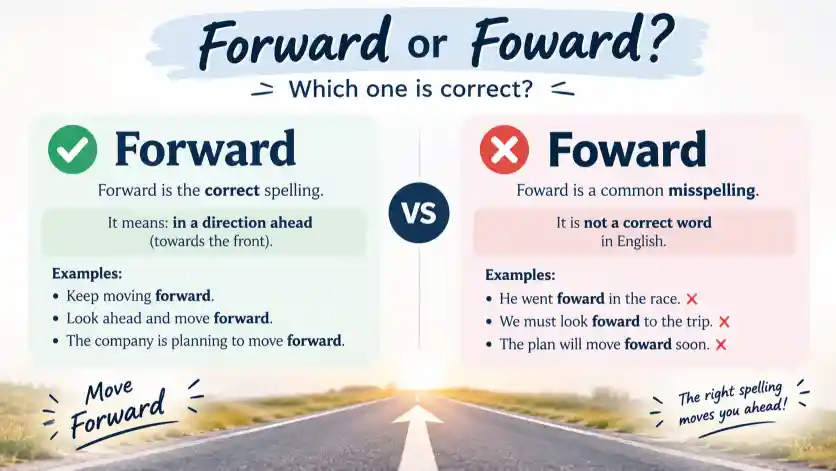
Forward is the correct spelling. Foward is incorrect because it leaves out the letter r. Use forward when you mean moving ahead, sending a message to another person, or looking toward the future.
Many people search for forward or foward because the two spellings look almost the same. When typing quickly, it is easy to miss a letter. This small mistake can happen in emails, schoolwork, social media posts, and formal documents. Learning the correct spelling helps you write clearly and avoid errors.
The word forward has several uses in everyday English. You can move forward in a line, forward an email to a friend, or make plans for the future. It can also describe progress toward a goal. These meanings are different, but they all use the same spelling.
The good news is that the correct form is easy to remember. Forward contains two letter r’s, while foward contains only one. The extra r appears before the letter w. Once you learn this pattern, you can use the word with confidence in both American and British English.
Forward or Foward : Quick Answer
Forward is correct, and foward is a misspelling. There is no standard British or American English rule that makes foward correct.
Examples:
- Correct: Please move forward to the next page.
- Incorrect: Please move foward to the next page.
- Correct: I will forward your email to the manager.
- Incorrect: I will foward your email to the manager.
Remember this simple rule: Always spell the word forward with two r’s.
Definition and Meaning of Forward
Forward is a common English word that can work as an adverb, an adjective, or a verb. Its meaning depends on how you use it in a sentence.
1. Forward as an Adverb
As an adverb, forward means toward the front or in the direction ahead.
Examples:
- She stepped forward to answer the question.
- The car moved forward slowly.
- Please look forward and follow the instructions.
2. Forward as an Adjective
As an adjective, forward can describe something related to the future or a position near the front.
Examples:
- We need a forward plan for the next year.
- The forward section of the bus was nearly empty.
- The team has a forward-looking approach to education.
3. Forward as a Verb
As a verb, forward means to send something onward to another person or place.
Examples:
- Please forward this message to your teacher.
- I will forward the documents tomorrow.
- She forwarded the invitation to her friends.
4. Forward in Everyday Expressions
Forward also appears in common phrases.
- Moving forward: From now on or making progress.
- Look forward to: To feel happy or excited about something that will happen.
- Forward thinking: Planning for the future.
- Step forward: To take action or offer help.
For example, “I look forward to meeting you” expresses positive feelings about a future meeting.
Key point: All these meanings use the same spelling: forward.
The Origin of Forward
The word forward has a long history in the English language. It developed from Old English forms related to the idea of moving toward the front or ahead.
Its early form, foreweard, combined elements connected with being in front and moving in a particular direction. Over time, the spelling changed into the modern form forward.
The word has kept its main meaning of moving ahead, but its uses have grown. Today, it can describe physical movement, progress, future plans, and the act of sending information.
The spelling mistake foward usually happens because people leave out the second r when typing or writing quickly. It is not a separate standard English word.
The letter r is part of the established spelling, so it should not be removed.
British English vs American English Spelling
British and American English sometimes use different spellings. For example, British English often uses colour, while American English uses color. However, forward is spelled the same way in both varieties.
| Feature | British English | American English |
| Correct spelling | Forward | Forward |
| Incorrect spelling | Foward | Foward |
| Meaning | Moving ahead or sending onward | Moving ahead or sending onward |
| Example | Please move forward. | Please move forward. |
| Verb example | Forward the email. | Forward the email. |
British English Examples
- We look forward to your visit.
- Please forward the letter to our office.
- The player moved forward to attack.
American English Examples
- I look forward to the weekend.
- Can you forward this email?
- The car rolled forward a few feet.
There is no spelling difference between British and American English for this word. The correct form is forward everywhere.
Which Spelling Should You Use?
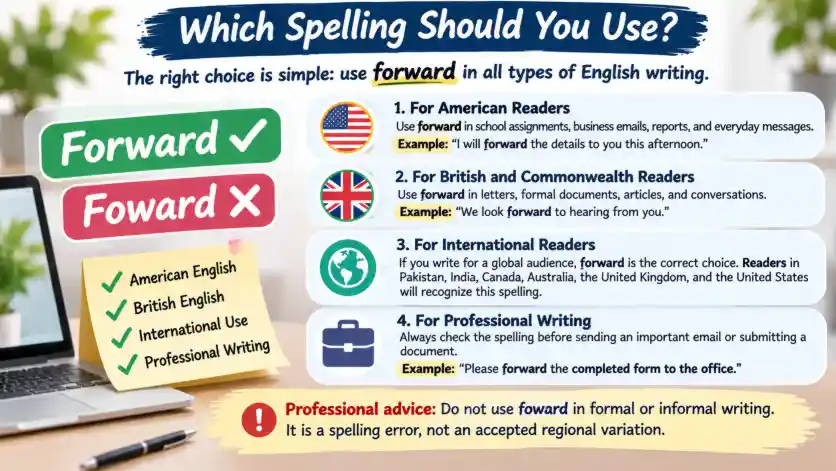
The right choice is simple: use forward in all types of English writing.
1. For American Readers
Use forward in school assignments, business emails, reports, and everyday messages.
Example: “I will forward the details to you this afternoon.”
2. For British and Commonwealth Readers
Use forward in letters, formal documents, articles, and conversations.
Example: “We look forward to hearing from you.”
3. For International Readers
If you write for a global audience, forward is the correct choice. Readers in Pakistan, India, Canada, Australia, the United Kingdom, and the United States will recognize this spelling.
4. For Professional Writing
Always check the spelling before sending an important email or submitting a document.
Example: “Please forward the completed form to the office.”
Professional advice: Do not use foward in formal or informal writing. It is a spelling error, not an accepted regional variation.
Common Mistakes with Forward
Writers often make small spelling errors when typing common words. Here are some mistakes to avoid.
1. Leaving Out the Second R
Incorrect: Please move foward.
Correct: Please move forward.
The missing r makes the spelling wrong.
2. Using Foward in Emails
Incorrect: I will foward your request to the team.
Correct: I will forward your request to the team.
Check the spelling before sending work messages.
3. Confusing Forward and Foreword
These two words look similar, but their meanings differ.
- Forward: Toward the front or to send something onward.
- Foreword: A short introduction at the beginning of a book, often written by someone other than the author.
Example: “The author asked a professor to write the foreword.”
4. Forgetting the Correct Spelling in Formal Documents
Incorrect: We look foward to your reply.
Correct: We look forward to your reply.
This error can make a professional message look careless.
5. Relying Only on Spell-Check
Some typing tools may catch foward, but you should still review your writing. A spelling checker may not catch every error in every situation.
Easy tip: Break the word into two parts: for + ward = forward. This can help you remember the full spelling.
Forward in Everyday Examples
The word forward appears in many situations. These examples show how to use it correctly.
1. In Emails
- I will forward the meeting details to you.
- We look forward to your response.
- Please forward the invoice to the accounts team.
2. In News Writing
- The government announced plans to move forward with the project.
- The team pushed forward during the final minutes.
- Officials are looking forward to further talks.
3. On Social Media
- Keep moving forward and believe in yourself.
- I look forward to seeing everyone again.
- Please forward this post to someone who needs it.
4. In Schoolwork
- Write your name before moving forward to the next question.
- The student stepped forward to give a presentation.
- The lesson helps students move forward in their studies.
5. In Formal Writing
- We look forward to receiving your application.
- The committee agreed to move forward with the proposal.
- Kindly forward the signed document by Friday.
These examples show that forward is correct in casual, academic, and professional writing.
Forward : Google Trends and Usage Data
Forward is a common English word used in everyday conversation, business communication, education, technology, and news. Foward, by contrast, is a spelling error that people may search for when checking their writing.
1. Search Interest by Country
People who use English in countries such as the United States, the United Kingdom, Canada, Australia, India, and Pakistan may search for spelling help.
However, the exact search volume and ranking of these countries can change over time. Without a current Google Trends comparison, it would not be accurate to claim that one country has the highest search interest for this particular spelling pair.
2. Why People Search for Forward or Foward
Common reasons include:
- Checking the correct spelling for an email.
- Correcting a school assignment.
- Learning English spelling rules.
- Checking a word before publishing an article or post.
- Understanding the difference between similar words.
3. How the Word Is Used
Forward has several common uses:
- Communication: Forwarding emails, messages, and documents.
- Movement: Moving toward the front.
- Progress: Moving forward with a plan.
- Future plans: Looking forward to an event.
4. Understanding Search Trends
Google Trends measures relative search interest over a selected period and location. It does not automatically provide exact search counts for every word.
To compare forward and foward, select both terms in Google Trends and choose a country and time range. The results can help show how interest changes, but they should not be treated as exact monthly search volumes.
Main takeaway: Forward is the standard spelling, while foward is a common typing or spelling mistake.
Forward vs. Foward: Comparison Table
| Feature | Forward | Foward |
| Spelling status | Correct | Incorrect |
| Standard English word | Yes | No |
| Number of r’s | Two | One |
| Meaning | Moving ahead or sending onward | No standard meaning |
| British English | Accepted | Incorrect |
| American English | Accepted | Incorrect |
| Suitable for formal writing | Yes | No |
| Example | Move forward. | Move foward. |
Remember: Forward contains the r immediately after the o and another r before the d? More simply, its exact letter sequence is F-O-R-W-A-R-D.
Frequently Asked Questions
1. Is forward or foward correct?
Forward is correct. Foward is a misspelling because it leaves out the second r.
2. Is foward a real English word?
No. Foward is not a standard English word. It is usually a typing mistake or a spelling error for forward.
3. Does British English use forward or foward?
British English uses forward. The spelling foward is incorrect in British English.
4. Does American English use forward or foward?
American English also uses forward. There is no American spelling rule that allows foward.
5. How do you remember the spelling of forward?
Remember the letter sequence F-O-R-W-A-R-D. You can also divide it into “for” and “ward” to help recall the correct form.
6. What is the difference between forward and foreword?
Forward means moving ahead or sending something onward. Foreword means an introductory section at the beginning of a book.
Example: “I will forward the report, and then I will read the foreword.”
7. Is forward one word or two?
Forward is one word. It is not normally written as “for ward” when used with its standard meaning.
Conclusion
The difference between forward and foward is simple. Forward is the correct spelling, while foward is incorrect. The word forward is used in many situations, including physical movement, sending emails, making plans, and talking about progress.
Both British and American English use the same spelling. You should write forward in school assignments, business emails, social media posts, news articles, and formal documents. There is no need to choose a different spelling based on your audience or location.
To avoid mistakes, remember the full sequence: F-O-R-W-A-R-D. The word contains two r’s, and both belong in the correct spelling. You can also remember common phrases such as “move forward,” “forward an email,” and “look forward to.”
If you are unsure about a sentence, check the spelling before submitting or sending it. Small corrections can make your writing clearer and more professional.
Ultimately, the rule is easy to follow: always use forward, never foward. Once you learn this spelling, you can use the word confidently in everyday communication and formal writing.
Read More:
- Temporarily or Temporary? Learn the Difference in Seconds
- Cummerbund or Cumberbund: Which Spelling Is Correct in 2026?
- Simular or Similar? Discover the Correct Word and Its Meaning


6 thoughts on “Forward or Foward? Don’t Let This Spelling Mistake Fool You”