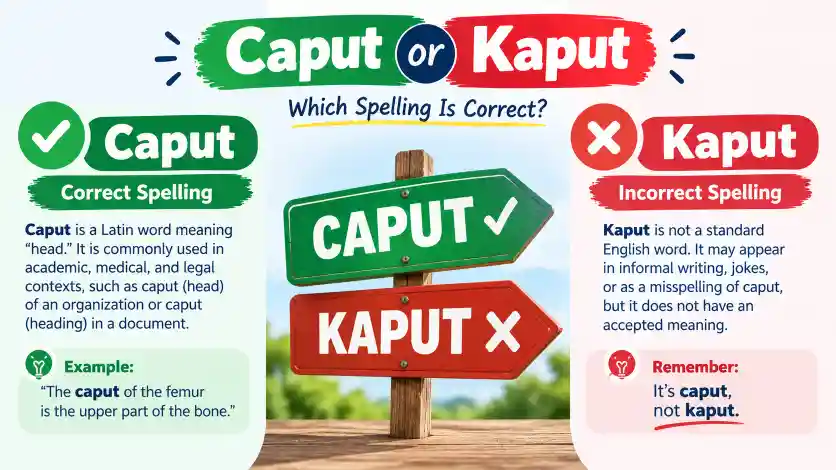
Caput or Kaput :the correct answer is kaput when you mean something broken, ruined, finished, or no longer working. Caput is also a real word, but it has different meanings in specialized contexts, including anatomy and Latin.
People often search for caput or kaput because the two words sound alike. The confusion is understandable: changing just one letter can lead to two words with very different uses. If your computer stops working, a machine breaks down, or a plan fails completely, kaput is usually the word you need.
For example, you might say, “My old laptop is kaput,” to mean it no longer works. In contrast, caput can refer to a head or a head like part in anatomical and scientific terminology.
Knowing the difference helps you avoid spelling mistakes in everyday writing, school assignments, emails, and professional documents. It also helps you recognize caput when it appears in medical or technical texts.
The simple rule is this: use kaput for something broken or finished, and use caput when the specific Latin or technical term is intended.
Caput or Kaput : Quick Answer
Kaput is the usual spelling when you mean broken, useless, ruined, or finished.
Caput is a separate word used in Latin-derived expressions and technical fields, especially anatomy.
Examples:
- Correct: My washing machine is kaput.
- Correct: After the crash, the old engine was kaput.
- Correct in anatomy: The caput is a head or head-like structure.
Quick tip: If you mean that something has stopped working, choose kaput.
Definition and Meaning of Caput and Kaput
The two words have different meanings and uses.
What Does Kaput Mean?
Kaput is an informal adjective meaning broken, ruined, useless, or finished.
It is often used when a machine stops working or when something cannot continue.
Examples:
- My phone is kaput.
- The printer went kaput during the meeting.
- After hours of work, our plan was completely kaput.
In casual conversation, kaput can also mean that a person’s energy is gone.
Example: “I’m kaput after a long day at work.”
What Does Caput Mean?
Caput is a Latin word meaning “head.” In English, it appears in specialized expressions, especially in anatomy, medicine, biology, and law.
Examples:
- Caput femoris refers to the head of the femur, or thigh bone.
- The term caput may describe a head-like part of an anatomical structure.
- In historical or legal contexts, caput can refer to a person, a head, or a principal part, depending on the expression.
Caput is not the usual word for something that is broken or finished.
What Is the Main Difference?
- Kaput: Broken, ruined, finished, or no longer working.
- Caput: A Latin-derived term meaning head, used in particular technical or historical contexts.
Although the words look similar, their meanings are not interchangeable.
The Origin of Caput and Kaput
The two words come from different linguistic backgrounds.
Origin of Caput
Caput comes directly from Latin, where it means “head.” It has appeared in English in scientific, medical, legal, and historical terms.
For example, anatomical terminology uses caput to identify the head of a bone or another head-like structure.
The Latin word is also related to several English words through historical language development, including terms associated with a head or a chief part.
Origin of Kaput
Kaput entered English through German kaputt, meaning broken or ruined. The German word became familiar in English, especially in informal speech.
Over time, English adopted the spelling kaput, although kaputt is also seen, particularly when referring to the German form.
The word is now commonly used to describe broken machines, failed plans, and exhausted people.
Why Do People Confuse Them?
The words look and sound similar, but their origins and meanings differ. People may mistakenly write caput when they intend to say that something is broken.
Remember: The everyday expression for broken or finished is kaput, not caput.
British English vs American English Spelling
Both caput and kaput can appear in British and American English, but their meanings remain distinct.
| Feature | British English | American English |
| Standard word for broken or finished | Kaput | Kaput |
| Technical Latin-derived term | Caput | Caput |
| Informal usage | Common | Common |
| Meaning of kaput | Broken or finished | Broken or finished |
| Meaning of caput | Head or technical term | Head or technical term |
| Spelling difference | No major difference | No major difference |
British English Examples
- My old computer is kaput.
- The heating system has gone kaput.
- The medical report refers to the caput femoris.
American English Examples
- The car’s engine is kaput.
- My headphones are completely kaput.
- The doctor discussed the caput of the bone.
Important: Unlike some British and American spelling pairs, this is not a regional spelling difference. The two forms have separate meanings in both varieties of English.
Which Spelling Should You Use?
Your choice depends on what you want to say, not on where your readers live.
1. For Everyday Conversation
Use kaput when something is broken, ruined, or finished.
Example: “My laptop is kaput, so I need a new one.”
2. For Emails and Business Writing
Kaput is informal. In a professional report, a clearer word may be better.
Instead of: “The system is kaput.”
Write: “The system is no longer working.”
3. For Medical and Scientific Writing
Use caput when it is part of the correct technical term.
Example: “The report describes the caput femoris.”
Do not replace a specialized anatomical term with kaput.
4. For Academic Writing
Check the context and the field. A language assignment may discuss kaput as an informal adjective, while an anatomy assignment may use caput as a Latin-derived term.
Best advice: Use kaput for everyday meanings related to failure and caput for its established technical or historical meanings.
Common Mistakes with Caput and Kaput
These words can be confused because they differ by only one letter.
1. Using Caput to Mean Broken
Incorrect: My washing machine is caput.
Better: My washing machine is kaput.
Use kaput to say that a machine no longer works.
2. Using Kaput in an Anatomical Term
Incorrect: The doctor referred to the kaput femoris.
Correct: The doctor referred to the caput femoris.
The anatomical term comes from Latin and uses caput.
3. Assuming Caput Is Always a Misspelling
Incorrect assumption: Caput is never a real English word.
Correct: Caput is a valid technical and Latin-derived term. It is simply not the standard spelling of the everyday word meaning broken.
4. Using Kaput in Formal Reports
Kaput is informal and can sound casual or humorous.
Informal: The software is kaput.
Formal: The software has stopped working.
Choose wording that suits your audience and purpose.
5. Confusing Similar-Looking Words
Do not decide which spelling to use based only on how the word sounds. Consider the meaning of the sentence.
Simple trick: If you can replace the word with “broken” or “finished,” kaput is probably the right choice.
Caput or Kaput in Everyday Examples
The words appear in different settings, so context is important.
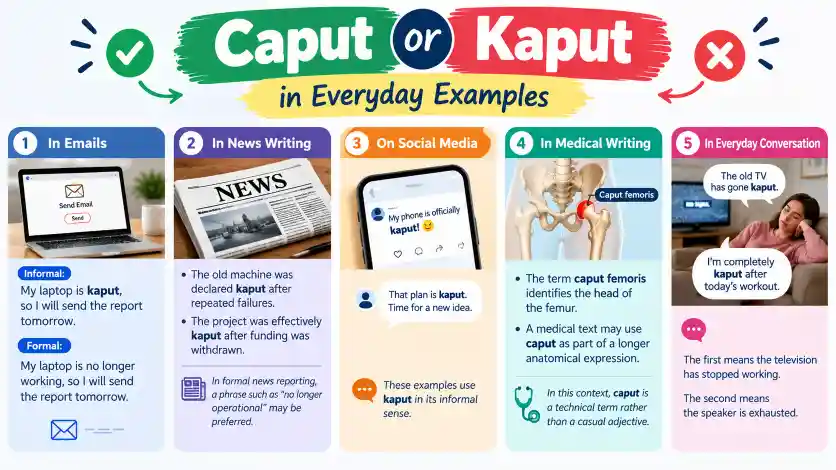
1. In Emails
Informal: My laptop is kaput, so I will send the report tomorrow.
Formal: My laptop is no longer working, so I will send the report tomorrow.
2. In News Writing
- The old machine was declared kaput after repeated failures.
- The project was effectively kaput after funding was withdrawn.
In formal news reporting, a phrase such as “no longer operational” may be preferred.
3. On Social Media
- My phone is officially kaput!
- That plan is kaput. Time for a new idea.
These examples use kaput in its informal sense.
4. In Medical Writing
- The term caput femoris identifies the head of the femur.
- A medical text may use caput as part of a longer anatomical expression.
In this context, caput is a technical term rather than a casual adjective.
5. In Everyday Conversation
- “The old TV has gone kaput.”
- “I’m completely kaput after today’s workout.”
The first means the television has stopped working. The second means the speaker is exhausted.
Caput vs Kaput : Google Trends and Usage Data
People may search for caput or kaput when checking spelling, learning word meanings, or encountering an unfamiliar term.
The words appear in different contexts, so search results may reflect different interests.
1. Why People Search for Kaput
Searches for kaput may relate to:
- The meaning of the word.
- Correct spelling.
- Informal expressions for broken machines.
- Words used to describe failed plans or exhaustion.
2. Why People Search for Caput
Searches for caput may relate to:
- Medical and anatomical terminology.
- Latin words and their meanings.
- Specialized expressions in science or law.
- Checking the difference between similar spellings.
3. Comparing Search Interest by Country
Interest may vary by location, language, and topic. However, without checking current Google Trends data, it would not be accurate to claim that a particular country has the highest search interest for either spelling.
4. How to Check Google Trends
To compare the terms:
- Open Google Trends.
- Search for “kaput” and compare it with “caput.”
- Select a country or worldwide results.
- Choose a time range.
- Review the interest graph and related topics.
Remember that Google Trends shows relative search interest rather than exact search counts. Results for caput may include technical meanings, so the graph does not necessarily measure spelling confusion alone.
Key takeaway: Search data can show interest in both terms, but their meanings determine which word is correct in a sentence.
Caput vs Kaput : Comparison Table
| Feature | Caput | Kaput |
| Is it a real word? | Yes | Yes |
| Main meaning | Head; a technical or Latin-derived term | Broken, ruined, or finished |
| Common context | Anatomy, science, history, law | Everyday conversation |
| Part of speech | Usually a noun in English technical usage | Usually an adjective |
| Example | Caput femoris | The engine is kaput |
| Suitable for casual use meaning broken | No | Yes |
| British spelling | Caput | Kaput |
| American spelling | Caput | Kaput |
Remember: Caput and kaput are both valid, but they do not mean the same thing.
Frequently Asked Questions
1. Is caput or kaput correct?
Both are correct words, but they have different meanings. Use kaput to mean broken or finished, and caput for a Latin-derived term meaning head.
2. Does kaput mean broken?
Yes. Kaput is an informal adjective meaning broken, ruined, useless, or no longer working.
3. Is caput a real English word?
Yes. Caput is used in English, particularly in anatomical, scientific, legal, and historical contexts. It comes from Latin and means “head.”
4. Is kaput British or American?
Kaput is used in both British and American English. It is not restricted to one regional variety.
5. Can I use kaput in formal writing?
You can, but it is generally informal. In professional writing, phrases such as “broken,” “no longer functioning,” or “no longer operational” may be more suitable.
6. What does caput mean in anatomy?
In anatomy, caput refers to the head or head-like part of a structure. For example, caput femoris means the head of the femur.
7. How can I remember the difference between caput and kaput?
Remember that kaput describes something that has broken down, while caput appears in technical terms related to the head. The meaning of the sentence will help you choose the correct spelling.
Conclusion
The difference between caput and kaput is mainly about meaning and context. Kaput is the usual English word for something that is broken, ruined, or finished. It is common in informal conversations about machines, plans, and even personal energy levels.
Caput is also a valid word, but it belongs to different contexts. It comes from Latin and means “head.” You may encounter it in anatomy, science, legal writing, and historical expressions. For example, caput femoris is an anatomical term for the head of the femur.
Both words can appear in British and American English, and neither spelling is simply a regional alternative to the other. The important thing is to match the spelling to the intended meaning.
If you are writing a casual message about a broken phone, computer, or machine, use kaput. If you are discussing an established technical term that contains caput, retain that spelling.
In formal writing, consider your audience and choose clear wording. The simplest rule is to remember that kaput means broken or finished, while caput refers to a head or a specialized term.
Read More:
- Cowlick or Calic: Can You Guess Which One Is Correct?
- Moron or Moran? Avoid This Common Spelling Mistake
- Organisational or Organizational: Which Spelling Is Correct?








1 thought on “Caput or Kaput? The Right Answer Will Surprise You”