
Grateful and thankful are both correct English words that express appreciation, but they can carry slightly different meanings. Grateful often emphasizes deep appreciation for someone’s kindness, help, or support, while thankful commonly expresses appreciation or relief that something good happened or something bad was avoided.
For example, you might feel grateful to a friend who supported you during a difficult time. You might feel thankful that your family arrived home safely after a long journey.
In everyday English, the two words overlap considerably and are often interchangeable. The best choice depends on the situation, the feeling you want to express, and the tone of your sentence.
Quick Answer
- Grateful: Feeling or showing appreciation for kindness, help, support, or something valuable.
- Thankful: Feeling or expressing gratitude, often because of something good that happened or a difficulty that was avoided.
Examples:
- I am grateful for your support during my studies.
- I am thankful that everyone arrived safely.
Both sentences are correct. Use grateful when emphasizing appreciation, and thankful when emphasizing appreciation or relief.
What Does Grateful Mean?
Grateful is an adjective that describes feeling or showing appreciation for something someone has done, something you have received, or a positive part of your life.
It often conveys a personal or heartfelt sense of appreciation.
Definition of Grateful
According to its common usage, grateful means feeling thankful or appreciative because of a benefit, kindness, favor, or positive experience.
People often use it when someone has helped them, offered encouragement, or made a meaningful difference in their lives.
Examples of Grateful in Sentences
- I am grateful for your friendship.
- She was grateful to her teacher for the extra help.
- We are grateful for the opportunity to work together.
- He felt grateful for his family’s support.
- I am grateful that you took the time to explain everything.
Common Expressions With Grateful
- Grateful for: I am grateful for your kindness.
- Grateful to someone: She is grateful to her parents.
- Grateful to someone for something: I am grateful to you for your advice.
- Deeply grateful: We are deeply grateful for your generosity.
The word grateful is especially useful when you want to express sincere appreciation in personal messages, professional communication, or formal writing.
What Does Thankful Mean?
Thankful is an adjective that describes feeling or expressing gratitude for something good, helpful, or fortunate.
It is commonly used when people appreciate a person’s kindness or feel relieved that a difficult or dangerous situation had a positive outcome.
Definition of Thankful
Thankful means feeling pleased and appreciative because of something beneficial or because an unwanted outcome did not occur.
For example, someone may be thankful for a kind gesture, a successful result, or the safety of a loved one.
Examples of Thankful in Sentences
- I am thankful for your help.
- She was thankful that she passed the examination.
- We are thankful for another opportunity.
- He felt thankful that nobody was injured.
- I am thankful to have such supportive friends.
Common Expressions With Thankful
- Thankful for: I am thankful for your kindness.
- Thankful to someone: She is thankful to her parents.
- Thankful that: I am thankful that everything worked out.
- Truly thankful: We are truly thankful for your generosity.
Thankful is common in everyday conversations, messages of appreciation, and situations where someone feels fortunate or relieved.
Grateful vs Thankful: Key Differences
Although the words have similar meanings, their emphasis can differ slightly.
| Feature | Grateful | Thankful |
| Part of speech | Adjective | Adjective |
| Main meaning | Appreciative of kindness or benefits | Appreciative or relieved about a positive outcome |
| Common emphasis | Appreciation and recognition | Gratitude and relief |
| Tone | Can sound heartfelt or formal | Often natural and conversational |
| Example | I am grateful for your guidance. | I am thankful that I passed. |
| Interchangeable? | Often | Often |
These differences are tendencies, not strict rules. You can be grateful that you passed an examination and thankful for a teacher’s guidance.
When Should You Use Grateful?
Use grateful when you want to highlight appreciation for someone’s effort, generosity, kindness, or lasting support.
1. When Someone Helps You
Example: I am grateful to my friend for helping me prepare for the interview.
This sentence recognizes the friend’s effort and support.
2. When Expressing Deep Appreciation
Example: We are deeply grateful for your generosity.
This wording works well in thank-you messages, formal letters, and public acknowledgments.
3. When Recognizing an Opportunity
Example: She is grateful for the opportunity to study abroad.
The sentence expresses appreciation for something valuable.
4. In Professional Communication
Example: I would be grateful if you could review my application.
Here, grateful appears in a polite request. It expresses appreciation for the other person’s possible help.
When Should You Use Thankful?
Use thankful when expressing gratitude for something good or relief that an unpleasant event did not happen.
1. When Something Goes Well
Example: I am thankful that my examination went well.
The sentence focuses on a positive result.
2. When Expressing Relief
Example: We are thankful that everyone returned home safely.
The wording communicates both appreciation and relief.
3. In Everyday Conversations
Example: I am thankful for all the support you have given me.
This is a natural way to express appreciation to a friend or family member.
4. When Reflecting on Life
Example: I am thankful for the opportunities I have received.
The sentence expresses appreciation for positive experiences and circumstances.
Can Grateful and Thankful Be Used Interchangeably?
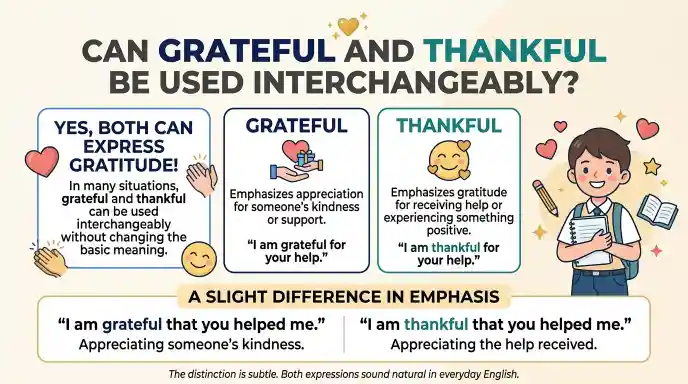
Yes. In many situations, grateful and thankful can be used interchangeably without changing the basic meaning.
For example:
- I am grateful for your help.
- I am thankful for your help.
Both sentences express appreciation.
However, the emphasis may change slightly in certain contexts.
- I am grateful that you helped me. This can emphasize appreciation for the person’s kindness.
- I am thankful that you helped me. This can emphasize gratitude for receiving the help.
The distinction is subtle, and many English speakers would use either sentence naturally.
Common Mistakes When Using Grateful and Thankful
Mistake 1: Thinking the Words Have Completely Different Meanings
Both words express gratitude. Their meanings overlap, so you do not need to treat them as opposites.
Mistake 2: Using the Wrong Preposition
Incorrect: I am grateful on your help.
Correct: I am grateful for your help.
Correct: I am grateful to you for your help.
Use grateful for when naming the thing you appreciate and grateful to when identifying the person you appreciate.
Mistake 3: Confusing Thankful and Thank You
Thankful is an adjective, while thank you is an expression used to offer thanks.
Examples:
- I am thankful for your advice.
- Thank you for your advice.
Both are correct, but they serve different grammatical purposes.
Mistake 4: Assuming Thankful Is Always Less Formal
Both words can be used in formal and informal contexts. Grateful is common in professional acknowledgments, but thankful is also appropriate in many formal sentences.
Everyday Examples of Grateful and Thankful
The following examples show how both words work in common situations.
| Situation | Grateful | Thankful |
| Help from a friend | I am grateful for your help. | I am thankful for your help. |
| Family support | We are grateful for our family’s support. | We are thankful for our family’s support. |
| Passing an exam | I am grateful for the chance to succeed. | I am thankful that I passed. |
| Safe journey | I am grateful for everyone’s concern. | I am thankful that we arrived safely. |
| Job opportunity | She is grateful for the opportunity. | She is thankful that she got the job. |
| Kind gesture | I am grateful for your kindness. | I am thankful for your kindness. |
The choice often comes down to the focus of the sentence rather than a strict difference in meaning.
Grateful vs Thankful in British and American English
Both grateful and thankful are standard in British and American English. Their spelling is the same in both varieties, and their core meanings do not change.
| Usage | American English | British English |
| Expressing appreciation | Grateful | Grateful |
| Expressing gratitude or relief | Thankful | Thankful |
| Formal acknowledgment | I am grateful for your assistance. | I am grateful for your assistance. |
| Everyday conversation | I am thankful for your help. | I am thankful for your help. |
There is no major British-American spelling difference between these words.
Easy Way to Remember the Difference
Use this simple memory tip:
- Grateful: Think of appreciating someone’s kindness, support, or generosity.
- Thankful: Think of feeling gratitude or relief because something good happened.
For example, you might be grateful to a friend who helped you prepare for an interview and thankful that you received the job.
Remember that this is a useful guideline rather than a strict grammatical rule. Both words can describe appreciation in many of the same situations.
Frequently Asked Questions (FAQs)
1. Is grateful or thankful correct?
Both are correct English words. They have similar meanings and are often interchangeable.
2. What is the main difference between grateful and thankful?
Grateful often emphasizes appreciation for kindness or support, while thankful can emphasize gratitude or relief about a positive outcome.
3. Can I say “I am grateful for your help”?
Yes. This is a correct and natural sentence expressing appreciation.
4. Can I say “I am thankful for your help”?
Yes. This sentence is also correct and expresses gratitude.
5. Is grateful more formal than thankful?
Grateful can sound more formal in certain contexts, especially professional acknowledgments, but both words are appropriate in formal and informal English.
6. Which word should I use in a thank-you message?
Both work well. Use grateful to emphasize appreciation for someone’s effort or kindness, or thankful to express general gratitude.
7. Is it correct to say “grateful to” and “grateful for”?
Yes. Use grateful to for the person and grateful for for the thing or action you appreciate.
Example: I am grateful to my teacher for her guidance.
8. Can thankful describe relief?
Yes. For example, “I am thankful that nobody was hurt” expresses gratitude and relief.
9. Are grateful and thankful spelled differently in British and American English?
No. Both words have the same spelling in British and American English.
10. Which word is more common in everyday English?
Both are widely used. The preferred choice depends on the context, sentence, and speaker.
Conclusion
Grateful and thankful are both correct words that express appreciation. Grateful often highlights appreciation for someone’s kindness, help, or support, while thankful frequently expresses gratitude or relief about a positive outcome.
Their meanings overlap, so either word can be suitable in many everyday situations. Choose the word that best communicates the feeling you want to express.
Read More:
- Sense or Sence: The Spelling Mistake You Need to Avoid
- Siting or Sitting? The Correct Spelling May Surprise You
- Statistic vs Parameter: The Mix-Up That Costs You Marks







1 thought on “Grateful or Thankful? Are These Words Really the Same?”