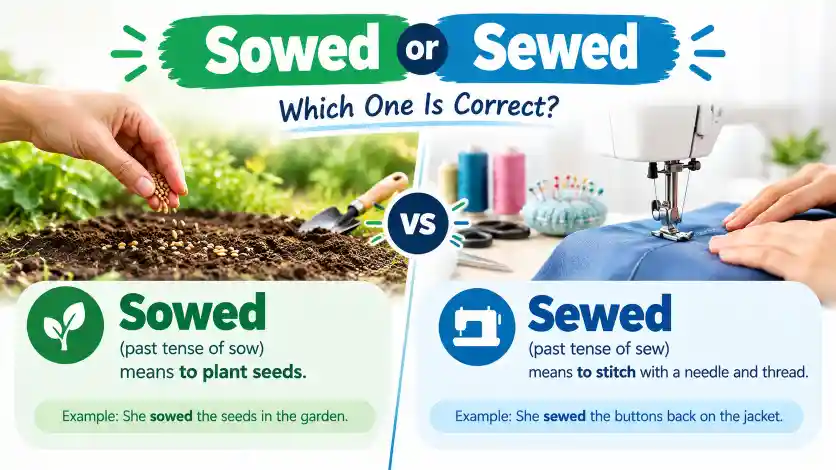
Sowed and sewed are both correct English words, but they have completely different meanings.
Sowed is the past tense of sow, meaning to plant seeds, while sewed is the past tense of sew, meaning to join or repair fabric with a needle and thread.
These two words are often confused because they look and sound somewhat similar.
However, they belong to different verbs and are used in completely different situations.
For example, if you put seeds into soil, you sowed them.
If you used a needle and thread to repair a shirt, you sewed it.
Understanding the difference is especially important in writing because using the wrong word can completely change the meaning of a sentence.
Sowed or Sewed: Quick Answer
| Word | Meaning | Example |
| Sowed | Planted seeds | She sowed the seeds in the garden. |
| Sewed | Joined fabric with needle and thread | She sewed the torn shirt. |
Simple rule:
🌱 Sowed = planted seeds
🧵 Sewed = stitched fabric
What Does Sowed Mean?
Sowed is the past tense and past participle of the verb sow.
To sow means to plant seeds in soil so that they can grow.
Examples:
The farmer sowed wheat in the field.
She sowed flower seeds in the garden.
They sowed the seeds before the rain came.
The word is mainly associated with:
- Seeds
- Crops
- Plants
- Farming
- Gardening
Present and past forms
Present: sow
Past: sowed
Past participle: sown or sowed, depending on usage and context
Example:
Farmers sow seeds in spring.
Farmers sowed seeds last week.
What Does Sewed Mean?
Sewed is the past tense of the verb sew.
To sew means to join, repair, or decorate fabric using a needle and thread.
Examples:
She sewed a button onto my shirt.
My grandmother sewed the dress herself.
He sewed the torn pocket.
The word is commonly associated with:
- Clothes
- Fabric
- Needles
- Thread
- Buttons
- Dresses
- Shirts
- Repairs
Verb forms
Present: sew
Past: sewed
Past participle: sewn or sewed
Example:
I sew clothes.
I sewed the dress yesterday.
Sowed vs Sewed: The Main Difference
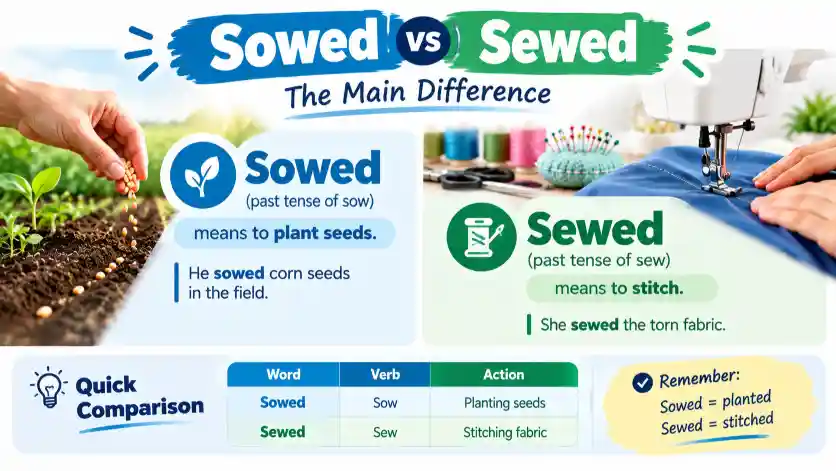
The easiest way to understand the difference is to remember what each action involves.
Sowed 🌱
Sowed = planted
He sowed corn seeds in the field.
Sewed 🧵
Sewed = stitched
She sewed the torn fabric.
| Word | Verb | Action |
| Sowed | Sow | Planting seeds |
| Sewed | Sew | Stitching fabric |
Sowed: Meaning and Examples
People mainly use the verb sow when talking about planting seeds.
Example 1
The farmer sowed the seeds in early spring.
Example 2
We sowed tomato seeds in the garden.
Example 3
The gardener sowed wildflower seeds.
Example 4
They sowed the field with wheat.
In each sentence, sowed refers to planting.
Sewed: Meaning and Examples
People use the verb “sew” when working with fabric using a needle and thread.
Example 1
She sewed a button onto her coat.
Example 2
My mother sewed my school uniform.
Example 3
He sewed the hole in his jeans.
Example 4
The tailor sewed the dress by hand.
In these sentences, sewed refers to stitching or joining material.
Why Are Sowed and Sewed Confused?
The confusion comes mainly from their similar spelling and pronunciation.
Both words begin with s and contain similar vowel sounds in some accents.
However, their meanings are completely different.
A useful memory trick is:
Sowed → seeds 🌱
Sewed → sewing 🧵
If you are talking about a garden or farm, you probably need sowed.
If you are talking about clothes or fabric, you probably need sewed.
The Origin of Sowed
Sowed comes from the verb sow, which has Old English and Germanic roots.
People have used the word for centuries in connection with agriculture and planting seeds.
People also use the same word metaphorically.
For example:
He sowed the seeds of doubt.
Here, no actual seeds are being planted. The sentence means that someone caused doubt to begin or develop.
This figurative use comes from the literal idea of planting something that later grows.
The Origin of Sewed
Sewed comes from the verb sew, which also has Old English and Germanic roots.
People have long associated the word with joining materials using a needle and thread.
Today, people use “sew” for both traditional hand sewing and machine sewing.
For example:
She sewed the dress herself.
The machine sewed the pieces of fabric together.
Sowed or Sewed in British and American English
Unlike some spelling differences between British and American English, sowed and sewed generally have the same spelling in both varieties.
British English
The farmer sowed the seeds.
She sewed the dress.
American English
The farmer sowed the seeds.
She sewed the dress.
The difference is therefore not primarily regional. The words have different meanings and come from different verbs.
Common Mistakes With Sowed or Sewed
1. Using “Sewed” for Planting
❌ She sewed the seeds in the garden.
✅ She sowed the seeds in the garden.
Seeds are sown, not sewn.
2. Using “Sowed” for Sewing Clothes
❌ She sowed the dress.
✅ She sewed the dress.
Clothes are sewed, not sowed.
3. Confusing Sowed With Sown
There is another important word to understand: sown.
Sown is commonly used as the past participle of sow.
The seeds were sown in spring.
However, sowed is also a correct past form:
She sowed the seeds yesterday.
4. Confusing Sewed With Sewn
Similarly, sewn is commonly used as the past participle of sew.
The dress was sewn by hand.
But sewed is the normal simple past form:
She sewed the dress yesterday.
Sowed vs Sown
These two forms are related but are not always interchangeable.
Sowed
Usually used as the simple past:
He sowed the seeds yesterday.
Sown
Commonly used as the past participle:
The seeds have been sown.
So:
Yesterday, he sowed the seeds.
But:
The seeds have been sown.
Sewed vs Sewn
The same pattern appears with sew.
Sewed
Simple past:
She sewed the shirt yesterday.
Sewn
Commonly used as a past participle:
The shirt was sewn by hand.
So remember:
Sew → sewed → sewn
and:
Sow → sowed → sown
Sowed or Sewed: Everyday Examples
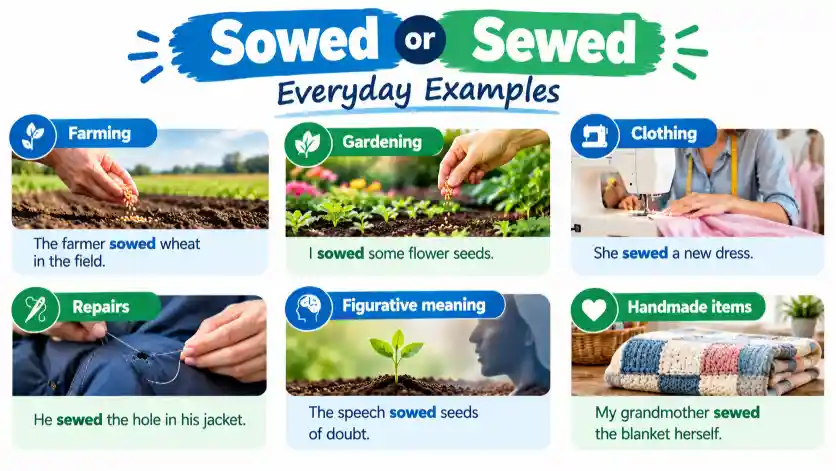
Farming
The farmer sowed wheat in the field.
Gardening
I sowed some flower seeds.
Clothing
She sewed a new dress.
Repairs
He sewed the hole in his jacket.
Figurative meaning
The speech sowed seeds of doubt.
Handmade items
My grandmother sewed the blanket herself.
Sowed and Sewed in Figurative Language
Sowed can have a figurative meaning beyond agriculture.
For example:
His actions sowed distrust among the team.
This means his actions caused distrust to develop.
You may also see:
- sowed doubt
- sowed confusion
- sowed fear
- sowed distrust
- sowed division
The idea is that something is metaphorically “planted” and later grows.
Sewed is usually more literal, although sewing can also be used metaphorically in creative writing.
Sowed or Sewed: Comparison Table
| Feature | Sowed | Sewed |
| Base verb | Sow | Sew |
| Meaning | Planted seeds | Stitched fabric |
| Related to | Farming/gardening | Clothing/fabric |
| Simple past | Sowed | Sewed |
| Common past participle | Sown | Sewn |
| Example | He sowed seeds. | She sewed a shirt. |
| Spelling variation by region | No major difference | No major difference |
How to Remember the Difference
Use this simple association:
🌱 SOWED = SEEDS
Both ideas relate to planting.
Sowed seeds
🧵 SEWED = SEWING
The first three letters are almost the same as the base verb:
sew → sewed
You can remember:
Sowed grows. Sewed stitches.
This short rule makes the difference easy to remember.
Sowed or Sewed for SEO
If you are creating an article around “sowed or sewed,” useful related keywords include:
- sowed or sewed
- sowed vs sewed
- sow vs sew
- sowed meaning
- sewed meaning
- sowed definition
- sewed definition
- sowed sentence examples
- sewed sentence examples
- sowed or sewn
- sewed or sewn
- sow seeds
- sew clothes
Use these terms naturally rather than repeating the exact keyword too many times.
Google Trends and Modern Usage
Both sowed and sewed remain active English words, but they appear in very different contexts.
Writers commonly associate “sowed” with agriculture, gardening, and figurative expressions involving planting.
Sewed appears in discussions about clothing, tailoring, crafts, textiles, and repairs.
Because both words have different meanings, searchers may encounter them when trying to identify the correct spelling for a sentence.
The easiest way to determine which word you need is to look at the action:
- Planting → sowed
- Stitching → sewed
FAQs About Sowed or Sewed
Is “sowed” a correct word?
Yes. Sowed is the past tense of sow, meaning to plant seeds.
Is “sewed” a correct word?
Yes. Sewed is the past tense of sew, meaning to join or repair fabric with needle and thread.
What is the difference between sowed and sewed?
Sowed means planted seeds, while sewed means stitched fabric.
Is it “sowed seeds” or “sewed seeds”?
The correct phrase is:
sowed seeds
Seeds are planted, so the verb is sow.
Is it “sowed a dress” or “sewed a dress”?
The correct phrase is:
sewed a dress
A dress is made or repaired using sewing.
What is the past tense of sow?
The simple past is sowed.
Example:
She sowed the seeds.
The past participle is commonly sown.
What is the past tense of sew?
The simple past is sewed.
Example:
She sewed the dress.
People commonly use “sewn” as the past participle.
Is “sown” the same as “sewn”?
No. Sown relates to planting seeds, while sewn relates to stitching fabric.
The seeds were sown.
The dress was sewn.
Final Thoughts
Sowed and sewed are both correct words, but they have completely different meanings.
Use sowed when talking about planting seeds:
The farmer sowed the seeds.
Use sewed when talking about stitching fabric:
She sewed the dress.
Also remember their common past participles:
Sow → sowed → sown 🌱
Sew → sewed → sewn 🧵
The easiest rule is:
Sowed = planted. Sewed = stitched.
Once you connect sowed with seeds and sewed with sewing, the difference becomes much easier to remember.
Read More:
- Series or Parallel: A Simple Breakdown for 2026
- Flown or Flew: Confused About These Two Words?
- Bookshelves or Bookshelf: Singular and Plural Explained in 2026





2 thoughts on “Sowed or Sewed? A 2026 Guide to Getting It Right Every Time”