
Halve and half are both correct English words, but they have different meanings and uses. Halve is a verb that means to divide something into two equal parts or reduce it by 50%. Half usually works as a noun, adjective, or adverb and refers to one of two equal parts.
People often confuse these words because they share the same root and have similar spellings. However, they are not interchangeable in a sentence. You might halve a recipe to make less food, but you might use half a cup of flour to measure an ingredient.
Learning the difference between halve and half can help you write more clearly. These words appear in everyday conversations, recipes, school assignments, business reports, financial discussions, and instructions.
The easiest way to remember the difference is this: halve means to divide, while half means one of two equal parts. Once you understand their grammatical roles, choosing the correct word becomes much easier.
Quick Answer: Halve or Half?
- Halve: A verb meaning to divide something into two equal parts or reduce it by 50%.
- Half: A noun, adjective, or adverb referring to one of two equal parts or an amount equal to 50%.
- Example with halve: We need to halve the recipe.
- Example with half: I ate half of the cake.
Easy trick: If you mean the action of dividing or reducing something by 50%, use halve. If you mean the amount or one of two equal parts, use half.
Definition and Meaning of Halve
Halve is a verb. It describes the action of dividing something into two equal parts or reducing an amount by half.
When you halve something, you make two equal portions or reduce its size, quantity, or value by 50%.
Examples of Halve in Sentences
- We should halve the number of ingredients in the recipe.
- The company plans to halve its operating costs.
- Please halve the apple before serving it.
- The new process helped us halve the time needed to complete the task.
- She decided to halve her daily sugar intake.
In each example, halve describes an action or change.
When Should You Use Halve?
Use halve when you are talking about:
- Dividing something into two equal parts.
- Reducing a quantity by 50%.
- Cutting food into two equal portions.
- Lowering costs, prices, or expenses by half.
- Reducing the time or effort needed for a task by 50%.
For example, “The store will halve the price” means the store will reduce the price by 50%.
Definition and Meaning of Half
Half refers to one of two equal parts of something. It can function as a noun, adjective, or adverb, depending on how it is used in a sentence.
Half as a Noun
As a noun, half refers to one of two equal parts.
Examples:
- I ate half of the sandwich.
- She spent half of her salary.
- Only half of the students attended the meeting.
- He gave me half of the chocolate bar.
Here, half identifies an amount or portion.
Half as an Adjective
As an adjective, half describes an amount equal to one of two equal parts.
Examples:
- I drank half a glass of water.
- She waited for half an hour.
- He bought half a kilogram of rice.
- We watched a half-hour program.
Half as an Adverb
Half can also function as an adverb to describe degree or extent.
Examples:
- The room was half empty.
- She was half asleep during the movie.
- The bottle was half full.
In these examples, half describes the condition or extent of something.
Origin of Halve and Half
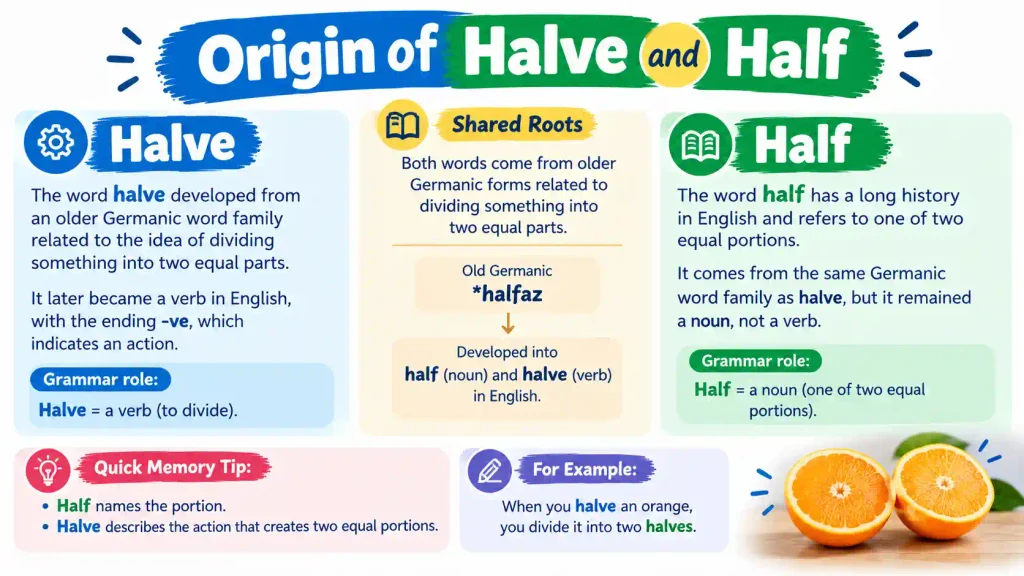
The words halve and half are closely related. Both developed from older Germanic forms associated with dividing something into two equal parts.
The word half has a long history in English and refers to one of two equal portions. The verb halve developed from the same word family, with the ending -ve forming a verb that describes the action of dividing something in half.
Their related meanings explain why the words look and sound similar. However, their grammatical roles differ.
A useful way to remember their relationship is:
- Half names the portion.
- Halve describes the action that creates two equal portions.
For example, when you halve an orange, you divide it into two halves.
Halve vs. Half in British and American English
The words halve and half have the same spelling and meaning in British and American English. There is no regional spelling difference between them.
| Feature | British English | American English |
| Verb | Halve | Halve |
| Noun | Half | Half |
| Adjective | Half | Half |
| Meaning of halve | Divide or reduce by 50% | Divide or reduce by 50% |
| Meaning of half | One of two equal parts | One of two equal parts |
Both varieties use halve for the action and half for the portion or amount.
Examples:
- British English: “We need to halve the budget.”
- American English: “We need to halve the budget.”
- British English: “I ate half the sandwich.”
- American English: “I ate half the sandwich.”
The spelling stays the same in both varieties.
Which Word Should You Use: Halve or Half?
The correct choice depends on what you want to say.
Use halve when describing an action that divides something into two equal parts or reduces an amount by 50%.
Use half when referring to one of two equal portions, a quantity, or an amount equal to 50%.
Compare These Examples
| Sentence | Correct word | Why? |
| Please the orange. | Halve | It describes the action of dividing. |
| I ate the orange. | Half | It refers to a portion. |
| We need to our expenses. | Halve | It means reduce expenses by 50%. |
| I spent my savings. | Half | It refers to an amount. |
| The bottle is full. | Half | It describes the extent to which it is full. |
A Simple Memory Trick
Think of these two sentences:
- “I will halve the cake.” I will divide it into two equal parts.
- “I will eat half the cake.” I will eat one of its two equal parts.
If you remember this difference, you can choose the right word in most everyday situations.
Common Mistakes with Halve and Half
Although both words are related, using one in place of the other can make a sentence incorrect or unclear.
1. Using Half as a Verb
Incorrect: Please half the apple.
Correct: Please halve the apple.
Explanation: In standard usage, halve is the verb that means to divide something into two equal parts.
2. Using Halve to Name a Portion
Incorrect: I ate a halve of the pizza.
Correct: I ate half of the pizza.
Explanation: Use half when naming one of two equal parts.
3. Confusing Halve with Cutting into Any Number of Pieces
The verb halve specifically means to divide something into two equal parts or reduce it by 50%. It does not simply mean to cut something into several pieces.
Incorrect: Halve the pizza into eight slices.
Better: Cut the pizza into eight slices.
Explanation: If you are dividing something into more than two pieces, divide or cut may be more suitable.
4. Using Halve When You Mean Halfway
Incorrect: We are halve through the project.
Correct: We are halfway through the project.
Explanation: Halfway means at the middle point of a distance, process, or period. Halve is a verb.
5. Forgetting the Difference in Business Writing
Incorrect: The company wants to half its expenses.
Better: The company wants to halve its expenses.
Explanation: When describing a planned reduction of 50%, halve is the appropriate verb.
Everyday Examples of Halve and Half
These examples show how both words work in common situations.
1. In Cooking
- “Halve the tomatoes before adding them to the salad.”
- “Add half a teaspoon of salt.”
The first sentence describes an action. The second identifies an amount.
2. In Business
- “The company hopes to halve its delivery costs.”
- “Half of the budget was spent on equipment.”
Halve describes reducing costs, while half identifies a portion of the budget.
3. In Education
- “Halve the number of questions to make a shorter practice test.”
- “I completed half of my assignment.”
The verb describes reducing the number of questions. The noun identifies the completed portion of the assignment.
4. In Finance
- “The business aims to halve its monthly expenses.”
- “Half of my income goes toward household bills.”
Use halve for the reduction and half for the amount.
5. In Everyday Conversation
- “Can you halve this sandwich?”
- “I have already eaten half of it.”
These sentences show the action and the resulting portion.
6. In Time and Measurements
- “We need to halve the cooking time.”
- “The journey took half an hour.”
The first sentence describes reducing a period by 50%. The second refers to a duration of 30 minutes.
Halve or Half: Comparison Table
| Point of comparison | Halve | Half |
| Part of speech | Verb | Noun, adjective, or adverb |
| Main meaning | Divide into two equal parts or reduce by 50% | One of two equal parts or an amount equal to 50% |
| Describes an action? | Yes | Usually no |
| Refers to a portion? | No, not by itself in standard usage | Yes |
| Example | Halve the quantity. | Use half the quantity. |
| Common context | Reducing, dividing, cutting | Amounts, portions, measurements |
The key difference is grammatical: halve is the action, and half is the portion or amount.
Frequently Asked Questions
1. Is halve or half correct?
Both are correct words, but they serve different purposes. Halve is a verb meaning to divide into two equal parts or reduce by 50%. Half refers to one of two equal parts or an amount equal to 50%.
2. What is the difference between halve and half?
Halve describes an action, such as dividing an apple into two equal parts. Half describes a portion, such as eating half an apple.
3. Is half a verb?
Half is mainly used as a noun, adjective, or adverb. The standard verb for dividing something into two equal parts is halve.
4. How do you use halve in a sentence?
You can use halve to describe dividing something into two equal portions or reducing it by 50%. For example: “We decided to halve the recipe.”
5. What is the plural of half?
The plural of half is halves. For example: “The two halves of the orange were placed on separate plates.”
6. Why does halve end in -ve while half ends in -f?
The words have different grammatical forms. Half is the base word for the portion, while halve is the related verb. The spelling change helps distinguish their roles.
7. Is it correct to say “halve the price”?
Yes. “Halve the price” means reduce the price by 50%. For example: “The shop decided to halve the price of the remaining items.”
Conclusion: Halve or Half?
Both halve and half are correct English words, but they are used in different ways. Halve is a verb that means to divide something into two equal parts or reduce it by 50%. Half usually refers to one of two equal parts and can function as a noun, adjective, or adverb.
For example, you can halve an apple, eat half a sandwich, or halve your monthly expenses. Each word has a clear role, and choosing the correct one makes your writing easier to understand.
Remember this simple rule: halve means to divide or reduce, while half means a portion or amount. This distinction works in British and American English alike. With a little practice, you can use both words confidently in everyday conversations, schoolwork, recipes, and professional writing.
Read More:
- Empathy or Sympathy? The Difference Most People Get Wrong
- Length or Girth: Stop Confusing These Two Measurements
- Born or Borne: Stop Making This Common Grammar Mistake






2 thoughts on “Halve or Half: Stop Making This Common Grammar Mistake”